



 Chat with AI
Exam 29: Relativity

Exam 1: Introduction to Physics98 Questions
Exam 2: One-Dimensional Kinematics138 Questions
Exam 3: Vectors in Physics69 Questions
Exam 4: Two-Dimensional Kinematics51 Questions
Exam 5: Newtons Laws of Motion54 Questions
Exam 6: Applications of Newtons Laws104 Questions
Exam 7: Work and Kinetic Energy55 Questions
Exam 8: Potential Energy and Conservation of Energy62 Questions
Exam 9: Linear Momentum and Collisions114 Questions
Exam 10: Rotational Kinematics and Energy60 Questions
Exam 11: Rotational Dynamics and Static Equilibrium69 Questions
Exam 12: Gravity53 Questions
Exam 13: Oscillations About Equilibrium79 Questions
Exam 14: Waves and Sound142 Questions
Exam 15: Fluids103 Questions
Exam 16: Temperature and Heat110 Questions
Exam 17: Phases and Phase Changes93 Questions
Exam 18: The Laws of Thermodynamics90 Questions
Exam 19: Electric Charges, Forces, and Fields75 Questions
Exam 20: Electric Potential and Electric124 Questions
Exam 21: Electric Current and Direct-Current Circuits228 Questions
Exam 22: Magnetism147 Questions
Exam 23: Magnetic Flux and Faradays Law of Induction98 Questions
Exam 24: Alternating-Current Circuits72 Questions
Exam 25: Electromagnetic Waves63 Questions
Exam 26: Geometrical Optics133 Questions
Exam 27: Optical Instruments103 Questions
Exam 28: Physical Optics: Interference and Diffraction119 Questions
Exam 29: Relativity98 Questions
Exam 30: Quantum Physics88 Questions
Exam 31: Atomic Physics97 Questions
Exam 32: Nuclear Physics and Nuclear Radiation137 Questions
Select questions type


If an electron in the lab has a kinetic energy equal to twice its rest energy,what is its speed in the lab?
(Multiple Choice)
4.8/5  (68)
(68) During a reaction,a reactant loses 4.8 × 10⁻²⁸ kg of mass.How many joules of energy are released? (c = 3.0 × 10⁸ m/s)
(Multiple Choice)
4.9/5 (90)
(90) Consider three galaxies,Alpha,Beta and Gamma.An astronomer in Beta sees each of the other two galaxies moving away from him in opposite directions at 0.70c.At what speed would an observer in Alpha see the galaxy Gamma moving?
(Multiple Choice)
4.9/5 (87)
(87) A particle in a 799=m-long linear particle accelerator is moving at  How long does the particle accelerator appear to the particle?
 (Multiple Choice)
4.8/5 (73)
(73) Astronaut Hans leaves Earth in a spaceship traveling at a speed of 0.280c relative to the observer Brian at rest on Earth.Hans is holding a pencil at an angle of 30° with the direction of travel,as seen by Hans.What angle does the pencil make with the direction of travel,as seen by Brian on Earth?
(Multiple Choice)
4.8/5 (79)
(79) You are a passenger on a spaceship.As the speed of the spaceship increases,you will observe
(Multiple Choice)
4.9/5 (83)
(83) One of Einstein's postulates in formulating the special theory of relativity was that the laws of physics are the same in reference frames that
(Multiple Choice)
4.8/5 (83)
(83) At age 21,you set out for a star that is 50 light-years from Earth.How fast would your spaceship have to travel in order to reach that star when you are 61 years old? One light-year is the distance light travels in one year.
(Multiple Choice)
4.9/5 (75)
(75) Consider three galaxies,Alpha,Beta and Gamma.An astronomer in Beta sees each of the other two galaxies moving away from her in opposite directions at 0.70c.At what speed would an observer in Alpha see the galaxy Beta moving?
(Multiple Choice)
5.0/5 (89)
(89) During a reaction,170 µJ of energy is released.What change of mass would accompany this release? (c = 3.0 × 10⁸ m/s)
(Multiple Choice)
4.8/5 (90)
(90) Suppose one twin takes a ride in a spaceship traveling at a very high speed to a distant star and then back again,while the other twin remains on Earth.Compared to the twin who remained on Earth,the astronaut twin is
(Multiple Choice)
4.9/5 (76)
(76) Two spaceships approach Earth from opposite directions.One has a speed of 0.21c and the other a speed of 0.34c,both relative to Earth.What is the speed of one spaceship relative to the other?
(Multiple Choice)
4.8/5 (65)
(65) The figure shows a right-angled construction frame ABC.When measured at rest,it has dimensions as follows: AB = 18.9 m,AC = 10.0 m,and BC = 16.0 m.This frame is now given a new velocity of 0.420c,relative to Earth,in a direction parallel to AC.How long is part BC of this frame with the new velocity as measured by Earth-based engineers? 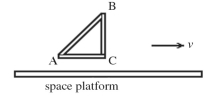
(Multiple Choice)
4.9/5 (78)
(78) In a certain chemical reaction,8.1 × 10-19 J of energy is released per molecule formed.What is the difference in mass per molecule between the sum of the masses of the molecules of the reagents before the reaction and the mass of the molecules produced by the reaction? (c = 3.0 × 10⁸ m/s)
(Multiple Choice)
4.9/5 (76)
(76) A spaceship carrying a light clock moves at a speed of 0.960c relative to an observer on Earth.If the clock on the ship advances by 1.00 s as measured by the space travelers aboard the ship,how long did that advance take as measured by the observer on Earth?
(Multiple Choice)
4.8/5 (81)
(81) How many MeV of energy is released during a reaction in which 1.67 × 10⁻²⁵ kg of material is converted to energy? (c = 3.0 × 10⁸ m/s,1 eV = 1.67 × 10⁻¹⁹ J)
(Multiple Choice)
4.8/5 (78)
(78) A spaceship with a constant speed of 0.800c relative to Earth travels to a star that is 4.30 light-years from Earth.How much time for this trip would elapse on a clock on board the spaceship?
(Multiple Choice)
4.8/5 (70)
(70) You are a passenger on a spaceship.As the speed of the spaceship increases,you will observe
(Multiple Choice)
4.9/5 (82)
(82) A spaceship approaching an asteroid at a speed of 0.60c launches a scout rocket with speed 0.40c relative to the spaceship.At what speed is the scout rocket approaching the asteroid?
(Multiple Choice)
4.8/5 (93)
(93) Astronaut Rachel leaves Earth in a spaceship at a speed of 0.960c relative to an observer on Earth.Rachel's destination is a star system 14.4 light-years away (one light-year is the distance light travels in one year).According to Rachel,how long does the trip take?
(Multiple Choice)
4.9/5 (68)
(68) 
Filters
- Essay(0)
- Multiple Choice(0)
- Short Answer(0)
- True False(0)
- Matching(0)