



 Chat with AI
Exam 26: Geometrical Optics

Exam 1: Introduction to Physics98 Questions
Exam 2: One-Dimensional Kinematics138 Questions
Exam 3: Vectors in Physics69 Questions
Exam 4: Two-Dimensional Kinematics51 Questions
Exam 5: Newtons Laws of Motion54 Questions
Exam 6: Applications of Newtons Laws104 Questions
Exam 7: Work and Kinetic Energy55 Questions
Exam 8: Potential Energy and Conservation of Energy62 Questions
Exam 9: Linear Momentum and Collisions114 Questions
Exam 10: Rotational Kinematics and Energy60 Questions
Exam 11: Rotational Dynamics and Static Equilibrium69 Questions
Exam 12: Gravity53 Questions
Exam 13: Oscillations About Equilibrium79 Questions
Exam 14: Waves and Sound142 Questions
Exam 15: Fluids103 Questions
Exam 16: Temperature and Heat110 Questions
Exam 17: Phases and Phase Changes93 Questions
Exam 18: The Laws of Thermodynamics90 Questions
Exam 19: Electric Charges, Forces, and Fields75 Questions
Exam 20: Electric Potential and Electric124 Questions
Exam 21: Electric Current and Direct-Current Circuits228 Questions
Exam 22: Magnetism147 Questions
Exam 23: Magnetic Flux and Faradays Law of Induction98 Questions
Exam 24: Alternating-Current Circuits72 Questions
Exam 25: Electromagnetic Waves63 Questions
Exam 26: Geometrical Optics133 Questions
Exam 27: Optical Instruments103 Questions
Exam 28: Physical Optics: Interference and Diffraction119 Questions
Exam 29: Relativity98 Questions
Exam 30: Quantum Physics88 Questions
Exam 31: Atomic Physics97 Questions
Exam 32: Nuclear Physics and Nuclear Radiation137 Questions
Select questions type


An oil layer that is 5.0 cm thick is spread smoothly and evenly over the surface of water on a windless day.A light ray from the air above enters the oil at 45° with the normal and then goes into the water.What is the angle of refraction of this ray in the water? The index of refraction for the oil is 1.15,and for water it is 1.33.
(Multiple Choice)
4.9/5  (67)
(67) A cup that is 6.0 cm tall is in front of a concave lens.The image of the cup is 2.5 cm tall and 7.5 cm from the lens.What is the focal length of the lens?
(Multiple Choice)
4.9/5 (80)
(80) Starting from very far away,an object is moved closer and closer to a converging lens,eventually reaching the lens.What happens to its image formed by that lens? (There could be more than one correct choice. )
(Multiple Choice)
4.8/5 (83)
(83) The index of refraction of a certain glass is measured to be 1.5.What is the speed of light in that glass? (c = 3.0 × 10⁸ m/s)
(Multiple Choice)
4.8/5 (84)
(84) A glass plate having an index of refraction is 1.66 is immersed in a certain alcohol.The surface of the glass is inclined at an angle of 44° with the vertical.When a horizontal ray in the glass strikes the interface,you observe that it is at the critical angle.What is the index of refraction of the alcohol?
(Multiple Choice)
4.8/5 (87)
(87) An object is placed on the left side of a thin lens,and the image of this object is formed on the left side of the lens.Which of the following statements must be true? (There could be more than one correct choice. )
(Multiple Choice)
5.0/5 (83)
(83) A tank holds a layer of oil,of thickness To = 1.65 m,that floats on a layer of syrup of thickness Ts = 0.830 m,as shown in the figure.Both liquids are clear and do not mix together.A light ray,originating at the bottom of the tank at point P,crosses the oil-syrup interface at a point 0.900 m from the axis.The ray continues and arrives at the oil-air interface,2.00 m to the right of P and at the critical angle.What is the index of refraction of the syrup? 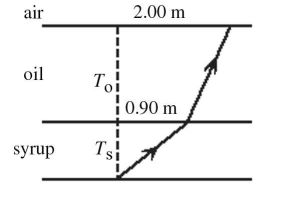
(Multiple Choice)
5.0/5 (69)
(69) A beam of light traveling in air strikes a glass slab at an angle of incidence less than 90°.After entering the glass slab,what does the beam of light do? (There could be more than one correct choice. )
(Multiple Choice)
4.7/5 (85)
(85) A thin flashlight beam traveling in air strikes a glass plate at an angle of 52° with the plane of the surface of the plate.If the index of refraction of the glass is 1.4,what angle will the beam make with the normal in the glass?
(Multiple Choice)
4.9/5 (77)
(77) An object is 5.7 cm from a spherical concave mirror.If the image is 4.7 cm tall and 10 cm from the mirror,how tall is the object?
(Multiple Choice)
4.8/5 (69)
(69) A convex spherical mirror has a focal length of magnitude 20 cm.If an object is placed 10 cm in front of the mirror on the mirror's axis,where is the image located?
(Multiple Choice)
4.8/5 (70)
(70) A cell phone that is 8.90 cm tall is placed in front of a convex mirror.The image of the phone is 7.80 cm tall and is located 14.8 cm from a mirror.What is the mirror's focal length?
(Multiple Choice)
4.9/5 (79)
(79) A coin is 12 cm in front of a converging lens with focal length of magnitude 4.0 cm.Where is the image?
(Multiple Choice)
4.9/5 (91)
(91) An object is placed 21 cm from a concave lens having a focal length of magnitude 25 cm.What is the magnification?
(Multiple Choice)
4.8/5 (89)
(89) A lab specimen is 15.2 mm from a converging lens.The image is 4.0 mm tall and 9.0 cm from the lens.How tall is the specimen?
(Multiple Choice)
4.7/5 (90)
(90) If a spherical concave mirror has a radius of curvature R,its focal length is
(Multiple Choice)
4.8/5 (81)
(81) A light ray in glass arrives at the glass-water interface an an angle of θ = 48° with the normal.The refracted ray in water makes an angle φ = 72° angle with the normal,as shown in the figure.The index of refraction of water is 1.33.The angle of incidence is now changed to θ = 37°.What is the new angle of refraction φ in the water? 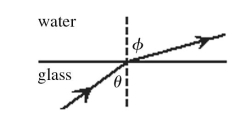
(Multiple Choice)
4.9/5 (81)
(81) An object is 10 cm in front of a concave spherical mirror with a focal length of magnitude 3.0 cm.Where is the image?
(Multiple Choice)
4.9/5 (78)
(78) 
Filters
- Essay(0)
- Multiple Choice(0)
- Short Answer(0)
- True False(0)
- Matching(0)