



 Chat with AI
Exam 22: Magnetism

Exam 1: Introduction to Physics98 Questions
Exam 2: One-Dimensional Kinematics138 Questions
Exam 3: Vectors in Physics69 Questions
Exam 4: Two-Dimensional Kinematics51 Questions
Exam 5: Newtons Laws of Motion54 Questions
Exam 6: Applications of Newtons Laws104 Questions
Exam 7: Work and Kinetic Energy55 Questions
Exam 8: Potential Energy and Conservation of Energy62 Questions
Exam 9: Linear Momentum and Collisions114 Questions
Exam 10: Rotational Kinematics and Energy60 Questions
Exam 11: Rotational Dynamics and Static Equilibrium69 Questions
Exam 12: Gravity53 Questions
Exam 13: Oscillations About Equilibrium79 Questions
Exam 14: Waves and Sound142 Questions
Exam 15: Fluids103 Questions
Exam 16: Temperature and Heat110 Questions
Exam 17: Phases and Phase Changes93 Questions
Exam 18: The Laws of Thermodynamics90 Questions
Exam 19: Electric Charges, Forces, and Fields75 Questions
Exam 20: Electric Potential and Electric124 Questions
Exam 21: Electric Current and Direct-Current Circuits228 Questions
Exam 22: Magnetism147 Questions
Exam 23: Magnetic Flux and Faradays Law of Induction98 Questions
Exam 24: Alternating-Current Circuits72 Questions
Exam 25: Electromagnetic Waves63 Questions
Exam 26: Geometrical Optics133 Questions
Exam 27: Optical Instruments103 Questions
Exam 28: Physical Optics: Interference and Diffraction119 Questions
Exam 29: Relativity98 Questions
Exam 30: Quantum Physics88 Questions
Exam 31: Atomic Physics97 Questions
Exam 32: Nuclear Physics and Nuclear Radiation137 Questions
Select questions type


A charged particle moves with a constant speed through a region where a uniform magnetic field is present.If the magnetic field points straight upward,the magnetic force acting on this particle will be strongest when the particle moves
(Multiple Choice)
4.8/5  (77)
(77) An electron,moving south,enters a magnetic field.Because of this field,the electron curves upward.We may conclude that the magnetic field must have a component
(Multiple Choice)
4.9/5 (82)
(82) The magnitude of the magnetic field that a long and extremely thin current-carrying wire produces at a distance of 3.0 µm from the center of the wire is 2.0 × 10⁻³ T.How much current is flowing through the wire? (μ0 = 4π × 10-7 T ∙ m/A)
(Multiple Choice)
4.9/5 (95)
(95) A vertical wire carries a current vertically downward.To the east of this wire,the magnetic field points
(Multiple Choice)
4.9/5 (79)
(79) Three very long,straight,parallel wires each carry currents of 4.0 A,directed out of the page as shown in the figure.These wires pass through the vertices of a right isosceles triangle as shown.Assume that all the quantities shown in the figure are accurate to two significant figures.What is the magnitude of the magnetic field at point P at the midpoint of the hypotenuse of the triangle? (μ0 = 4π × 10-7 T ∙ m/A) 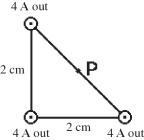
(Multiple Choice)
4.8/5 (71)
(71) A long straight wire on the z-axis carries a current of 8.0 A in the +z direction (out of the paper).A circular loop of radius 10 cm lies in the xy-plane and carries a 3.0-A current,as shown in the figure.Point P,at the center of the loop,is 25 cm from the z-axis.An electron is projected from P with a velocity of 3.0 × 10⁶ m/s in the -x direction.What is the y component of the magnetic force on the electron? (e = 1.60 × 10⁻¹⁹,μ0 = 4π × 10-7 T ∙ m/A) 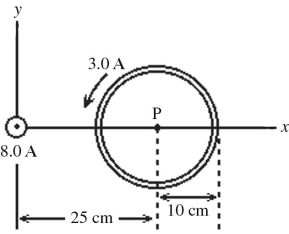
(Multiple Choice)
4.9/5 (84)
(84) A wire is carrying current vertically downward.What is the direction of the force on this wire due to Earth's magnetic field?
(Multiple Choice)
4.8/5 (83)
(83) 
Filters
- Essay(0)
- Multiple Choice(0)
- Short Answer(0)
- True False(0)
- Matching(0)