



 Chat with AI
Exam 19: Electric Charges, Forces, and Fields

Exam 1: Introduction to Physics98 Questions
Exam 2: One-Dimensional Kinematics138 Questions
Exam 3: Vectors in Physics69 Questions
Exam 4: Two-Dimensional Kinematics51 Questions
Exam 5: Newtons Laws of Motion54 Questions
Exam 6: Applications of Newtons Laws104 Questions
Exam 7: Work and Kinetic Energy55 Questions
Exam 8: Potential Energy and Conservation of Energy62 Questions
Exam 9: Linear Momentum and Collisions114 Questions
Exam 10: Rotational Kinematics and Energy60 Questions
Exam 11: Rotational Dynamics and Static Equilibrium69 Questions
Exam 12: Gravity53 Questions
Exam 13: Oscillations About Equilibrium79 Questions
Exam 14: Waves and Sound142 Questions
Exam 15: Fluids103 Questions
Exam 16: Temperature and Heat110 Questions
Exam 17: Phases and Phase Changes93 Questions
Exam 18: The Laws of Thermodynamics90 Questions
Exam 19: Electric Charges, Forces, and Fields75 Questions
Exam 20: Electric Potential and Electric124 Questions
Exam 21: Electric Current and Direct-Current Circuits228 Questions
Exam 22: Magnetism147 Questions
Exam 23: Magnetic Flux and Faradays Law of Induction98 Questions
Exam 24: Alternating-Current Circuits72 Questions
Exam 25: Electromagnetic Waves63 Questions
Exam 26: Geometrical Optics133 Questions
Exam 27: Optical Instruments103 Questions
Exam 28: Physical Optics: Interference and Diffraction119 Questions
Exam 29: Relativity98 Questions
Exam 30: Quantum Physics88 Questions
Exam 31: Atomic Physics97 Questions
Exam 32: Nuclear Physics and Nuclear Radiation137 Questions
Select questions type


Three equal negative point charges -q are placed at three of the corners of a square of side d as shown in the figure.Which one of the arrows shown represents the direction of the net electric field at the vacant corner of the square? 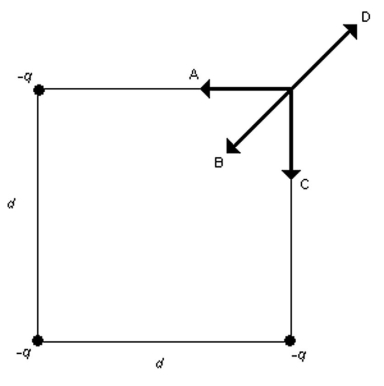
(Multiple Choice)
4.7/5  (79)
(79) The figure shows two unequal charges,+q and -Q.Charge -Q has greater magnitude than charge +q.Point X is midway between the charges.In what section of the line will there be a point where the resultant electric field is zero? 
(Multiple Choice)
4.8/5 (79)
(79) The figure shows two tiny 5.0-g spheres suspended from very light 1.0-m-long threads.The spheres repel each other after each one is given the same positive charge and hang at rest when θ = 4.1°.What is the charge on each sphere? (k = 1/4πε0 = 9.0 × 10⁹ N ∙ m2/C2) 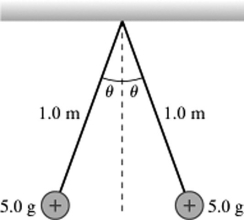
(Multiple Choice)
4.8/5 (87)
(87) A pair of charged conducting plates produces a uniform field of 12,000 N/C,directed to the right,between the plates.The separation of the plates is 40 mm.An electron is projected from plate A,directly toward plate B,with an initial speed of v0 = 2.0 × 10⁷ m/s.What is the speed of the electron as it strikes plate B? 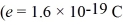 ,melectron = 9.11 × 10⁻³¹ kg)
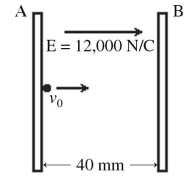
,melectron = 9.11 × 10⁻³¹ kg) (Multiple Choice)
4.7/5 (82)
(82) An asteroid of mass 58,000 kg carrying a negative charge of  Is
 From a second asteroid of mass
 Carrying a negative charge of
 What is the magnitude of the net force the asteroids exert upon each other,assuming we can treat them as point particles? (G = 6.67 × 10⁻¹¹ N ∙ m2/kg2,k = 1/4 πε0 = 8.99 × 10⁹ N ∙ m2/C2)
Is
From a second asteroid of mass
Carrying a negative charge of
What is the magnitude of the net force the asteroids exert upon each other,assuming we can treat them as point particles? (G = 6.67 × 10⁻¹¹ N ∙ m2/kg2,k = 1/4 πε0 = 8.99 × 10⁹ N ∙ m2/C2) (Multiple Choice)
4.9/5 (82)
(82) A solid aluminum cube rests on a wooden table in a region where a uniform external electric field is directed straight upward.What can we say concerning the charge on the top surface of the cube?
(Multiple Choice)
4.9/5 (86)
(86) Two very small plastic balls of equal mass are released from rest.One of them carries +10 µC of excess charge and the other one carries +1µC of charge.No other charges or fields are present.Which of the following statements are true about them as they move away from each other? (There may be more than one correct choice. )
(Multiple Choice)
4.8/5 (92)
(92) An electron and a proton are released simultaneously from rest and start moving toward each other due to their electrostatic attraction,with no other forces present.Which of the following statements are true just before they are about to collide? (There could be more than one correct choice. )
(Multiple Choice)
4.9/5 (77)
(77) The electric field at point P due to a point charge Q a distance R away from P has magnitude E.In order to double the magnitude of the field at P,you could
(Multiple Choice)
4.9/5 (70)
(70) 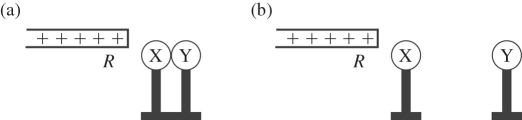 X and Y are two initially uncharged metal spheres on insulating stands,and they are in contact with each other.A positively charged rod R is brought close to X as shown in part (a)of the figure.Sphere Y is now moved away from X,as shown in part (b).What are the final charge states of X and Y?
 (Multiple Choice)
4.8/5 (89)
(89) Two tiny particles having charges of +5.00 μC and +7.00 μC are placed along the x-axis.The +5.00-µC particle is at x = 0.00 cm,and the other particle is at x = 100.00 cm.Where on the x-axis must a third charged particle be placed so that it does not experience any net electrostatic force due to the other two particles?
(Multiple Choice)
4.8/5 (76)
(76) What is the magnitude of a the vertical electric field that will balance the weight of a plastic sphere of mass  That has been charged to -3.0 nC? (k = 1/4πε0 = 9.0 × 10⁹ N ∙ m2/C2)
 (Multiple Choice)
5.0/5 (71)
(71) The force of attraction that a -40.0 μC point charge exerts on a +108 μC point charge has magnitude 4.00 N.How far apart are these two charges? (k = 1/4πε0 = 8.99 × 10⁹ N ∙ m2/C2)
(Multiple Choice)
4.9/5 (59)
(59) A hydrogen nucleus,which has a charge +e,is situated to the left of a carbon nucleus,which has a charge +6e.Which statement is true?
(Multiple Choice)
4.8/5 (75)
(75) A +5.00-μC point charge is placed at the 0.0 cm mark of a meter stick and a -4.00-μC point charge is placed at the 50.0 cm mark.At what point on a line through the ends of the meter stick is the electric field equal to zero?
(Multiple Choice)
5.0/5 (76)
(76) 
Filters
- Essay(0)
- Multiple Choice(0)
- Short Answer(0)
- True False(0)
- Matching(0)