



 Chat with AI
Exam 8: Potential Energy and Conservation of Energy

Exam 1: Introduction to Physics98 Questions
Exam 2: One-Dimensional Kinematics138 Questions
Exam 3: Vectors in Physics69 Questions
Exam 4: Two-Dimensional Kinematics51 Questions
Exam 5: Newtons Laws of Motion54 Questions
Exam 6: Applications of Newtons Laws104 Questions
Exam 7: Work and Kinetic Energy55 Questions
Exam 8: Potential Energy and Conservation of Energy62 Questions
Exam 9: Linear Momentum and Collisions114 Questions
Exam 10: Rotational Kinematics and Energy60 Questions
Exam 11: Rotational Dynamics and Static Equilibrium69 Questions
Exam 12: Gravity53 Questions
Exam 13: Oscillations About Equilibrium79 Questions
Exam 14: Waves and Sound142 Questions
Exam 15: Fluids103 Questions
Exam 16: Temperature and Heat110 Questions
Exam 17: Phases and Phase Changes93 Questions
Exam 18: The Laws of Thermodynamics90 Questions
Exam 19: Electric Charges, Forces, and Fields75 Questions
Exam 20: Electric Potential and Electric124 Questions
Exam 21: Electric Current and Direct-Current Circuits228 Questions
Exam 22: Magnetism147 Questions
Exam 23: Magnetic Flux and Faradays Law of Induction98 Questions
Exam 24: Alternating-Current Circuits72 Questions
Exam 25: Electromagnetic Waves63 Questions
Exam 26: Geometrical Optics133 Questions
Exam 27: Optical Instruments103 Questions
Exam 28: Physical Optics: Interference and Diffraction119 Questions
Exam 29: Relativity98 Questions
Exam 30: Quantum Physics88 Questions
Exam 31: Atomic Physics97 Questions
Exam 32: Nuclear Physics and Nuclear Radiation137 Questions
Select questions type


A heavy sled and a light sled,both moving horizontally with the same kinetic energy,suddenly slide onto a rough patch of snow and eventually come to a stop.The coefficient of kinetic friction between the sleds and the rough snow is the same for both of them.Which of the following statements about these sleds are correct? (There could be more than one correct choice. )
(Multiple Choice)
4.9/5  (86)
(86) What is the minimum energy needed to lift a 1.0-kg rocket to a height of 200 km and to give it a speed of 8.0 km/s at that height? (Neglect air resistance and the small decrease in g over that distance. )
(Multiple Choice)
4.9/5 (82)
(82) A 5.0-N projectile leaves the ground with a kinetic energy of 220 J.At the highest point in its trajectory,its kinetic energy is 120 J.To what vertical height,relative to its launch point,did it rise if there was no air resistance?
(Multiple Choice)
4.9/5 (96)
(96) An object with a mass of 10 kg is initially at rest at the top of a frictionless inclined plane that rises at 30° above the horizontal.At the top,the object is initially 8.0 m from the bottom of the incline,as shown in the figure.When the object is released from this position,it eventually stops at a distance d from the bottom of the inclined plane along a horizontal surface,as shown.The coefficient of kinetic friction between the horizontal surface and the object is 0.20,and air resistance is negligible.Find the distance d. 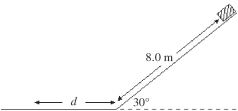
(Multiple Choice)
4.8/5 (87)
(87) A 0.46-kg block is held in place against the spring by a 30-N horizontal external force.The external force is removed,and the block is projected with a velocity v1=1.2 m/s. Upon separation from the spring,as shown in the figure.The block descends a ramp and has a velocity v2=1.5 m/ s. At the bottom.The track is frictionless between points A and B.The block enters a rough section at point B,extending to E.The coefficient of kinetic friction between the block and the rough surface is 0.38.The velocity of the block is v3=1.4 m/ s. At point C.The block moves on to D,where it stops.What distance does the block travel between points B and D? 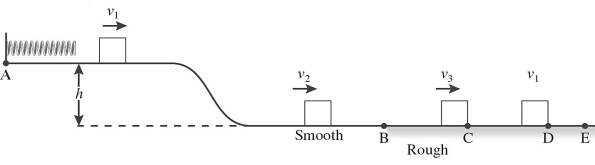
(Multiple Choice)
4.9/5 (85)
(85) A person stands on the edge of a cliff.She throws three identical rocks with the same speed.Rock X is thrown vertically upward,rock Y is thrown horizontally,and rock Z is thrown vertically downward.If the ground at the base of the cliff is level,which rock hits the ground with the greatest speed if there is no air resistance?
(Multiple Choice)
4.9/5 (80)
(80) The figure shows a famous roller coaster ride.You can ignore friction.If the roller coaster leaves point Q from rest,what is its speed at the top of the 25-m peak (point S)? 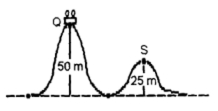
(Multiple Choice)
4.8/5 (93)
(93) If electricity costs 7.06¢/kW∙h,how much would it cost you to run a  Stereo system
 Per day for

Stereo system
Per day for (Multiple Choice)
4.9/5 (79)
(79) A heavy sled and a light sled,both moving horizontally with the same speed,suddenly slide onto a rough patch of snow and eventually come to a stop.The coefficient of kinetic friction between the sleds and the rough snow is the same for both of them.Which of the following statements about these sleds are correct? (There could be more than one correct choice. )
(Multiple Choice)
4.8/5 (81)
(81) A heavy dart and a light dart are launched horizontally on a frictionless table by identical ideal springs.Both springs were initially compressed by the same amount.Which of the following statements about these darts are correct? (There could be more than one correct choice. )
(Multiple Choice)
4.8/5 (78)
(78) A heavy rock and a light rock are dropped from the same height and experience no significant air resistance as they fall.Which of the following statements about these rocks are correct? (There could be more than one correct choice. )
(Multiple Choice)
4.7/5 (78)
(78) You and your friend,who weighs the same as you,want to go to the top of the Eiffel Tower.Your friend takes the elevator straight up.You decide to walk up the spiral stairway,taking longer to do so.Compare the gravitational potential energy of you and your friend,after you both reach the top.
(Multiple Choice)
4.9/5 (85)
(85) A 0.12-kg block is held in place against the spring by a 35-N horizontal external force.The external force is removed,and the block is projected with a velocity v1=1.2 m/s. When it separates from the spring,as shown in the figure.The block descends a ramp and has a velocity v2=1.4 m/s. At the bottom of the ramp.The track is frictionless between points A and B.The block enters a rough section at B,extending to E.The coefficient of kinetic friction between the block and the rough surface is 0.26.The block moves on to D,where it stops.By how many centimeters was the spring initially compressed? 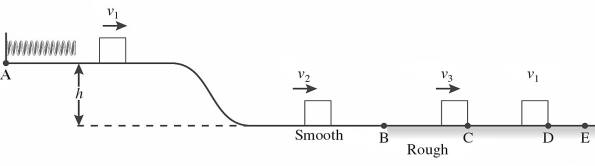
(Multiple Choice)
4.9/5 (77)
(77) A 60-kg skier starts from rest from the top of a 50-m high slope.If the work done by friction is -6.0 kJ,what is the speed of the skier on reaching the bottom of the slope?
(Multiple Choice)
4.8/5 (84)
(84) An ideal spring with a force constant (spring constant)of 15 N/m is initially compressed by 3.0 cm from its uncompressed position.How much work is required to compress the spring an additional 4.0 cm?
(Multiple Choice)
4.9/5 (68)
(68) A spring-loaded dart gun is used to shoot a dart straight up into the air,and the dart reaches a maximum height of 24 meters.The same dart is shot up a second time from the same gun,but this time the spring is compressed only half as far (compared to the first shot).How far up does the dart go this time (neglect all friction and assume the spring is ideal)?
(Multiple Choice)
4.9/5 (62)
(62) In a museum exhibit of a simple pendulum,a very small but dense 6.0-kg ball swings from a very light 2.5-m wire.The ball is released from rest when the pendulum wire makes a 65° angle with the vertical,and it swings in a circular arc with no appreciable friction or air resistance.What is the tension in the wire just as the ball swings through its lowest position?
(Multiple Choice)
4.8/5 (80)
(80) An ideal spring with a spring constant (force constant)of  Is stretched from equilibrium to 2.9 m.How much work is done in the process?
 (Multiple Choice)
4.9/5 (97)
(97) You do 116 J of work while pulling your sister back on a frictionless swing,whose chain is  Long,until the swing makes an angle of 32.0° with the vertical.What is your sister's mass?
 (Multiple Choice)
4.8/5 (90)
(90) How many joules of energy are used by a 1.0-hp motor that runs for 1.0 hour? (1 hp = 746 W)
(Multiple Choice)
4.8/5 (74)
(74) 
Filters
- Essay(0)
- Multiple Choice(0)
- Short Answer(0)
- True False(0)
- Matching(0)