



 Chat with AI
Exam 2: One-Dimensional Kinematics

Exam 1: Introduction to Physics98 Questions
Exam 2: One-Dimensional Kinematics138 Questions
Exam 3: Vectors in Physics69 Questions
Exam 4: Two-Dimensional Kinematics51 Questions
Exam 5: Newtons Laws of Motion54 Questions
Exam 6: Applications of Newtons Laws104 Questions
Exam 7: Work and Kinetic Energy55 Questions
Exam 8: Potential Energy and Conservation of Energy62 Questions
Exam 9: Linear Momentum and Collisions114 Questions
Exam 10: Rotational Kinematics and Energy60 Questions
Exam 11: Rotational Dynamics and Static Equilibrium69 Questions
Exam 12: Gravity53 Questions
Exam 13: Oscillations About Equilibrium79 Questions
Exam 14: Waves and Sound142 Questions
Exam 15: Fluids103 Questions
Exam 16: Temperature and Heat110 Questions
Exam 17: Phases and Phase Changes93 Questions
Exam 18: The Laws of Thermodynamics90 Questions
Exam 19: Electric Charges, Forces, and Fields75 Questions
Exam 20: Electric Potential and Electric124 Questions
Exam 21: Electric Current and Direct-Current Circuits228 Questions
Exam 22: Magnetism147 Questions
Exam 23: Magnetic Flux and Faradays Law of Induction98 Questions
Exam 24: Alternating-Current Circuits72 Questions
Exam 25: Electromagnetic Waves63 Questions
Exam 26: Geometrical Optics133 Questions
Exam 27: Optical Instruments103 Questions
Exam 28: Physical Optics: Interference and Diffraction119 Questions
Exam 29: Relativity98 Questions
Exam 30: Quantum Physics88 Questions
Exam 31: Atomic Physics97 Questions
Exam 32: Nuclear Physics and Nuclear Radiation137 Questions
Select questions type


The figure shows a graph of the velocity of an object as a function of time.What is the displacement of the object from 0 s to 6.0 s? 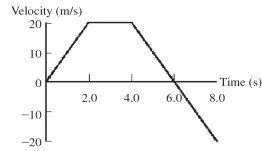
(Multiple Choice)
4.8/5  (73)
(73) A runner runs around a track consisting of two parallel lines 96 m long connected at the ends by two semicircles with a radius of 49 m.She completes one lap in 100 seconds.What is her average velocity?
(Multiple Choice)
4.9/5 (68)
(68) Suppose that a car traveling to the west (-x direction)begins to slow down as it approaches a traffic light.Which statement concerning its acceleration must be correct?
(Multiple Choice)
4.9/5 (91)
(91) If the velocity of an object is zero at one instant,what is true about the acceleration of that object? (There could be more than one correct choice. )
(Multiple Choice)
4.8/5 (85)
(85) A ball is thrown downward in the absence of air resistance.After it has been released,which statement(s)concerning its acceleration is correct? (There could be more than one correct choice. )
(Multiple Choice)
4.8/5 (84)
(84) An object is moving in a straight line with constant acceleration.Initially it is traveling at 16 m/s.Three seconds later it is traveling at 10 m/s.How far does it move during this time?
(Multiple Choice)
5.0/5 (74)
(74) The graph in the figure shows the velocity of a particle as it travels along the x-axis.What is the magnitude of the average acceleration of the particle between t = 1.0 s and t = 4.0 s? 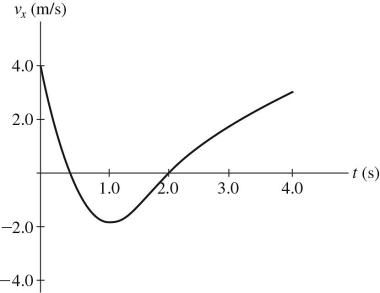
(Multiple Choice)
4.9/5 (75)
(75) A racing car accelerates uniformly from rest along a straight track.This track has markers spaced at equal distances along it from the start,as shown in the figure.The car reaches a speed of 140 km/h as it passes marker 2.  Where on the track was the car when it was traveling at half this speed,that is at 70 km/h?
 (Multiple Choice)
4.7/5 (91)
(91) The graph in the figure shows the position of a particle as it travels along the x-axis.  At what value of t is the speed of the particle equal to 0 m/s?
 (Multiple Choice)
4.8/5 (77)
(77) An object starts from rest and undergoes uniform acceleration.During the first second it travels 5.0 m.How far will it travel during the third second?
(Multiple Choice)
4.9/5 (98)
(98) A 10-kg rock and a 20-kg rock are thrown upward with the same initial speed v0 and experience no significant air resistance.If the 10-kg rock reaches a maximum height h,what maximum height will the 20-kg ball reach?
(Multiple Choice)
5.0/5 (91)
(91) A motorist makes a trip of 180 miles.For the first 90 miles she drives at a constant speed of 30 mph.At what constant speed must she drive the remaining distance if her average speed for the total trip is to be 40 mph?
(Multiple Choice)
4.9/5 (82)
(82) If the velocity of an object is zero at some point,then its acceleration must also be zero at that point.
(True/False)
4.9/5 (75)
(75) Two athletes jump straight up.John has twice the initial speed of Harry.Compared to Harry,John stays in the air
(Multiple Choice)
4.9/5 (83)
(83) A ball is thrown straight upward from ground level with a speed of 18 m/s. How much time passes before the ball strikes the ground if we disregard air resistance?
(Multiple Choice)
4.8/5 (79)
(79) A ball is thrown straight up,reaches a maximum height,then falls to its initial height.Which of the following statements about the direction of the velocity and acceleration of the ball as it is going up is correct?
(Multiple Choice)
4.9/5 (80)
(80) Two cars are traveling at the same speed and hit the brakes at the same time.Car A decelerates (decreases its velocity) at twice the rate of car B.If car B takes time T to stop,how long does it take car A to stop?
(Multiple Choice)
4.9/5 (93)
(93) The area under a curve in a velocity versus time graph gives
(Multiple Choice)
4.9/5 (70)
(70) Abby throws a ball straight up and times it.She sees that the ball goes by the top of a flagpole after 0.50 s and reaches the level of the top of the pole after a total elapsed time of 4.1 s.What was the speed of the ball at as it passed the top of the flagpole? Neglect air resistance.
(Multiple Choice)
4.8/5 (76)
(76) A ball is thrown upward at a velocity of 19.6 m/s.What is its velocity after 3.0 s,assuming negligible air resistance?
(Multiple Choice)
4.8/5 (95)
(95) 
Filters
- Essay(0)
- Multiple Choice(0)
- Short Answer(0)
- True False(0)
- Matching(0)