



 Chat with AI
Exam 19: The International Financial System

Exam 1: Economics: Foundations and Models219 Questions
Exam 2: Trade-Offs, Comparative Advantage, and the Market System236 Questions
Exam 3: Where Prices Come From: The Interaction of Demand and Supply234 Questions
Exam 4: Economic Efficiency, Government Price Setting, and Taxes212 Questions
Exam 5: The Economics of Health Care166 Questions
Exam 6: Firms, the Stock Market, and Corporate Governance251 Questions
Exam 7: Comparative Advantage and the Gains From International Trade188 Questions
Exam 8: GDP: Measuring Total Production and Income260 Questions
Exam 9: Unemployment and Inflation289 Questions
Exam 10: Economic Growth, the Financial System, and Business Cycles251 Questions
Exam 11: Long-Run Economic Growth: Sources and Policies261 Questions
Exam 12: Aggregate Expenditure and Output in the Short Run304 Questions
Exam 13: Aggregate Demand and Aggregate Supply Analysis284 Questions
Exam 14: Money,Banks,and the Federal Reserve System276 Questions
Exam 15: Monetary Policy278 Questions
Exam 16: Fiscal Policy313 Questions
Exam 17: Inflation, Unemployment, and Federal Reserve Policy257 Questions
Exam 18: Macroeconomics in an Open Economy277 Questions
Exam 19: The International Financial System256 Questions
Select questions type


Both countries involved in a pegging of currency must agree to the terms of the pegging.
(True/False)
4.8/5  (76)
(76) Exchange rates under the Bretton Woods system were determined by relative supplies of gold held by countries within the system.
(True/False)
4.9/5 (86)
(86) In order to support an undervalued euro,the European Central Bank must ________ dollars.Over time,this action will cause the rate of inflation in the EU to ________.
(Multiple Choice)
4.8/5 (77)
(77) If speculators believe a currency is undervalued,their trades in international exchange markets will
(Multiple Choice)
4.8/5 (78)
(78) Countries that use the euro as their currency face similar concerns as countries did during the years of the gold standard in that each are (were)
(Multiple Choice)
5.0/5 (78)
(78) Before 1980,U.S.investors rarely invested in foreign capital markets.
(True/False)
5.0/5 (78)
(78) Compared to a situation in which there is no change in the value of the dollar relative to the peso,in which of the following situations would you be worse off?
(Multiple Choice)
4.8/5 (84)
(84) One reason purchasing power parity does not exactly hold is that many goods are not traded internationally.
(True/False)
4.9/5 (78)
(78) If the average productivity of American firms is rising more quickly than the average productivity of Indian firms,which of the following would you expect to see? (India's currency is the rupee.)
(Multiple Choice)
4.9/5 (85)
(85) Figure 19-1 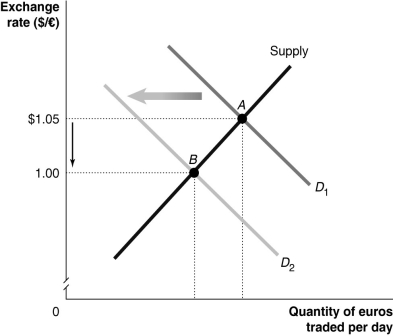 -Refer to Figure 19-1.Which of the following would cause the change depicted in the figure above?
 (Multiple Choice)
4.8/5 (77)
(77) Which of the following would increase the value of the dollar in the long run?
(Multiple Choice)
4.8/5 (71)
(71) If a country's currency ________ the dollar,its exchange rate is fixed.
(Multiple Choice)
5.0/5 (93)
(93) By 2017,how many European countries were members of the European Union?
(Multiple Choice)
4.7/5 (70)
(70) Suppose Mexico and the United States are on the gold standard.If there is a half an ounce of gold in the dollar,and one quarter an ounce of gold in the peso,then the exchange rate is
(Multiple Choice)
4.9/5 (82)
(82) Figure 19-8 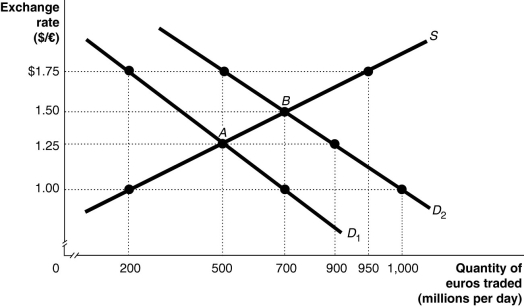 -Refer to Figure 19-8.The equilibrium exchange rate is at A,$1.25/euro.Suppose the European Central Bank pegs its currency at $1.00/euro.At the pegged exchange rate
 (Multiple Choice)
4.7/5 (95)
(95) The "Big Mac Theory of Exchange Rates" tests the accuracy of purchasing power parity theory.In January 2017,The Economist reported that the average price of a Big Mac in the United States was $4.93.In Switzerland,the average price of a Big Mac at that time was 6.50 Swiss francs.If the exchange rate between the dollar and the Swiss franc was 0.93 Swiss francs per dollar,explain how it would be profitable to buy Big Macs in the United States instead of in Switzerland.
(Essay)
4.8/5 (71)
(71) If a country sets a pegged exchange rate that is above the equilibrium exchange rate,how can the country maintain the peg?
(Multiple Choice)
4.9/5 (80)
(80) By the end of 2017,________ members of the European Union were using the euro as their currency.
(Multiple Choice)
4.8/5 (84)
(84) 
Filters
- Essay(0)
- Multiple Choice(0)
- Short Answer(0)
- True False(0)
- Matching(0)