



 Chat with AI
Exam 17: Inflation, Unemployment, and Federal Reserve Policy

Exam 1: Economics: Foundations and Models219 Questions
Exam 2: Trade-Offs, Comparative Advantage, and the Market System236 Questions
Exam 3: Where Prices Come From: The Interaction of Demand and Supply234 Questions
Exam 4: Economic Efficiency, Government Price Setting, and Taxes212 Questions
Exam 5: The Economics of Health Care166 Questions
Exam 6: Firms, the Stock Market, and Corporate Governance251 Questions
Exam 7: Comparative Advantage and the Gains From International Trade188 Questions
Exam 8: GDP: Measuring Total Production and Income260 Questions
Exam 9: Unemployment and Inflation289 Questions
Exam 10: Economic Growth, the Financial System, and Business Cycles251 Questions
Exam 11: Long-Run Economic Growth: Sources and Policies261 Questions
Exam 12: Aggregate Expenditure and Output in the Short Run304 Questions
Exam 13: Aggregate Demand and Aggregate Supply Analysis284 Questions
Exam 14: Money,Banks,and the Federal Reserve System276 Questions
Exam 15: Monetary Policy278 Questions
Exam 16: Fiscal Policy313 Questions
Exam 17: Inflation, Unemployment, and Federal Reserve Policy257 Questions
Exam 18: Macroeconomics in an Open Economy277 Questions
Exam 19: The International Financial System256 Questions
Select questions type


The natural rate of unemployment is the rate that exists when the economy is producing at potential GDP.
(True/False)
4.7/5  (76)
(76) Figure 17-2 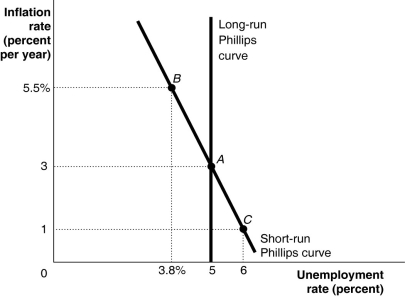 -Refer to Figure 17-2.Suppose the economy is at point B in the figure above.Which of the following is true?
 (Multiple Choice)
4.9/5 (73)
(73) Figure 17-7  -Refer to Figure 17-7.Consider the Phillips curves depicted in the graph above.The Fed announces its intention to decrease inflation from 10 percent to 5 percent per year,and it succeeds.If expectations of inflation are not altered by the Fed's announcement,the rate of unemployment will be ________ in the short run.
 (Multiple Choice)
4.9/5 (79)
(79) Figure 17-7
-Refer to Figure 17-7.Consider the Phillips curves depicted in the graph above.The Fed announces its intention to decrease inflation from 10 percent to 5 percent per year,and it succeeds.If expectations of inflation are reduced to 8 percent by the Fed's announcement,the rate of unemployment will be ________ in the short run.
-Refer to Figure 17-7.Consider the Phillips curves depicted in the graph above.The Fed announces its intention to decrease inflation from 10 percent to 5 percent per year,and it succeeds.If expectations of inflation are reduced to 8 percent by the Fed's announcement,the rate of unemployment will be ________ in the short run. (Multiple Choice)
4.8/5 (64)
(64) In the decade of the ________,A.W.Phillips plotted data for Great Britain which revealed a relationship between rates of changes in wages versus unemployment rates.Economists later discovered other "Phillips Curve" relationships between rates of inflation versus unemployment rates.
(Multiple Choice)
4.7/5 (75)
(75) All other factors held constant,increased growth in aggregate demand will
(Multiple Choice)
4.9/5 (73)
(73) Explain why an anticipated expansionary monetary policy would not result in reduced unemployment rates if workers and firms have rational expectations.
(Essay)
4.8/5 (82)
(82) What can the Federal Reserve do to reduce the natural rate of unemployment?
(Multiple Choice)
4.8/5 (73)
(73) Fed Chairman Alan Greenspan managed to keep the rate of inflation low as the economy was growing at a brisk pace by setting and hitting low money supply growth rate targets.
(True/False)
4.9/5 (79)
(79) If the Federal Reserve announces that its target for the federal funds rate is rising from 4 percent to 4.25 percent,how do you expect workers and firms to react?
(Multiple Choice)
4.8/5 (74)
(74) A provision of the Dodd-Frank Act of 2010 revised the Federal Reserve Act to
(Multiple Choice)
5.0/5 (71)
(71) Robert Shiller posed the following question to workers: "Imagine that next year the inflation rate unexpectedly doubles.How long would it probably take,in these times,before your income is increased enough so that you can afford the same things as you do today?" Shiller found that ________ percent of the workers he interviewed reported that it would take several years to restore the purchasing power of their wages or that this power would never be restored.
(Multiple Choice)
4.8/5 (86)
(86) Which of the following could increase unemployment and inflation simultaneously?
(Multiple Choice)
4.9/5 (80)
(80) During the 1960s,when confronted with moderate and stable inflation,people tended to form adaptive expectations of future inflation rates.
(True/False)
4.7/5 (86)
(86) 
Filters
- Essay(0)
- Multiple Choice(0)
- Short Answer(0)
- True False(0)
- Matching(0)