



 Chat with AI
Exam 13: Aggregate Demand and Aggregate Supply Analysis

Exam 1: Economics: Foundations and Models219 Questions
Exam 2: Trade-Offs, Comparative Advantage, and the Market System236 Questions
Exam 3: Where Prices Come From: The Interaction of Demand and Supply234 Questions
Exam 4: Economic Efficiency, Government Price Setting, and Taxes212 Questions
Exam 5: The Economics of Health Care166 Questions
Exam 6: Firms, the Stock Market, and Corporate Governance251 Questions
Exam 7: Comparative Advantage and the Gains From International Trade188 Questions
Exam 8: GDP: Measuring Total Production and Income260 Questions
Exam 9: Unemployment and Inflation289 Questions
Exam 10: Economic Growth, the Financial System, and Business Cycles251 Questions
Exam 11: Long-Run Economic Growth: Sources and Policies261 Questions
Exam 12: Aggregate Expenditure and Output in the Short Run304 Questions
Exam 13: Aggregate Demand and Aggregate Supply Analysis284 Questions
Exam 14: Money,Banks,and the Federal Reserve System276 Questions
Exam 15: Monetary Policy278 Questions
Exam 16: Fiscal Policy313 Questions
Exam 17: Inflation, Unemployment, and Federal Reserve Policy257 Questions
Exam 18: Macroeconomics in an Open Economy277 Questions
Exam 19: The International Financial System256 Questions
Select questions type


Figure 13-4 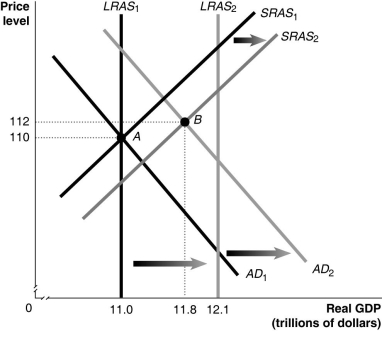 -Refer to Figure 13-4.Given the economy is at point A in year 1,what is the difference between the actual growth rate in GDP in year 2 and the potential growth rate in GDP in year 2?
 (Multiple Choice)
4.7/5  (87)
(87) When potential GDP increases,short-run aggregate supply also increases,but long-run aggregate supply does not change.
(True/False)
4.8/5 (85)
(85) Stagflation occurs when aggregate supply and aggregate demand both increase.
(True/False)
4.8/5 (79)
(79) Workers and firms both expect that prices will be 2.5% higher next year than they are this year.As a result
(Multiple Choice)
4.8/5 (89)
(89) Workers expect inflation to rise from 3% to 5% next year.As a result,this should
(Multiple Choice)
5.0/5 (84)
(84) Figure 13-2 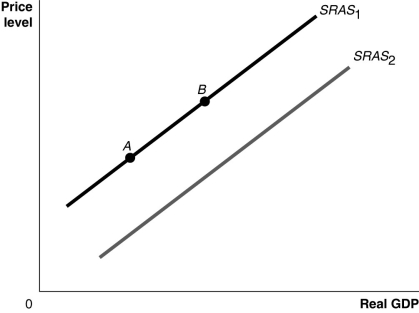 -Refer to Figure 13-2.Ceteris paribus,an increase in productivity would be represented by a movement from
 (Multiple Choice)
4.8/5 (79)
(79) The invention of the integrated circuit by Jack Kilby of Texas Instruments gave rise to the information age.What did this technological change do the short-run supply curve?
(Multiple Choice)
4.8/5 (66)
(66) The short-run aggregate supply curve has a(n)________ slope because as prices of ________ rise,prices of ________ rise more slowly.
(Multiple Choice)
4.9/5 (84)
(84) Use the dynamic model of aggregate demand and supply to illustrate a situation where the economy is growing but experiencing inflation in the long run.
(Essay)
4.9/5 (68)
(68) Figure 13-1 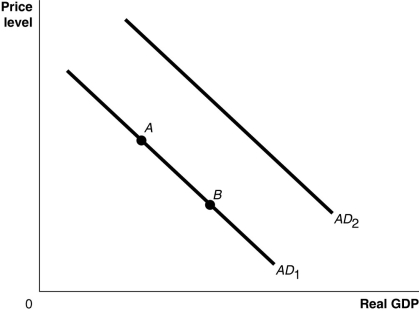 -Refer to Figure 13-1.Ceteris paribus,an increase in firms' expectations of the future profitability of investment spending would be represented by a movement from
 (Multiple Choice)
4.8/5 (83)
(83) A decrease in aggregate demand causes a decrease in ________ only in the short run,but causes a decrease in ________ in both the short run and the long run.
(Multiple Choice)
4.9/5 (90)
(90) When people became less concerned with the underlying value of their houses and instead focused on the expectations of the prices of their houses increasing,________ occurred.
(Multiple Choice)
5.0/5 (78)
(78) Explain the three reasons the aggregate demand curve slopes downward.
(Essay)
4.9/5 (76)
(76) The long-run adjustment to a negative supply shock results in
(Multiple Choice)
4.8/5 (86)
(86) Which of the following correctly describes the automatic mechanism through which the economy adjusts to long-run equilibrium?
(Multiple Choice)
4.8/5 (77)
(77) Explain how the static aggregate demand and aggregate supply model gives us misleading results about the price level,particularly with respect to decreases in aggregate demand.Describe how the aggregate demand curve is different in the dynamic model as compared to the static model.Describe how potential GDP is different in the dynamic model as compared to the static model.
(Essay)
4.7/5 (85)
(85) The dynamic aggregate demand and aggregate supply model assumes that potential GDP increases over time.
(True/False)
4.8/5 (70)
(70) 
Filters
- Essay(0)
- Multiple Choice(0)
- Short Answer(0)
- True False(0)
- Matching(0)