



 Chat with AI
Exam 4: Economic Efficiency, Government Price Setting, and Taxes

Exam 1: Economics: Foundations and Models219 Questions
Exam 2: Trade-Offs, Comparative Advantage, and the Market System236 Questions
Exam 3: Where Prices Come From: The Interaction of Demand and Supply234 Questions
Exam 4: Economic Efficiency, Government Price Setting, and Taxes212 Questions
Exam 5: The Economics of Health Care166 Questions
Exam 6: Firms, the Stock Market, and Corporate Governance251 Questions
Exam 7: Comparative Advantage and the Gains From International Trade188 Questions
Exam 8: GDP: Measuring Total Production and Income260 Questions
Exam 9: Unemployment and Inflation289 Questions
Exam 10: Economic Growth, the Financial System, and Business Cycles251 Questions
Exam 11: Long-Run Economic Growth: Sources and Policies261 Questions
Exam 12: Aggregate Expenditure and Output in the Short Run304 Questions
Exam 13: Aggregate Demand and Aggregate Supply Analysis284 Questions
Exam 14: Money,Banks,and the Federal Reserve System276 Questions
Exam 15: Monetary Policy278 Questions
Exam 16: Fiscal Policy313 Questions
Exam 17: Inflation, Unemployment, and Federal Reserve Policy257 Questions
Exam 18: Macroeconomics in an Open Economy277 Questions
Exam 19: The International Financial System256 Questions
Select questions type


Figure 4-3  Figure 4-3 shows the market for granola.The market is initially in equilibrium at a price of P1 and a quantity of Q1.Now suppose producers decide to cut output to Q2 in order to raise the price to P2.
-Refer to Figure 4-3.What area represents consumer surplus at P2?
Figure 4-3 shows the market for granola.The market is initially in equilibrium at a price of P1 and a quantity of Q1.Now suppose producers decide to cut output to Q2 in order to raise the price to P2.
-Refer to Figure 4-3.What area represents consumer surplus at P2? (Multiple Choice)
4.9/5  (79)
(79) Producer surplus is the difference between the highest price someone is willing to pay and the price he actually pays.
(True/False)
4.9/5 (72)
(72) Table 4-6
 -Refer to Table 4-6.The equations above describe the demand and supply for Aunt Maud's Premium Hand Lotion.The equilibrium price and quantity for Aunt Maud's lotion are $20 and 30 thousand units.What is the value of consumer surplus?
 (Multiple Choice)
4.8/5 (80)
(80) Figure 4-1  Figure 4-1 shows Kendra's demand curve for ice cream cones.
-Refer to Figure 4-1.If the market price is $4.00,what is the maximum number of ice cream cones that Kendra will buy?
Figure 4-1 shows Kendra's demand curve for ice cream cones.
-Refer to Figure 4-1.If the market price is $4.00,what is the maximum number of ice cream cones that Kendra will buy? (Multiple Choice)
4.9/5 (71)
(71) Figure 4-9  Figure 4-9 shows the market for cigarettes.The government plans to impose a per-unit tax in this market.
-Refer to Figure 4-9.How much of the tax is paid by producers?
Figure 4-9 shows the market for cigarettes.The government plans to impose a per-unit tax in this market.
-Refer to Figure 4-9.How much of the tax is paid by producers? (Multiple Choice)
4.9/5 (79)
(79) Figure 4-4  -Refer to Figure 4-4.The figure above represents the market for iced tea.Assume that this is a competitive market.At an output of 30,000 units
 (Multiple Choice)
4.8/5 (70)
(70) The following equations represent the demand and supply for kumquats. QD = 60 - 3P
QS = -20 + 5P
What is the equilibrium price (P)and quantity (Q - in thousands)of kumquats?
(Multiple Choice)
4.9/5 (82)
(82) Table 4-5
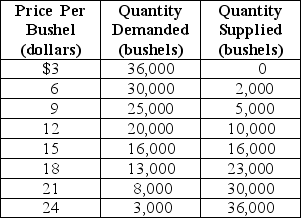 Table 4-5 above contains information about the wheat market.Answer the following questions based on this table.
-Refer to Table 4-5.An agricultural price floor is a price that the government guarantees farmers will receive for a particular crop.Suppose the federal government sets a price floor for wheat at $21 per bushel.
a.What is the amount of shortage or surplus in the wheat market as result of the price floor?
b.If the government agrees to purchase any surplus output at $21,how much will it cost the government?
c.If the government buys all of the farmers' output at the floor price,how many bushels of wheat will it have to purchase and how much will it cost the government?
d.Suppose the government buys up all of the farmers' output at the floor price and then sells the output to consumers at whatever price it can get.Under this scheme,what is the price at which the government will be able to sell off all of the output it had purchased from farmers? What is the revenue received from the government's sale?
e.In this problem we have considered two government schemes: (1)a price floor is established and the government purchases any excess output and (2)the government buys all the farmers' output at the floor price and resells at whatever price it can get.Which scheme will taxpayers prefer?
f.Consider again the two schemes.Which scheme will the farmers prefer?
g.Consider again the two schemes.Which scheme will wheat buyers prefer?
Table 4-5 above contains information about the wheat market.Answer the following questions based on this table.
-Refer to Table 4-5.An agricultural price floor is a price that the government guarantees farmers will receive for a particular crop.Suppose the federal government sets a price floor for wheat at $21 per bushel.
a.What is the amount of shortage or surplus in the wheat market as result of the price floor?
b.If the government agrees to purchase any surplus output at $21,how much will it cost the government?
c.If the government buys all of the farmers' output at the floor price,how many bushels of wheat will it have to purchase and how much will it cost the government?
d.Suppose the government buys up all of the farmers' output at the floor price and then sells the output to consumers at whatever price it can get.Under this scheme,what is the price at which the government will be able to sell off all of the output it had purchased from farmers? What is the revenue received from the government's sale?
e.In this problem we have considered two government schemes: (1)a price floor is established and the government purchases any excess output and (2)the government buys all the farmers' output at the floor price and resells at whatever price it can get.Which scheme will taxpayers prefer?
f.Consider again the two schemes.Which scheme will the farmers prefer?
g.Consider again the two schemes.Which scheme will wheat buyers prefer? (Essay)
4.9/5 (79)
(79) Figure 4-4
-Refer to Figure 4-4.The figure above represents the market for iced tea.Assume that this is a competitive market.If the price of iced tea is $3,what changes in the market would result in an economically efficient output?
-Refer to Figure 4-4.The figure above represents the market for iced tea.Assume that this is a competitive market.If the price of iced tea is $3,what changes in the market would result in an economically efficient output? (Multiple Choice)
4.9/5 (72)
(72) Figure 4-1 Figure 4-1 shows Kendra's demand curve for ice cream cones.
-Refer to Figure 4-1.If the market price is $2.50,what is the consumer surplus on the third ice cream cone?
Figure 4-1 shows Kendra's demand curve for ice cream cones.
-Refer to Figure 4-1.If the market price is $2.50,what is the consumer surplus on the third ice cream cone? (Multiple Choice)
4.8/5 (84)
(84) Figure 4-1 Figure 4-1 shows Kendra's demand curve for ice cream cones.
-Refer to Figure 4-1.What is the total amount that Kendra is willing to pay for 2 ice cream cones?
Figure 4-1 shows Kendra's demand curve for ice cream cones.
-Refer to Figure 4-1.What is the total amount that Kendra is willing to pay for 2 ice cream cones? (Multiple Choice)
4.7/5 (93)
(93) Figure 4-1 Figure 4-1 shows Kendra's demand curve for ice cream cones.
-Refer to Figure 4-1.If the market price is $3.50,what is the maximum number of ice cream cones that Kendra will buy?
Figure 4-1 shows Kendra's demand curve for ice cream cones.
-Refer to Figure 4-1.If the market price is $3.50,what is the maximum number of ice cream cones that Kendra will buy? (Multiple Choice)
4.9/5 (86)
(86) The market price for coffee is $2.25 per cup.Austin is willing to pay $5.00 per cup,Colin is willing to pay $4.00 per cup,Lucy is willing to pay $3.00 per cup,and Ike is willing to pay $2.00 per cup.Construct a graph showing the consumer surplus for each cup of coffee purchased.How many cups of coffee will be purchased? What is the value of the consumer surplus each of the four consumers receives from their coffee purchases?
(Essay)
4.8/5 (86)
(86) Figure 4-1 Figure 4-1 shows Kendra's demand curve for ice cream cones.
-Refer to Figure 4-1.If the market price is $2.50,what is the consumer surplus on the first ice cream cone?
Figure 4-1 shows Kendra's demand curve for ice cream cones.
-Refer to Figure 4-1.If the market price is $2.50,what is the consumer surplus on the first ice cream cone? (Multiple Choice)
4.8/5 (76)
(76) In a competitive market the ________ curve shows the marginal benefit received by consumers and the ________ curve shows the marginal cost to producers.
(Multiple Choice)
4.7/5 (81)
(81) If the price of toothpaste is represented by equation P = 40 - .5QD,then the corresponding quantity of toothpaste demanded is represented by the equation
(Multiple Choice)
4.8/5 (77)
(77) 
Filters
- Essay(0)
- Multiple Choice(0)
- Short Answer(0)
- True False(0)
- Matching(0)