



 Chat with AI
Exam 2: Trade-Offs, Comparative Advantage, and the Market System

Exam 1: Economics: Foundations and Models219 Questions
Exam 2: Trade-Offs, Comparative Advantage, and the Market System236 Questions
Exam 3: Where Prices Come From: The Interaction of Demand and Supply234 Questions
Exam 4: Economic Efficiency, Government Price Setting, and Taxes212 Questions
Exam 5: The Economics of Health Care166 Questions
Exam 6: Firms, the Stock Market, and Corporate Governance251 Questions
Exam 7: Comparative Advantage and the Gains From International Trade188 Questions
Exam 8: GDP: Measuring Total Production and Income260 Questions
Exam 9: Unemployment and Inflation289 Questions
Exam 10: Economic Growth, the Financial System, and Business Cycles251 Questions
Exam 11: Long-Run Economic Growth: Sources and Policies261 Questions
Exam 12: Aggregate Expenditure and Output in the Short Run304 Questions
Exam 13: Aggregate Demand and Aggregate Supply Analysis284 Questions
Exam 14: Money,Banks,and the Federal Reserve System276 Questions
Exam 15: Monetary Policy278 Questions
Exam 16: Fiscal Policy313 Questions
Exam 17: Inflation, Unemployment, and Federal Reserve Policy257 Questions
Exam 18: Macroeconomics in an Open Economy277 Questions
Exam 19: The International Financial System256 Questions
Select questions type


Carmelita can perform either a combination of 35 manicures and 70 pedicures or a combination of 50 manicures and 45 pedicures.If she now performs 35 manicures and 70 pedicures,what is the opportunity cost of performing an additional 15 manicures?
(Multiple Choice)
4.8/5  (81)
(81) Figure 2-9 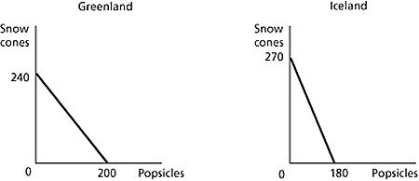 Figure 2-9 shows the production possibilities frontiers for Greenland and Iceland.Each country produces two goods,snow cones and popsicles.
-Refer to Figure 2-9.Which country has a comparative advantage in the production of popsicles?
Figure 2-9 shows the production possibilities frontiers for Greenland and Iceland.Each country produces two goods,snow cones and popsicles.
-Refer to Figure 2-9.Which country has a comparative advantage in the production of popsicles? (Multiple Choice)
5.0/5 (73)
(73) Table 2-6
 Table 2-6 shows the output per week of two people,James and Lucy.They can either devote their time to making wagons or making tricycles.
-Refer to Table 2-6.What is Lucy's opportunity cost of making a wagon?
Table 2-6 shows the output per week of two people,James and Lucy.They can either devote their time to making wagons or making tricycles.
-Refer to Table 2-6.What is Lucy's opportunity cost of making a wagon? (Multiple Choice)
4.8/5 (61)
(61) Figure 2-4 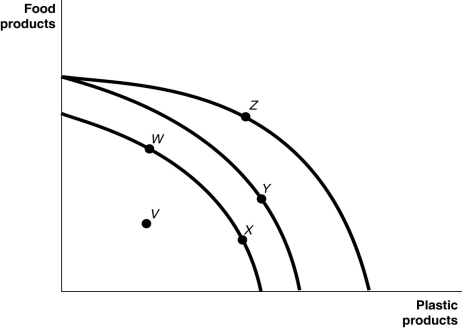 Figure 2-4 shows various points on three different production possibilities frontiers for a nation.
-Refer to Figure 2-4.Consider the following movements: a.from point V to point W
B.from point W to point Y
C.from point Y to point Z
Which of the movements listed above represents advancements in technology with respect to both plastic production and food production?
Figure 2-4 shows various points on three different production possibilities frontiers for a nation.
-Refer to Figure 2-4.Consider the following movements: a.from point V to point W
B.from point W to point Y
C.from point Y to point Z
Which of the movements listed above represents advancements in technology with respect to both plastic production and food production? (Multiple Choice)
4.8/5 (92)
(92) Table 2-9
 Table 2-9 shows the number of labor hours required to produce a wristwatch and a pound of rice in Japan and Thailand.
-Refer to Table 2-9.What is Japan's opportunity cost of producing one pound of rice?
Table 2-9 shows the number of labor hours required to produce a wristwatch and a pound of rice in Japan and Thailand.
-Refer to Table 2-9.What is Japan's opportunity cost of producing one pound of rice? (Multiple Choice)
4.9/5 (73)
(73) Horatio can produce either a combination of 15 bird houses and 25 wind chimes or a combination of 30 bird houses and 15 wind chimes.If he now produces 30 bird houses and 15 wind chimes,what is the opportunity cost of producing an additional 10 wind chimes?
(Multiple Choice)
4.8/5 (77)
(77) Figure 2-1  -Refer to Figure 2-1.________ is (are)unattainable with current resources.
 (Multiple Choice)
4.8/5 (74)
(74) The slope of a production possibilities frontier measures the ________ of producing one more unit of a good.
(Multiple Choice)
4.8/5 (62)
(62) ________ exists because unlimited wants exceed the limited resources available to fulfill those wants.
(Multiple Choice)
5.0/5 (75)
(75) Figure 2-2  Figure 2-2 above shows the production possibilities frontier for Vidalia,a nation that produces two goods,roses and orchids.
-Refer to Figure 2-2.If Vidalia chooses to produce 80 dozen roses,how many orchids can it produce to maximize production?
Figure 2-2 above shows the production possibilities frontier for Vidalia,a nation that produces two goods,roses and orchids.
-Refer to Figure 2-2.If Vidalia chooses to produce 80 dozen roses,how many orchids can it produce to maximize production? (Multiple Choice)
4.9/5 (83)
(83) Which of the following statements about an entrepreneur is true?
(Multiple Choice)
4.8/5 (85)
(85) If additional units of a good could be produced at a constant opportunity cost,the production possibilities frontier would be linear.
(True/False)
4.8/5 (82)
(82) Table 2-8
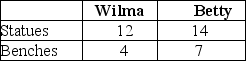 Table 2-8 shows the output per month of two people,Wilma and Betty.They can either devote their time to making marble statues or making marble benches.
-Refer to Table 2-8.What is Betty's opportunity cost of making a bench?
Table 2-8 shows the output per month of two people,Wilma and Betty.They can either devote their time to making marble statues or making marble benches.
-Refer to Table 2-8.What is Betty's opportunity cost of making a bench? (Multiple Choice)
4.8/5 (71)
(71) It is not possible to have a comparative advantage in producing a good or service without having an absolute advantage.
(True/False)
4.9/5 (64)
(64) Table 2-7
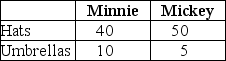 Table 2-7 shows the output per week of two people,Minnie and Mickey.They can either devote their time to making hats or making umbrellas.
-Refer to Table 2-7.What is Minnie's opportunity cost of making an umbrella?
Table 2-7 shows the output per week of two people,Minnie and Mickey.They can either devote their time to making hats or making umbrellas.
-Refer to Table 2-7.What is Minnie's opportunity cost of making an umbrella? (Multiple Choice)
4.9/5 (79)
(79) Consider a country that produces only two goods: bird feeders and binoculars.Suppose it is possible for this country to increase its production of bird feeders without producing fewer binoculars.In this case,its current output combination is inefficient.
(True/False)
4.9/5 (72)
(72) Article Summary
Two U.S.Senators have introduced a bipartisan bill to strengthen patent protection in the United States.The STRONGER Patents Act,designed to improve the patent system,includes provisions which would permit injunctions to protect patent owners against infringement both during and after court cases and guarantee fairness in administrative proceedings by limiting repetitive and harassing challenges against inventors.Changes over the last decade have lessened some U.S.patent rights,while countries such as China and Germany have moved to strengthen their own patent protections.In 2016,the United States fell to 10th place in the U.S.Chamber of Commerce's international ranking of patent system strength.
Source: Brian Pomper,"Senators Coons and Cotton Introduce STRONGER Patents Act of 2017," ipwatchdog.com,June 21,2017.
-Refer to the Article Summary.If the STRONGER patents Act of 2017 does not become law and patent protection in the United States continues to fall further behind patent protection in other countries,which of the following would most likely occur in the United States?
(Multiple Choice)
4.9/5 (85)
(85) Figure 2-6  -Refer to Figure 2-6.If the economy is currently producing at point E,what is the gain in production if the economy moves to point D?
 (Multiple Choice)
4.8/5 (62)
(62) 
Filters
- Essay(0)
- Multiple Choice(0)
- Short Answer(0)
- True False(0)
- Matching(0)