



 Chat with AI
Exam 3: Biological Basis for Understanding Psychotropic Drugs

Exam 1: Mental Health and Mental Illness28 Questions
Exam 2: Relevant Theories and Therapies for Nursing Practice31 Questions
Exam 3: Biological Basis for Understanding Psychotropic Drugs35 Questions
Exam 4: Psychiatric Mental Health Nursing in Acute Care Settings25 Questions
Exam 5: Psychiatric Mental Health Nursing in Community Settings25 Questions
Exam 6: Cultural Implications for Psychiatric Mental Health Nursing37 Questions
Exam 7: Legal and Ethical Guidelines for Safe Practice29 Questions
Exam 8: The Nursing Process and Standards of Care for Psychiatric Mental Health Nursing29 Questions
Exam 9: Therapeutic Relationships32 Questions
Exam 10: Communication and the Clinical Interview33 Questions
Exam 11: Understanding Responses to Stress19 Questions
Exam 12: Anxiety and Anxiety Disorders52 Questions
Exam 13: Depressive Disorders36 Questions
Exam 14: Bipolar Disorders40 Questions
Exam 15: Schizophrenia40 Questions
Exam 16: Eating Disorders32 Questions
Exam 17: Cognitive Disorders34 Questions
Exam 18: Addictive Disorders35 Questions
Exam 19: Personality Disorders33 Questions
Exam 20: Sleep Disorders27 Questions
Exam 21: Sexual Dysfunction and Sexual Disorders19 Questions
Exam 22: Somatoform, Factitious, and Dissociative Disorders28 Questions
Exam 23: Crisis and Disaster27 Questions
Exam 24: Suicide31 Questions
Exam 25: Anger, Aggression, and Violence28 Questions
Exam 26: Child, Older Adult, and Intimate Partner Abuse26 Questions
Exam 27: Sexual Assault24 Questions
Exam 28: Disorders of Children and Adolescents36 Questions
Exam 29: Psychosocial Needs of the Older Adult28 Questions
Exam 30: Serious Mental Illness19 Questions
Exam 31: Psychological Needs of Patients With Medical Conditions19 Questions
Exam 32: Care for the Dying and for Those Who Grieve34 Questions
Exam 33: Forensic Psychiatric Nursing19 Questions
Exam 34: Therapeutic Groups26 Questions
Exam 35: Family Interventions16 Questions
Exam 36: Integrative Care20 Questions
Select questions type


The parent of an adolescent with schizophrenia asks the nurse,"My child's doctor ordered a PET.What kind of test is that?" Select the nurse's best reply.

Free
(Multiple Choice)
4.8/5  (77)
(77) Correct Answer: Verified
B
A patient tells the nurse,"My doctor prescribed Paxil (paroxetine)for my depression.I assume I'll have side effects like I had when I was taking Tofranil (imipramine)." The nurse's reply should be based on the knowledge that paroxetine is a:
Free
(Multiple Choice)
4.7/5 (89)
(89) Correct Answer:Verified
VerifiedA
A patient with bipolar disorder has an unstable mood,aggressiveness,agitation,talkativeness,and irritability.The nurse begins care planning based on the expectation that the health care provider is most likely to prescribe a medication classified as a(n):
Free
(Multiple Choice)
5.0/5 (82)
(82) Correct Answer:Verified
VerifiedB
A patient has acute anxiety related to an automobile accident 2 hours ago.The patient needs teaching about drugs from which group?
(Multiple Choice)
5.0/5 (77)
(77) A nurse could anticipate that treatment for a patient with memory difficulties might include medications designed to:
(Multiple Choice)
4.9/5 (74)
(74) A nurse can anticipate anticholinergic side effects are likely when a patient takes:
(Multiple Choice)
4.7/5 (90)
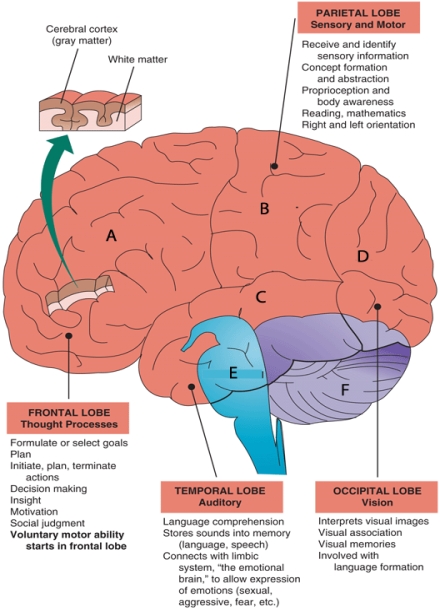
(90) A patient has difficulty with mathematical calculations.Which area of the brain is most likely involved with this problem?
(Multiple Choice)
4.9/5 (97)
(97) A patient has disorganized thinking associated with schizophrenia.Neuroimaging would most likely show dysfunction in which part of the brain?
(Multiple Choice)
4.9/5 (83)
(83) The nurse administers a medication that potentiates the action of GABA.Which effect would be expected?
(Multiple Choice)
4.9/5 (72)
(72) A patient is hospitalized for severe depression.Of the medications listed below,the nurse can expect to provide the patient with teaching about:
(Multiple Choice)
4.9/5 (90)
(90) The nurse wants to assess a patient with major depression for disturbances in circadian rhythms.Select the best question for this aspect of the assessment.
(Multiple Choice)
5.0/5 (52)
(52) A nurse assesses that a patient has fear as well as increased heart rate and blood pressure.The nurse suspects increased activity of which neurotransmitter?
(Multiple Choice)
4.8/5 (89)
(89) A patient begins therapy with a phenothiazine medication.What teaching should the nurse provide related to the drug's strong dopaminergic effect?
(Multiple Choice)
4.8/5 (72)
(72) A category 5 hurricane is approaching.Which change in an individual's vital signs is most likely?
(Multiple Choice)
4.9/5 (72)
(72) Which instruction has priority when teaching a patient taking clozapine (Clozaril)?
(Multiple Choice)
4.9/5 (84)
(84) A nurse cares for four patients who are receiving clozapine,lithium,fluoxetine,and venlafaxine,respectively.With which patient should the nurse be most alert for alterations in cardiac or cerebral electrical conductivity and fluid and electrolyte imbalance? The patient receiving:
(Multiple Choice)
4.8/5 (78)
(78) A nurse cares for patients taking various medications,including buspirone (BuSpar),haloperidol (Haldol),carbamazepine (Tegretol),trazodone (Desyrel),and phenelzine (Nardil).The nurse will order a special diet for the patient who takes:
(Multiple Choice)
4.8/5 (92)
(92) A nurse caring for a patient taking an SSRI will develop outcome criteria related to:
(Multiple Choice)
4.7/5 (71)
(71) Consider these medications: carbamazepine (Tegretol),lamotrigine (Lamictal),gabapentin (Neurontin).Which medication below also belongs with this group?
(Multiple Choice)
5.0/5 (75)
(75) An obese patient has schizophrenia.Medications that block which receptors would contribute to further weight gain?
(Multiple Choice)
4.9/5 (85)
(85) 
Filters
- Essay(0)
- Multiple Choice(0)
- Short Answer(0)
- True False(0)
- Matching(0)