



 Chat with AI
Exam 18: Externalities, Open-Access, and Public Goods

Exam 1: Introduction50 Questions
Exam 2: Supply and Demand141 Questions
Exam 3: Applying the Supply and Demand Model114 Questions
Exam 4: Consumer Choice115 Questions
Exam 5: Applying Consumer Theory108 Questions
Exam 6: Firms and Production117 Questions
Exam 7: Costs114 Questions
Exam 8: Competitive Firms and Markets117 Questions
Exam 9: Applying the Competitive Model146 Questions
Exam 10: General Equilibrium and Economic Welfare112 Questions
Exam 11: Monopoly138 Questions
Exam 12: Pricing and Advertising125 Questions
Exam 13: Oligopoly and Monopolistic Competition118 Questions
Exam 14: Game Theory99 Questions
Exam 15: Factor Markets93 Questions
Exam 16: Interest Rates, Investments, and Capital Markets110 Questions
Exam 17: Uncertainty112 Questions
Exam 18: Externalities, Open-Access, and Public Goods113 Questions
Exam 19: Asymmetric Information109 Questions
Exam 20: Contracts and Moral Hazards97 Questions
Select questions type


Markets tend to produce too little of an excludable public good because
(Multiple Choice)
4.8/5  (75)
(75) Fishermen on the East Coast are using lobster traps out of which most of the lobsters that enter can escape.Why?
(Multiple Choice)
4.8/5 (86)
(86) Explain how a specific tax equal to the marginal harm of pollution can increase or decrease total welfare in a monopoly market.
(Essay)
4.9/5 (97)
(97) 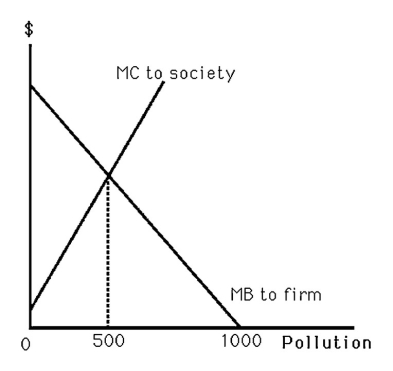 -The above figure shows the marginal benefit to a firm of polluting in the local river while producing its output,and the marginal cost to the firm's neighbor.The marginal cost of production is zero for the firm.If there is just one neighbor who owns the river,how much pollution is likely to occur?
 (Multiple Choice)
5.0/5 (86)
(86) When majority rule voting is used to determine whether to purchase a public good,
(Multiple Choice)
4.9/5 (80)
(80) 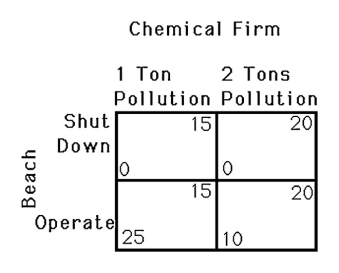 -The above figure shows the payoff matrix for two firms.A chemical firm must choose between a low level of production which yields one ton of pollution into a nearby lake and a high level of production which yields two tons of pollution into the nearby lake.A private beach on the lake must decide whether to operate or not.Increased pollution reduces the number of people who wish to visit the beach.Determine the Nash equilibrium without property rights.
 (Essay)
4.8/5 (89)
(89) A tax on a previously untaxed monopoly-produced good will necessarily lower total welfare if
(Multiple Choice)
4.9/5 (76)
(76)
-The above figure shows the marginal benefit to a firm of polluting in the local river while producing its output,and the marginal cost to the surrounding neighbors.The marginal cost of production is zero for the firm.If property rights are not defined,how much pollution will occur?
-The above figure shows the marginal benefit to a firm of polluting in the local river while producing its output,and the marginal cost to the surrounding neighbors.The marginal cost of production is zero for the firm.If property rights are not defined,how much pollution will occur? (Multiple Choice)
4.9/5 (80)
(80) In the presence of a negative externality in production,a monopoly will produce
(Multiple Choice)
5.0/5 (79)
(79) If children go to school and become productive members of society,
(Multiple Choice)
4.9/5 (70)
(70) In terms of cost-benefit analysis,explain why a competitive market with an externality produces too much pollution.
(Essay)
4.8/5 (77)
(77) 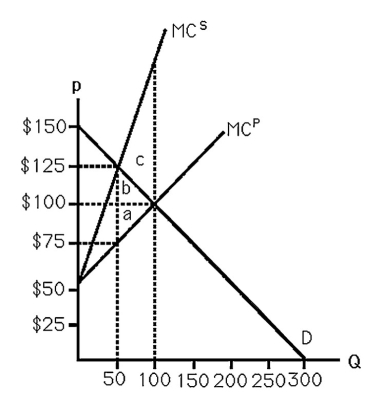 -The above figure shows the market for steel ingots.If the market is competitive,then to achieve the socially optimal level of pollution,the government can
 (Multiple Choice)
4.9/5 (76)
(76)
-The above figure shows the marginal benefit to a firm of polluting in the local river while producing its output,and the marginal cost to the surrounding neighbors.The marginal cost of production is zero for the firm.According to Coase's Theorem,which of the following scenarios is most likely to lead to the socially optimal level of pollution?
-The above figure shows the marginal benefit to a firm of polluting in the local river while producing its output,and the marginal cost to the surrounding neighbors.The marginal cost of production is zero for the firm.According to Coase's Theorem,which of the following scenarios is most likely to lead to the socially optimal level of pollution? (Multiple Choice)
4.9/5 (76)
(76) 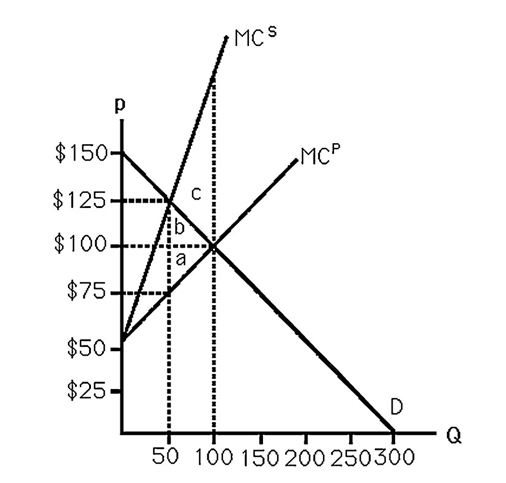 -The above figure shows the market for steel ingots.The socially optimal quantity of steel is
 (Multiple Choice)
5.0/5 (91)
(91) What is one reason drunk driving is held in such disrepute?
(Multiple Choice)
4.9/5 (79)
(79) 
Filters
- Essay(0)
- Multiple Choice(0)
- Short Answer(0)
- True False(0)
- Matching(0)