



 Chat with AI
Exam 12: Pricing and Advertising

Exam 1: Introduction50 Questions
Exam 2: Supply and Demand141 Questions
Exam 3: Applying the Supply and Demand Model114 Questions
Exam 4: Consumer Choice115 Questions
Exam 5: Applying Consumer Theory108 Questions
Exam 6: Firms and Production117 Questions
Exam 7: Costs114 Questions
Exam 8: Competitive Firms and Markets117 Questions
Exam 9: Applying the Competitive Model146 Questions
Exam 10: General Equilibrium and Economic Welfare112 Questions
Exam 11: Monopoly138 Questions
Exam 12: Pricing and Advertising125 Questions
Exam 13: Oligopoly and Monopolistic Competition118 Questions
Exam 14: Game Theory99 Questions
Exam 15: Factor Markets93 Questions
Exam 16: Interest Rates, Investments, and Capital Markets110 Questions
Exam 17: Uncertainty112 Questions
Exam 18: Externalities, Open-Access, and Public Goods113 Questions
Exam 19: Asymmetric Information109 Questions
Exam 20: Contracts and Moral Hazards97 Questions
Select questions type


A monopoly faces the following demand function: Q = 100 - p + sqrt(A),where A equals the dollar amount spent on advertising.If the cost function is A + 10 + 2Q,what are the profit-maximizing levels of price,output,and advertising? Compare this outcome to the case where the firm does not advertise at all.
(Essay)
4.9/5  (77)
(77) Explain why a firm can earn more profit by price discrimination than from setting a uniform price.
(Essay)
4.8/5 (69)
(69) If the price of business broadband is greater than that of residential broadband,all else equal,
(Multiple Choice)
4.9/5 (81)
(81) Which of the following is an example for group price discrimination?
(Multiple Choice)
4.8/5 (66)
(66) Suppose all individuals are identical,and their monthly demand for Internet access from a certain leading provider can be represented as p = 5 - (1/2)q where p is price in $ per hour and q is hours per month.The firm faces a constant marginal cost of $1.Potential consumer surplus equals
(Multiple Choice)
4.8/5 (81)
(81) A perfect price discriminator receives a price equal to marginal revenue for each unit.
(True/False)
4.8/5 (77)
(77) 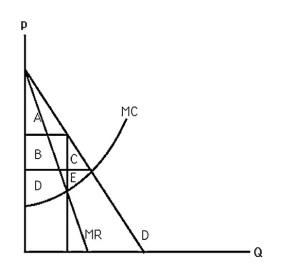 -The above figure shows the market for a particular good.If the market is controlled by a perfect-price-discriminating monopoly,consumer surplus equals
 (Multiple Choice)
4.9/5 (82)
(82) 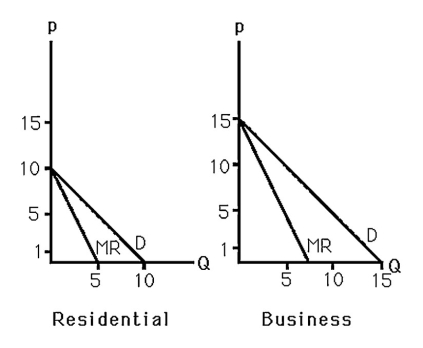 -Bob is the only carpet installer in a small isolated town.The above figure shows the demand curves of two distinct groups of customers-residential and business.If the marginal cost of installing carpet is a constant $1 per sq yard,what price does Bob charge each segment?
 (Multiple Choice)
4.8/5 (75)
(75) If somebody posing as a vacationer were able to purchase large numbers of airline tickets from the airlines and later resell them to business travelers,
(Multiple Choice)
4.8/5 (83)
(83) A hotel with market power charges customers who check in before 5:00 pm more than those who check in after 5:00 pm.Those who check in early are much more likely to use the hotel's pool.Explain why this price difference may not be price discrimination.
(Essay)
4.9/5 (88)
(88) When a firm uses a form of quantity discrimination that charges large purchasers less it is the high quantity purchasers that generate most profit.
(True/False)
4.7/5 (83)
(83) Under what conditions would firms be likely to support an industry-wide advertising ban?
(Essay)
4.9/5 (78)
(78) Two-part tariffs allow the monopoly firm to capture all of the potential consumer surplus generated by the sale of its product.
(True/False)
5.0/5 (78)
(78) If two markets have the same price elasticity of demand at every price,a monopoly will not practice multimarket price discrimination.
(True/False)
4.8/5 (69)
(69) If Ben values good X more than good Y,and Catherine values good Y more than good X,a firm can increase its profits by
(Multiple Choice)
4.9/5 (81)
(81) A mail-order clothing company offers a discount if customers purchase two shirts instead of only one.This is necessarily an example of quantity discrimination.
(True/False)
4.8/5 (82)
(82) 
Filters
- Essay(0)
- Multiple Choice(0)
- Short Answer(0)
- True False(0)
- Matching(0)