



 Chat with AI
Exam 11: Monopoly

Exam 1: Introduction50 Questions
Exam 2: Supply and Demand141 Questions
Exam 3: Applying the Supply and Demand Model114 Questions
Exam 4: Consumer Choice115 Questions
Exam 5: Applying Consumer Theory108 Questions
Exam 6: Firms and Production117 Questions
Exam 7: Costs114 Questions
Exam 8: Competitive Firms and Markets117 Questions
Exam 9: Applying the Competitive Model146 Questions
Exam 10: General Equilibrium and Economic Welfare112 Questions
Exam 11: Monopoly138 Questions
Exam 12: Pricing and Advertising125 Questions
Exam 13: Oligopoly and Monopolistic Competition118 Questions
Exam 14: Game Theory99 Questions
Exam 15: Factor Markets93 Questions
Exam 16: Interest Rates, Investments, and Capital Markets110 Questions
Exam 17: Uncertainty112 Questions
Exam 18: Externalities, Open-Access, and Public Goods113 Questions
Exam 19: Asymmetric Information109 Questions
Exam 20: Contracts and Moral Hazards97 Questions
Select questions type


What is one problem with trying to regulate a monopoly's price?
(Multiple Choice)
4.8/5  (71)
(71) A monopoly faces an inverse demand curve of P = 100 - 2Q.The marginal cost curve is MC = .5Q.What government price ceiling would represent optimal price regulation?
(Essay)
4.9/5 (73)
(73) Which of the following DOES NOT contribute to the market power of a firm?
(Multiple Choice)
4.8/5 (87)
(87) 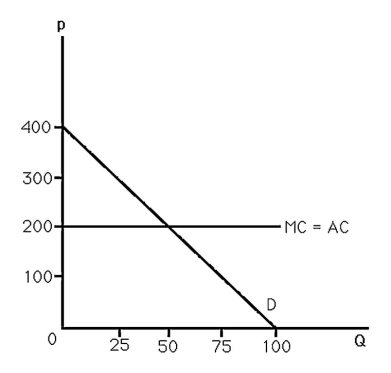 -The above figure shows the demand and cost curves facing a monopoly.A $100 per unit tax would raise price by
 (Multiple Choice)
4.8/5 (97)
(97) Why is the monopoly total welfare lower than the competitive total welfare?
(Essay)
4.9/5 (68)
(68) A monopolist changes price from $1 to $2 and sells 10 fewer units.The marginal revenue is
(Multiple Choice)
4.8/5 (89)
(89) The average cost for a typical electric-power-production firm is AC = 100 - 10Q + Q2 where Q is measured in billion kilowatt hours per day.At the current regulated price,consumers demand 4 billion kilowatt hours per day.Is this market a natural monopoly? If demand increases to 10 billion kilowatt hours,is this market a natural monopoly? Explain.
(Essay)
4.8/5 (69)
(69) If the inverse demand curve a monopoly faces is p = 100 - 2Q,and MC is constant at 16,then profit maximization is achieved when the monopoly sets price equal to
(Multiple Choice)
4.8/5 (87)
(87) If the demand for a monopoly's output shifts rightward,the change in quantity produced is not predictable because
(Multiple Choice)
4.9/5 (83)
(83) If a monopoly can produce a good at zero marginal cost,then its Lerner Index is
(Multiple Choice)
4.8/5 (68)
(68) Since there are no close substitutes for the monopoly's product,the monopoly can charge any price it wishes.
(True/False)
4.8/5 (94)
(94) The existence of a deadweight loss associated with a monopoly can be seen because
(Multiple Choice)
4.8/5 (80)
(80) When attempting price regulation,a government faces what problem(s)?
(Multiple Choice)
4.9/5 (78)
(78) If the government regulates the price a monopoly can charge,and the price ceiling is set below what the competitive market price would be,then
(Multiple Choice)
5.0/5 (72)
(72) When generic drugs enter the market after the patent for a brand name drug expires,the price of the brand name drug often increases.This is usually due to
(Multiple Choice)
4.9/5 (83)
(83) 
Filters
- Essay(0)
- Multiple Choice(0)
- Short Answer(0)
- True False(0)
- Matching(0)