



 Chat with AI
Exam 15: The Influence of Monetary and Fiscal Policy on Aggregate Demand

Exam 1: Ten Principles of Economics205 Questions
Exam 2: Thinking Like an Economist230 Questions
Exam 3: Interdependence and the Gains From Trade200 Questions
Exam 4: The Market Forces of Supply and Demand303 Questions
Exam 5: Measuring a Nations Income168 Questions
Exam 6: Measuring the Cost of Living176 Questions
Exam 7: Production and Growth185 Questions
Exam 8: Saving, Investment, and the Financial System208 Questions
Exam 9: Unemployment and Its Natural Rate186 Questions
Exam 10: The Monetary System196 Questions
Exam 11: Money Growth and Inflation193 Questions
Exam 12: Open-Economy Macroeconomics: Basic Concepts215 Questions
Exam 13: A Macroeconomic Theory of the Open Economy184 Questions
Exam 14: Aggregate Demand and Aggregate Supply241 Questions
Exam 15: The Influence of Monetary and Fiscal Policy on Aggregate Demand219 Questions
Exam 16: The Short-Run Tradeoff Between Inflation and Unemployment203 Questions
Exam 17: Five Debates Over Macroeconomic Policy118 Questions
Select questions type


The most important lag for monetary policy is the time it takes to formulate policy, while the most important lag for fiscal policy is the time it takes for the economy to respond to changes in government spending.
(True/False)
4.9/5  (86)
(86) Which of the following properly describes the interest rate effect?
(Multiple Choice)
4.7/5 (73)
(73) In a small open economy with perfect capital mobility, if the Bank of Canada chooses to fix the value of the Canadian dollar, what will a contractionary monetary policy do?
(Multiple Choice)
4.8/5 (71)
(71) If the federal government cuts spending to balance the federal budget, how can the Bank of Canada act to prevent unemployment and recession while maintaining the balanced budget?
(Multiple Choice)
4.8/5 (80)
(80) If at some interest rate the quantity of money demanded is greater than the quantity of money supplied, what will people desire to do and what will happen to the interest rate?
(Multiple Choice)
4.7/5 (71)
(71) In recent years, the Bank of Canada has conducted policy by setting a target for which of the following?
(Multiple Choice)
4.8/5 (82)
(82) Which of the following illustrates how the investment accelerator works?
(Multiple Choice)
4.9/5 (67)
(67) According to the theory of liquidity preference, what does a decrease in the price level cause the interest rate and investment to do?
(Multiple Choice)
4.9/5 (80)
(80) Explain why the interest rate is the opportunity cost of holding currency. What is the benefit of holding currency?
(Essay)
4.8/5 (82)
(82) When the Bank of Canada increases the money supply, the interest rate decreases. This decrease in the interest rate increases consumption and investment demand so the aggregate demand curve shifts to the right.
(True/False)
4.7/5 (71)
(71) When the Bank of Canada decreases the money supply, what do we expect to happen to interest rates and stock prices?
(Multiple Choice)
4.8/5 (84)
(84) If at some interest rate the quantity of money supplied is greater than the quantity of money demanded, what will people desire to do and what happens to the interest rate?
(Multiple Choice)
4.8/5 (89)
(89) Which of the following tends to make the size of a shift in aggregate demand resulting from a tax change smaller than otherwise?
(Multiple Choice)
4.9/5 (79)
(79) How does an automatic stabilizer interfere with fiscal policy? Discuss possible positive and negative effects.
(Essay)
4.8/5 (81)
(81) Which of the following best defines the multiplier effect?
(Multiple Choice)
4.9/5 (74)
(74) Assuming the multiplier effect but no crowding-out or investment-accelerator effects, what is the effect of a $300 billion increase in government expenditures on the aggregate demand or supply?
(Multiple Choice)
4.9/5 (82)
(82) For the following questions, consult the diagram below.
Figure 15-2 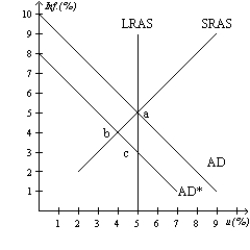 -Refer to Figure 15-2. In a closed economy, which of the following would cause the aggregate demand curve to shift from AD to AD*?
 (Multiple Choice)
5.0/5 (78)
(78) 
Filters
- Essay(0)
- Multiple Choice(0)
- Short Answer(0)
- True False(0)
- Matching(0)