



 Chat with AI
Exam 12: Open-Economy Macroeconomics: Basic Concepts

Exam 1: Ten Principles of Economics205 Questions
Exam 2: Thinking Like an Economist230 Questions
Exam 3: Interdependence and the Gains From Trade200 Questions
Exam 4: The Market Forces of Supply and Demand303 Questions
Exam 5: Measuring a Nations Income168 Questions
Exam 6: Measuring the Cost of Living176 Questions
Exam 7: Production and Growth185 Questions
Exam 8: Saving, Investment, and the Financial System208 Questions
Exam 9: Unemployment and Its Natural Rate186 Questions
Exam 10: The Monetary System196 Questions
Exam 11: Money Growth and Inflation193 Questions
Exam 12: Open-Economy Macroeconomics: Basic Concepts215 Questions
Exam 13: A Macroeconomic Theory of the Open Economy184 Questions
Exam 14: Aggregate Demand and Aggregate Supply241 Questions
Exam 15: The Influence of Monetary and Fiscal Policy on Aggregate Demand219 Questions
Exam 16: The Short-Run Tradeoff Between Inflation and Unemployment203 Questions
Exam 17: Five Debates Over Macroeconomic Policy118 Questions
Select questions type


If Canada buys cameras from Japan, both Canadian net exports and Canadian net capital outflow decrease.
(True/False)
4.8/5  (75)
(75) A country has $150 million of net exports and $190 million of saving. What is net capital outflow?
(Multiple Choice)
4.8/5 (87)
(87) Suppose that money supply growth continues to be higher in Turkey than it is in Canada. What does purchasing-power parity imply will happen to the real and to the nominal exchange rate?
(Essay)
4.8/5 (80)
(80) Suppose a lobster supper in Nova Scotia costs fewer dollars than a lobster supper in Moscow. Explain why this is inconsistent with purchasing-power parity and explain why the inconsistency may exist.
(Essay)
4.9/5 (79)
(79) Which of the following best describes net capital outflow in Canada from 1961 to about 1998?
(Multiple Choice)
4.8/5 (93)
(93) If the purchasing power of the dollar is always the same at home and abroad, then the nominal exchange rate defined as foreign goods per unit of Canadian goods decreases if the Canadian price level rises more than the price level in foreign countries.
(True/False)
4.9/5 (77)
(77) Which of the following best describes Canadian net capital outflow and net exports since 1999?
(Multiple Choice)
4.9/5 (95)
(95) According to purchasing-power parity theory, the real exchange rate should equal the nominal exchange rate.
(True/False)
5.0/5 (80)
(80) Suppose the price level in Canada (P) and the nominal exchange rate (e) between the Canadian dollar and the foreign currency remain the same, while the price level abroad increases from P1* to P2*. Let the real exchange rate be X. What is the percentage change in the real exchange rate?
(Essay)
5.0/5 (79)
(79) A firm in India sells jackets to a Canadian department store chain. Which of the following correctly identifies the effects of this transaction?
(Multiple Choice)
4.9/5 (73)
(73) Sue, a Canadian citizen, buys stock in a French chain of boutiques. Her purchase counts as which of the following?
(Multiple Choice)
4.7/5 (86)
(86) Table 31-1
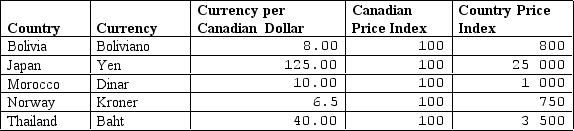 -Refer to Table 31-1. Which currency (ies) is (are) more valuable than predicted by the doctrine of purchasing-power parity?
 (Multiple Choice)
5.0/5 (81)
(81) How do we find the real exchange rate from the nominal exchange rate?
(Essay)
4.9/5 (83)
(83) If the exchange rate changes from 40 Thai baht per dollar to 35 Thai baht per dollar, what has happened to the dollar?
(Multiple Choice)
4.7/5 (74)
(74) If the world real interest rate exceeds the Canadian real interest rate, what would Canadian savers most likely do?
(Multiple Choice)
4.8/5 (73)
(73) Which of the following would be Canadian foreign direct investment?
(Multiple Choice)
4.8/5 (80)
(80) Which of the following would a depreciation of the Canadian real exchange rate induce Canadian consumers to buy?
(Multiple Choice)
4.9/5 (72)
(72) 
Filters
- Essay(0)
- Multiple Choice(0)
- Short Answer(0)
- True False(0)
- Matching(0)