



 Chat with AI
Exam 11: Money Growth and Inflation

Exam 1: Ten Principles of Economics205 Questions
Exam 2: Thinking Like an Economist230 Questions
Exam 3: Interdependence and the Gains From Trade200 Questions
Exam 4: The Market Forces of Supply and Demand303 Questions
Exam 5: Measuring a Nations Income168 Questions
Exam 6: Measuring the Cost of Living176 Questions
Exam 7: Production and Growth185 Questions
Exam 8: Saving, Investment, and the Financial System208 Questions
Exam 9: Unemployment and Its Natural Rate186 Questions
Exam 10: The Monetary System196 Questions
Exam 11: Money Growth and Inflation193 Questions
Exam 12: Open-Economy Macroeconomics: Basic Concepts215 Questions
Exam 13: A Macroeconomic Theory of the Open Economy184 Questions
Exam 14: Aggregate Demand and Aggregate Supply241 Questions
Exam 15: The Influence of Monetary and Fiscal Policy on Aggregate Demand219 Questions
Exam 16: The Short-Run Tradeoff Between Inflation and Unemployment203 Questions
Exam 17: Five Debates Over Macroeconomic Policy118 Questions
Select questions type


In 2009, Canadian economic activity was reduced by approximately 2.5 percent. What would our money demand-money supply model predict would happen to prices if money supply and velocity would have remained constant? Did this happen in reality? (Hint: to answer this question, you will need to look for information about the inflation level in 2009.) If you have found that your prediction was not supported by data, why do you think this happened?
(Essay)
5.0/5  (83)
(83) Inflation distorts relative prices. What does this mean and why does it impose a cost on society?
(Essay)
4.9/5 (77)
(77) Which of the following best describes the impact of open-market purchases by the Bank of Canada?
(Multiple Choice)
4.9/5 (80)
(80) Assuming that velocity is stable, if real GDP grows by 10 percent this year, and if the money supply does not change this year, how does the price level change?
(Multiple Choice)
4.9/5 (77)
(77) The quantity theory implies that if output and velocity are constant, then a 50 percent increase in the money supply would lead to less than a 50 percent increase in the price level.
(True/False)
4.7/5 (71)
(71) Monica buys a bond for $750 and then sells it later for $950. Monica's gain is which of the following?
(Multiple Choice)
4.8/5 (80)
(80) Which of the following best describes the effect of printing money to finance government expenditures on the economy?
(Multiple Choice)
4.8/5 (87)
(87) Which of the following events in took place in the early 1920s in Germany?
(Multiple Choice)
4.8/5 (81)
(81) Which of the following inflation costs matter even if actual inflation and expected inflation are the same?
(Multiple Choice)
4.9/5 (84)
(84) According to the classical dichotomy, which of the following is influenced by monetary factors?
(Multiple Choice)
4.9/5 (81)
(81) Velocity in the country of Nemedia is always stable. In 2009, the money supply was $100 billion and real GDP was $300 billion. In 2010, the money supply increased by 10 percent, real GDP increased by 5 percent, and nominal GDP equalled $660 billion. By how much did the price level increase between 2009 and 2010?
(Multiple Choice)
4.9/5 (72)
(72) Using separate graphs, demonstrate what happens to the money supply, money demand, the value of money, and the price level if:
a.the Bank of Canada increases the money supply.
b.people decide to demand less money at each value of money.
(Essay)
4.8/5 (73)
(73) As the price level decreases, which of the following happens to the value of money?
(Multiple Choice)
4.9/5 (75)
(75) Which of the following are people required to report on income tax forms?
(Multiple Choice)
4.7/5 (66)
(66) Use the figure below for the following questions.
Figure 30-1 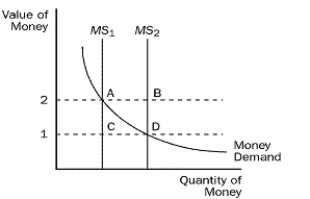 -Refer to Figure 30-1. If the current money supply is located at MS1 and the value of money is 2, what is the excess demand or supply?
 (Multiple Choice)
4.9/5 (80)
(80) When prices are falling, which of the following terms do economists use?
(Multiple Choice)
5.0/5 (73)
(73) In this problem we try to establish a link between the quantity equation, MdV = PY, and the money demand-money supply diagram (Md is the quantity of money demanded).
-Show in your graph how this curve changes when Y changes.
(Essay)
5.0/5 (77)
(77) You put money in an account that earns 6 percent. The inflation rate is 4 percent, and your marginal tax rate is 10 percent. Which of the following is your after-tax real rate of interest?
(Multiple Choice)
4.8/5 (81)
(81) 
Filters
- Essay(0)
- Multiple Choice(0)
- Short Answer(0)
- True False(0)
- Matching(0)