



 Chat with AI
Exam 8: Saving, Investment, and the Financial System

Exam 1: Ten Principles of Economics205 Questions
Exam 2: Thinking Like an Economist230 Questions
Exam 3: Interdependence and the Gains From Trade200 Questions
Exam 4: The Market Forces of Supply and Demand303 Questions
Exam 5: Measuring a Nations Income168 Questions
Exam 6: Measuring the Cost of Living176 Questions
Exam 7: Production and Growth185 Questions
Exam 8: Saving, Investment, and the Financial System208 Questions
Exam 9: Unemployment and Its Natural Rate186 Questions
Exam 10: The Monetary System196 Questions
Exam 11: Money Growth and Inflation193 Questions
Exam 12: Open-Economy Macroeconomics: Basic Concepts215 Questions
Exam 13: A Macroeconomic Theory of the Open Economy184 Questions
Exam 14: Aggregate Demand and Aggregate Supply241 Questions
Exam 15: The Influence of Monetary and Fiscal Policy on Aggregate Demand219 Questions
Exam 16: The Short-Run Tradeoff Between Inflation and Unemployment203 Questions
Exam 17: Five Debates Over Macroeconomic Policy118 Questions
Select questions type


You are required to testify before Parliament concerning the effects of an increase in the government surplus. Which of the following is the correct thing for you to say?
(Multiple Choice)
4.7/5  (74)
(74) Which of the following happens when a person buys shares in a mutual fund?
(Multiple Choice)
4.8/5 (77)
(77) Which of the following would most likely happen in the market for loanable funds if the government were to decrease the tax rate on interest income?
(Multiple Choice)
4.9/5 (72)
(72) Which of the following would a macroeconomist consider as investment?
(Multiple Choice)
4.9/5 (70)
(70) When the federal government is in debt, it follows that it has a deficit.
(True/False)
5.0/5 (79)
(79) If Parliament instituted an investment tax credit, the demand for loanable funds would shift right.
(True/False)
4.9/5 (93)
(93) Which of the following is a characteristic of the bond market?
(Multiple Choice)
4.9/5 (71)
(71) Suppose Microsoft sells a bond. What is the company doing?
(Multiple Choice)
4.9/5 (79)
(79) Which of the following people purchased the correct asset to meet their objective?
(Multiple Choice)
4.8/5 (95)
(95) Consider three different closed economies with the following national income statistics. Country A has taxes of $40 billion, transfers of $20 billion, and government expenditures on goods and services of $30 billion. Country B has private savings of $60 billion, and investment expenditures of $50 billion. Country C has GDP of $300 billion, investment of $70 billion, consumption of $180 billion, taxes of $60 billion, and transfers of $20 billion. Based on this information, which country has a $10 billion deficit?
(Multiple Choice)
4.9/5 (84)
(84) A decrease in taxes on interest income would increase the interest rate.
(True/False)
4.8/5 (82)
(82) If the government's expenditures exceeded its receipts, what would it most likely do?
(Multiple Choice)
4.8/5 (76)
(76) When will a change in the tax laws that increases the supply of loanable funds have a bigger effect on investment?
(Multiple Choice)
4.9/5 (82)
(82) Table 8-1
 -Refer to Table 8-1. In dollar terms, which company paid the highest dividend per share?
 (Multiple Choice)
4.8/5 (74)
(74) Table 8-2.
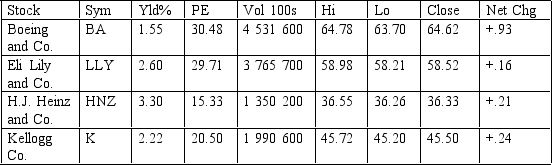 -Refer to Table 8-2. Which company had the highest dollar dividend?
 (Multiple Choice)
4.9/5 (75)
(75) Suppose the Canadian government allowed taxpayers to earn their first $5000 of interest free of income tax. How would this shift the supply of, or demand for, loanable funds?
(Multiple Choice)
4.9/5 (71)
(71) If Parliament reduced the tax rate on interest income, which of the following would most likely happen to investment and saving?
(Multiple Choice)
5.0/5 (87)
(87) 
Filters
- Essay(0)
- Multiple Choice(0)
- Short Answer(0)
- True False(0)
- Matching(0)