



 Chat with AI
Exam 4: The Market Forces of Supply and Demand

Exam 1: Ten Principles of Economics205 Questions
Exam 2: Thinking Like an Economist230 Questions
Exam 3: Interdependence and the Gains From Trade200 Questions
Exam 4: The Market Forces of Supply and Demand303 Questions
Exam 5: Measuring a Nations Income168 Questions
Exam 6: Measuring the Cost of Living176 Questions
Exam 7: Production and Growth185 Questions
Exam 8: Saving, Investment, and the Financial System208 Questions
Exam 9: Unemployment and Its Natural Rate186 Questions
Exam 10: The Monetary System196 Questions
Exam 11: Money Growth and Inflation193 Questions
Exam 12: Open-Economy Macroeconomics: Basic Concepts215 Questions
Exam 13: A Macroeconomic Theory of the Open Economy184 Questions
Exam 14: Aggregate Demand and Aggregate Supply241 Questions
Exam 15: The Influence of Monetary and Fiscal Policy on Aggregate Demand219 Questions
Exam 16: The Short-Run Tradeoff Between Inflation and Unemployment203 Questions
Exam 17: Five Debates Over Macroeconomic Policy118 Questions
Select questions type


Market demand is given as Qd = 40 - 2P. Market supply is given as Qs = 2P. What would result if the market price were $13?
(Multiple Choice)
4.9/5  (80)
(80) What would happen to the equilibrium price and quantity of coffee if the wages of coffee-bean pickers fell and the price of tea fell?
(Multiple Choice)
4.8/5 (69)
(69) What would an early frost in the vineyards of the Okanagan Valley cause?
(Multiple Choice)
4.8/5 (87)
(87) Market demand is given as Qd = 300 - 6P. Market supply is given as Qs = 4P. In a perfectly competitive equilibrium, what will be price and quantity traded in the market?
(Multiple Choice)
4.8/5 (76)
(76) If a company making frozen orange juice expects the price of their product to be higher next month, they will supply more to the market this month.
(True/False)
4.9/5 (67)
(67) What impact would a higher price for batteries tend to have?
(Multiple Choice)
4.9/5 (84)
(84) Complete the following: Two goods are complements if a decrease in the price of one good
(Multiple Choice)
4.8/5 (84)
(84) Figure 4-5 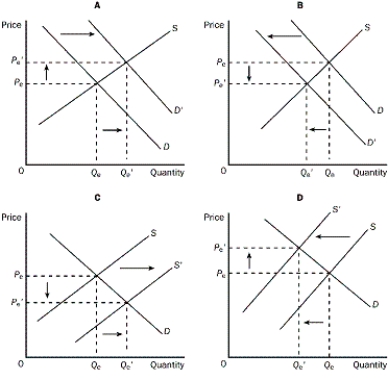 -Refer to Figure 4-5. Which of the four graphs represents the market for winter boots in June?
 (Multiple Choice)
4.9/5 (77)
(77) New oak tables are normal goods. What would happen to the equilibrium price and quantity in the market for oak tables if the price of maple tables rises, the price of oak wood rises, more buyers enter the market for oak tables, and the price of wood saws increased?
(Multiple Choice)
4.8/5 (79)
(79) Recent forest fires in the western provinces are expected to cause the price of lumber to rise in the next 6 months. As a result, what can we expect to happen to the supply of lumber?
(Multiple Choice)
4.7/5 (92)
(92) New oak tables are normal goods. What would happen to the equilibrium price and quantity in the market for oak tables if the price of maple tables rises, the price of oak wood rises, some buyers exit the market for oak tables, and the price of wood saws increased?
(Multiple Choice)
4.8/5 (78)
(78) Figure 4-10  -Refer to Figure 4-10. What is the movement from point A to point B on the graph called?
 (Multiple Choice)
4.9/5 (79)
(79) What is the side of the market that deals with the willingness and ability to produce and sell?
(Multiple Choice)
4.9/5 (63)
(63) You have been asked by your economics professor to graph the market for lumber and then to analyze the change that would occur in equilibrium price as a result of recent forest fires in the West. What would your first step be?
(Multiple Choice)
4.9/5 (86)
(86) Market demand is given as Qd = 200 - 3P. Market supply is given as Qs = 2P + 100. What would result if the market price were $30?
(Multiple Choice)
4.8/5 (69)
(69) Figure 4-7 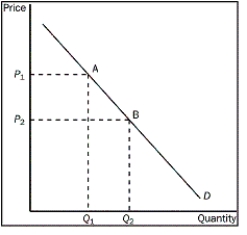 -Refer to Figure 4-7. What does the movement from point A to point B on the graph show?
 (Multiple Choice)
4.9/5 (68)
(68) 
Filters
- Essay(0)
- Multiple Choice(0)
- Short Answer(0)
- True False(0)
- Matching(0)