



 Chat with AI
Exam 14: Decision Analysis

Exam 1: Introduction to Modeling and Decision Analysis51 Questions
Exam 2: Introduction to Optimization and Linear Programming62 Questions
Exam 3: Modeling and Solving Lp Problems in a Spreadsheet89 Questions
Exam 4: Sensitivity Analysis and the Simplex Method72 Questions
Exam 5: Network Modeling73 Questions
Exam 6: Integer Linear Programming73 Questions
Exam 7: Goal Programming and Multiple Objective Optimization62 Questions
Exam 8: Nonlinear Programming and Evolutionary Optimization69 Questions
Exam 9: Regression Analysis77 Questions
Exam 10: Discriminant Analysis60 Questions
Exam 11: Time Series Forecasting116 Questions
Exam 12: Introduction to Simulation Using Risk Solver Platform65 Questions
Exam 13: Queuing Theory80 Questions
Exam 14: Decision Analysis101 Questions
Exam 15: Project Management Online63 Questions
Select questions type


A student wants to buy a new car. She has three cars to choose from, A, B and C. The cars differ with respect to price, performance and looks. The student has developed the following AHP tables for price and summary. The other tables are not shown due to space limitations.

 -Refer to Exhibit 14.13. What formula should go in cell F11 and copied to cells F12:F13 of the Price worksheet to compute the Price Score?
 (Short Answer)
4.8/5  (86)
(86)
The following questions use the information below.
A decision maker is faced with two alternatives. The decision maker has determined that she is indifferent between the two alternatives when p = 0.45.
 -Refer to Exhibit 14.7. What is the decision maker's risk premium for this problem?
 (Multiple Choice)
4.9/5 (68)
(68)
A company is planning a plant expansion. They can build a large or small plant. The payoffs for the plant depend on the level of consumer demand for the company's products. The company believes that there is an 72% chance that demand for their products will be high and a 28% chance that it will be low. The company can pay a market research firm to survey consumer attitudes towards the company's products. There is a 76% chance that the customers will like the products and a 24% chance that they won't. The payoff matrix and costs of the two plants are listed below. The company believes that if the survey is favorable there is an 87% chance that demand will be high for the products. If the survey is unfavorable there is only a 25% chance that the demand will be high.  The company has developed the following conditional probability table for their decision problem.
 -Refer to Exhibit 14.11. What is P(
 ), where F = favorable response and H = high demand?
The company has developed the following conditional probability table for their decision problem.
-Refer to Exhibit 14.11. What is P(), where F = favorable response and H = high demand? (Short Answer)
4.9/5 (79)
(79) An investor is considering 2 investments, A, B, which can be made now. After these investments are made he can pursue choices C, D, E and F depending on whether he chose A or B originally. He has developed the following decision tree to aid in his selection process. What are the correct original and subsequent decisions based on an expected monetary value criteria? 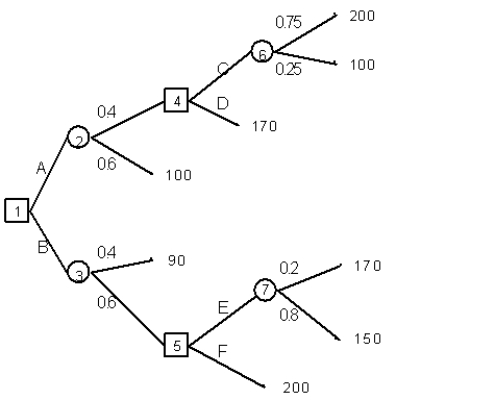
(Multiple Choice)
4.9/5 (79)
(79) The scores in a scoring model can be thought of as subjective assessments of
(Multiple Choice)
4.8/5 (84)
(84)
A company needs to buy a new insurance policy. They have three policies to choose from, A, B and C. The policies differ with respect to price, coverage and ease of billing. The company has developed the following AHP tables for price and summary. The other tables are not shown due to space limitations.

 -Refer to Exhibit 14.8. The Consistency Ratio indicates consistency in the pairwise comparison matrix if the ratio is
 (Multiple Choice)
4.9/5 (77)
(77)
A student wants to buy a new car. She has three cars to choose from, A, B and C. The cars differ with respect to price, performance and looks. The student has developed the following AHP tables for price and summary. The other tables are not shown due to space limitations.
-Refer to Exhibit 14.13. What formula should go in cell G11 and copied to cells G12:G13 of the Price worksheet to compute the Consistency Measure?
-Refer to Exhibit 14.13. What formula should go in cell G11 and copied to cells G12:G13 of the Price worksheet to compute the Consistency Measure? (Short Answer)
4.8/5 (83)
(83)
 -Refer to Exhibit 14.4. What is the expected value of perfect information for the investor?
 (Multiple Choice)
5.0/5 (74)
(74) A company is planning a plant expansion. They can build a large or small plant. The payoffs for the plant depend on the level of consumer demand for the company's products. The company believes that there is a 72% chance that demand for their products will be high and a 28% chance that it will be low. The company can pay a market research firm to survey consumer attitudes towards the company's products. There is a 76% chance that the customers will like the products and a 24% chance that they won't. The payoff matrix and costs of the two plants are listed below. The company believes that if the survey is favorable there is an 87% chance that demand will be high for the products. If the survey is unfavorable there is only a 25% chance that the demand will be high. Draw the decision tree for the problem when the survey is performed before the plant size decision is made. 
(Essay)
4.8/5 (84)
(84)
The following questions use the Decision Tree model and strategy table information below. 
 -Refer to Exhibit 14.14. What formula is placed in cell B3 of the strategy table to complete the table as provided?
 (Essay)
4.8/5 (76)
(76)
The following questions use the information below.
A decision maker is faced with two alternatives. The decision maker has determined that she is indifferent between the two alternatives when p = 0.45.
-Refer to Exhibit 14.7. What is the decision maker's certainty equivalent for this problem?
-Refer to Exhibit 14.7. What is the decision maker's certainty equivalent for this problem? (Multiple Choice)
4.9/5 (79)
(79)
The following questions are based on the information below.
An investor is considering 4 investments, W, X, Y, and Z. The payoff from each investment is a function of the economic climate over the next 2 years. The economy can expand or decline. The following payoff matrix has been developed for the investment decision problem.
 -Refer to Exhibit 14.9. What formula should go in cell D5 and get copied to D6:D8 to implement the maximin decision rule?
 (Short Answer)
4.7/5 (89)
(89) A "risk averse" decision maker assigns the ____ relative utility to any payoff but has a(n) ____ marginal utility for increased payoffs.
(Multiple Choice)
4.8/5 (76)
(76) Which of the following summarizes the final outcome for each decision alternative?
(Multiple Choice)
4.9/5 (86)
(86)
A student wants to buy a new car. She has three cars to choose from, A, B and C. The cars differ with respect to price, performance and looks. The student has developed the following AHP tables for price and summary. The other tables are not shown due to space limitations.
-Refer to Exhibit 14.13. What formula should go in cell G15 of the Price worksheet to compute the Consistency Ratio?
-Refer to Exhibit 14.13. What formula should go in cell G15 of the Price worksheet to compute the Consistency Ratio? (Short Answer)
4.8/5 (81)
(81) Which decision rule pessimistically assumes that nature will always be "against us" regardless of what decision we make?
(Multiple Choice)
4.8/5 (82)
(82) Exhibit 14.10
The following questions are based on the information below.
An investor is considering 4 investments, W, X, Y, and Z. The payoff from each investment is a function of the economic climate over the next 2 years. The economy can expand or decline. The following payoff matrix has been developed for the decision problem. The investor has estimated the probability of a declining economy at 80% and an expanding economy at 20%.
 -Refer to Exhibit 14.10. What formulas should go in cell D5:D14 and B12:C12 of the spreadsheet to compute the EVPI?
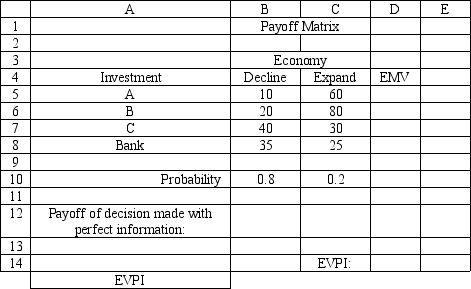
-Refer to Exhibit 14.10. What formulas should go in cell D5:D14 and B12:C12 of the spreadsheet to compute the EVPI?
(Essay)
4.9/5 (81)
(81)
The following questions are based on the information below.
An investor is considering 4 investments, W, X, Y, and Z. The payoff from each investment is a function of the economic climate over the next 2 years. The economy can expand or decline. The following payoff matrix has been developed for the investment decision problem.
-Refer to Exhibit 14.9. What decision should be made according to the maximax decision rule?
-Refer to Exhibit 14.9. What decision should be made according to the maximax decision rule? (Short Answer)
4.9/5 (76)
(76) 
Filters
- Essay(0)
- Multiple Choice(0)
- Short Answer(0)
- True False(0)
- Matching(0)