



 Chat with AI
Exam 5: Network Modeling

Exam 1: Introduction to Modeling and Decision Analysis51 Questions
Exam 2: Introduction to Optimization and Linear Programming62 Questions
Exam 3: Modeling and Solving Lp Problems in a Spreadsheet89 Questions
Exam 4: Sensitivity Analysis and the Simplex Method72 Questions
Exam 5: Network Modeling73 Questions
Exam 6: Integer Linear Programming73 Questions
Exam 7: Goal Programming and Multiple Objective Optimization62 Questions
Exam 8: Nonlinear Programming and Evolutionary Optimization69 Questions
Exam 9: Regression Analysis77 Questions
Exam 10: Discriminant Analysis60 Questions
Exam 11: Time Series Forecasting116 Questions
Exam 12: Introduction to Simulation Using Risk Solver Platform65 Questions
Exam 13: Queuing Theory80 Questions
Exam 14: Decision Analysis101 Questions
Exam 15: Project Management Online63 Questions
Select questions type


You are a military training analyst in charge of initial training for the XXX career field and must decide how to best train the new recruits to satisfy the requirements for skilled recruits. There are six different courses (A, B, C, D, E, F) used for training in the XXX career field and four different sequences of courses that can be taken to achieve the required skill level. These sequences are A-E, B, C-F, and A-D-F. The table below provides information on the six courses.
 There are 100 recruits available for training and a demand for 100 skilled recruits. Assume all recruits pass each course and that you are trying to put students in classes in order to minimize the total cost of training. Assume non-integer solutions are acceptable. Further, assume each course will be held.
a.Draw a network flow diagram describing the problem.
b.Formulate the associated network flow linear program.
c.Implement a spreadsheet model and use Risk Solver Platform (RSP) to obtain a solution to the problem. Use your model to answer the following questions.
What is the expected student load for each course?
Should any course be expanded?
Should any course or sequence be considered for elimination?
Next, assume that not all students pass each course. In fact only 90% of the students pass courses A, E, and F and only 95% of the students pass courses B, C, and D. Each course is considered independent. The requirement for 100 skilled recruits remains. Your job is now to determine the number of recruits to place into the training program to obtain the 100 trained recruits while continuing to minimize the total cost of training.
d.Re-draw the network flow diagram describing the problem to accommodate the above changes.
e.Formulate the associated generalized network flow linear program.
f. Implement a spreadsheet model of this changed model and use Risk Solver Platform (RSP) to obtain a solution to the expanded problem. How many recruits are needed and what is the change in total training cost?
There are 100 recruits available for training and a demand for 100 skilled recruits. Assume all recruits pass each course and that you are trying to put students in classes in order to minimize the total cost of training. Assume non-integer solutions are acceptable. Further, assume each course will be held.
a.Draw a network flow diagram describing the problem.
b.Formulate the associated network flow linear program.
c.Implement a spreadsheet model and use Risk Solver Platform (RSP) to obtain a solution to the problem. Use your model to answer the following questions.
What is the expected student load for each course?
Should any course be expanded?
Should any course or sequence be considered for elimination?
Next, assume that not all students pass each course. In fact only 90% of the students pass courses A, E, and F and only 95% of the students pass courses B, C, and D. Each course is considered independent. The requirement for 100 skilled recruits remains. Your job is now to determine the number of recruits to place into the training program to obtain the 100 trained recruits while continuing to minimize the total cost of training.
d.Re-draw the network flow diagram describing the problem to accommodate the above changes.
e.Formulate the associated generalized network flow linear program.
f. Implement a spreadsheet model of this changed model and use Risk Solver Platform (RSP) to obtain a solution to the expanded problem. How many recruits are needed and what is the change in total training cost? (Essay)
4.9/5  (86)
(86) A trucking company wants to find the quickest route from Seattle to Denver. What values should be placed in cells L6:L10 of the following Excel spreadsheet?
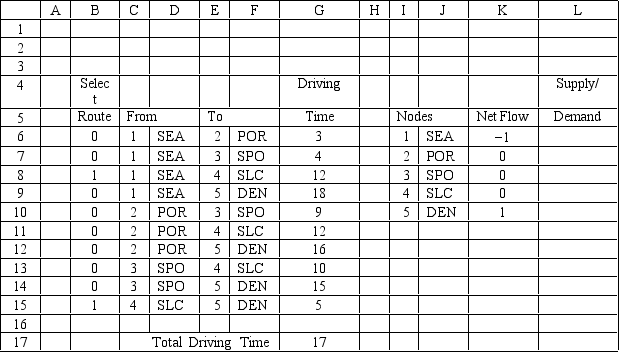
(Essay)
4.8/5 (66)
(66) Decision variables in network flow problems are represented by
(Multiple Choice)
4.7/5 (85)
(85) Solve the following minimal spanning tree problem starting at node 1. 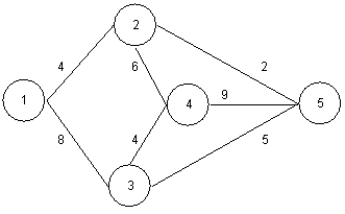
(Essay)
4.8/5 (69)
(69) An oil company wants to create lube oil, gasoline and diesel fuel at two refineries. There are two sources of crude oil. Consider arc 2-4. The per unit shipping cost of crude B from source 2 (node 2) to refinery 2 (node 4) is $11 and the yield is 85 percent. The following flowchart depicts this problem. What is the balance of flow constraint for node 7 (Diesel)? 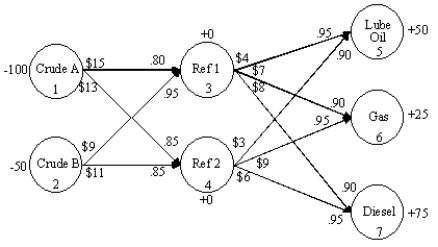
(Multiple Choice)
4.8/5 (78)
(78) The following network depicts a balanced assignment/transportation problem for Joe Fix's repair scheduling problem. Formulate the LP for Joe assuming he wishes to maximize the total repairperson to plane assignment preferences. 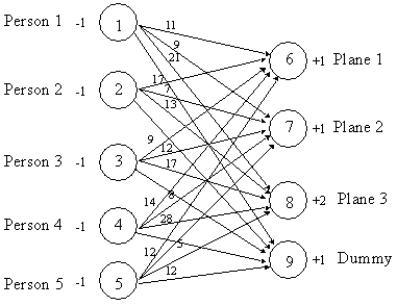
(Essay)
4.8/5 (72)
(72) A manufacturing company has a pool of 50 labor hours. A customer has requested two products, Product A and Product B, and has requested 15 and 20 of each respectively. It requires 2 hours of labor to produce Product A and 3 hours of labor to produce Product B. The company can obtain up to 50 additional hours of labor if required. In-house labor costs $25 per hour while contracted labor costs $45 per hour. The following network flow model captures this problem. 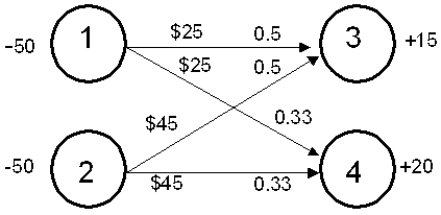 Write out the LP formulation for this problem.
 (Essay)
4.9/5 (83)
(83) What is the objective function for the following shortest path problem? 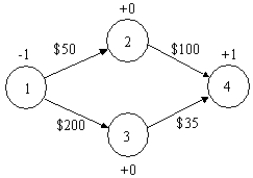
(Multiple Choice)
4.8/5 (77)
(77) The number of constraints in network flow problems is determined by the number of
(Multiple Choice)
4.9/5 (89)
(89) What is the interpretation of units "shipped" along arcs from dummy supply nodes to demand nodes?
(Multiple Choice)
4.8/5 (76)
(76) Demand quantities for demand nodes in a transshipment problem are customarily indicated by
(Multiple Choice)
4.7/5 (77)
(77) A company needs to ship 100 units from Seattle to Denver at the lowest possible cost. The costs associated with shipping between the cities are listed below. Also, the decision variable associated with each pair of cities is shown next to the cost.
 Write out the LP formulation for this problem.
 (Essay)
4.9/5 (92)
(92)
Jack Small Enterprises runs two factories in Ohio, one in Toledo and one in Centerville. His factories produce a variety of products. Two of his product lines are polished wood clocks which he adorns with a regional theme. Naturally, clocks popular in the southwest are not as popular in the northeast, and vice versa. Each plant makes both of the clocks. These clocks are shipped to St Louis for distribution to the southeast and western states and to Pittsburg for distribution to the south and northeast.
Jack is considering streamlining his plants by removing certain production lines from certain plants. Among his options is potentially eliminating the clock production line at either the Toledo or the Centerville plant. Each plant carries a fixed operating cost for setting up the line and a unit production cost, both in terms of money and factory worker hours. This information is summarized in the table below.
 The Southwest clocks are sold for $23 each and the Northwest clocks are sold for $25 each. Demand rates used for production planning are 1875 Southwest clocks for sale out of the St Louis distribution center and 2000 Northeast clocks for sale out of the Pittsburg distribution center. Assume all these units are sold. The per clock transportation costs from plant to distribution center is given in the following table.
 Develop a generalized network flow model for this problem and implement this model in solver. Use the model to answer the following questions.
a.Should any of the production lines be shut down?
b.How should worker hours be allocated to produce the clocks to meet the demand forecasts? Are there any excess hours, and if so how many?
c.What is the expected monthly profit?
d.If a plant is closed, what are the estimated monthly savings?
The Southwest clocks are sold for $23 each and the Northwest clocks are sold for $25 each. Demand rates used for production planning are 1875 Southwest clocks for sale out of the St Louis distribution center and 2000 Northeast clocks for sale out of the Pittsburg distribution center. Assume all these units are sold. The per clock transportation costs from plant to distribution center is given in the following table. Develop a generalized network flow model for this problem and implement this model in solver. Use the model to answer the following questions.
a.Should any of the production lines be shut down?
b.How should worker hours be allocated to produce the clocks to meet the demand forecasts? Are there any excess hours, and if so how many?
c.What is the expected monthly profit?
d.If a plant is closed, what are the estimated monthly savings? (Essay)
4.9/5 (82)
(82) What formula would be entered in cell G18 in this Excel model? 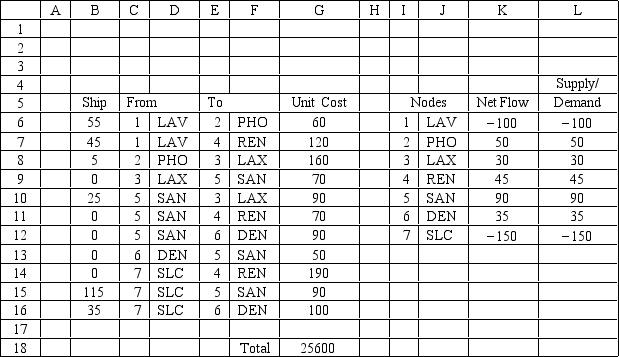
(Multiple Choice)
4.8/5 (80)
(80) Consider the equipment replacement problem presented in the chapter. Recall that in the network model formulation of this problem a node represents a year when the equipment was purchased. An arc from node i to node j indicates that the equipment purchased in year i can be replaced at the beginning of year j. How could the network model below be modified to depict an equipment purchase in year 4 and operating costs only through the remainder of the planning window? 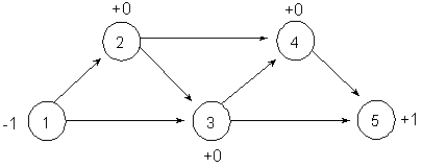
(Multiple Choice)
4.8/5 (79)
(79) What is the correct constraint for node 2 in the following diagram? 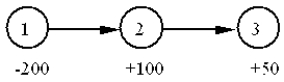
(Multiple Choice)
5.0/5 (79)
(79) Which method is preferred for solving fully connected transportation problems?
(Multiple Choice)
4.9/5 (100)
(100) Clifton Distributing has three plants and four distribution centers. The plants, their supply, the distribution centers, their demands, and the distance between each location is summarized in the following table:
 Draw the balanced transportation network for Clifton's distribution problem.
 (Essay)
4.8/5 (81)
(81) Which method is preferred for solving minimal spanning tree problems?
(Multiple Choice)
4.7/5 (73)
(73) 
Filters
- Essay(0)
- Multiple Choice(0)
- Short Answer(0)
- True False(0)
- Matching(0)