



 Chat with AI
Exam 15: Oligopoly

Exam 1: What Is Economics479 Questions
Exam 2: The Economic Problem440 Questions
Exam 3: Demand and Supply515 Questions
Exam 4: Elasticity533 Questions
Exam 5: Efficiency and Equity450 Questions
Exam 6: Government Actions in Markets412 Questions
Exam 7: Global Markets in Action200 Questions
Exam 8: Utility and Demand364 Questions
Exam 9: Possibilities, Preferences, and Choices459 Questions
Exam 10: Organizing Production385 Questions
Exam 11: Output and Costs493 Questions
Exam 12: Perfect Competition487 Questions
Exam 13: Monopoly599 Questions
Exam 14: Monopolistic Competition319 Questions
Exam 15: Oligopoly276 Questions
Exam 16: Public Choices, Public Goods, and Healthcare205 Questions
Exam 17: Externalities437 Questions
Exam 18: Markets for Factors of Production382 Questions
Exam 19: Economic Inequality353 Questions
Exam 20: Uncertainty and Information233 Questions
Select questions type


A market in which firms can enter and leave so easily that firms in the market face competition from potential entrants is called a
(Multiple Choice)
4.8/5  (95)
(95) The local banking industry currently has a Herfindahl-Hirschman index (HHI) value of 1945 and two of the competing banks have considered merging. Because the merger would raise the HHI by 155 points, the Federal Trade Commission would likely
(Multiple Choice)
4.9/5 (81)
(81) Under Federal Trade Commission merger guidelines, an industry with a Herfindahl-Hirschman index (HHI) of 800 points is considered
(Multiple Choice)
4.7/5 (74)
(74) Tying arrangements are always held to be illegal under U.S. antitrust law.
(True/False)
5.0/5 (76)
(76) Which of the following is a defining characteristic of oligopoly?
(Multiple Choice)
4.8/5 (74)
(74) What is meant by the term "exclusive dealing"? Give an example of an exclusive deal. When is it illegal?
(Essay)
4.8/5 (77)
(77) Nimbus, Inc., and Cleansweep, Inc., are the only producers of flying brooms. Each firm has two strategies: Spend 30,000 galleons a year on research and development (R&D) or spend nothing on R&D. If neither firm spends on R&D, Nimbus' economic profit is 80, 000 galleons and Cleansweep's economic profit is 40,000 galleons. If each firm conducts R&D, market shares are maintained, but each firm's profit is lower by the amount spent on R&D. If Nimbus conducts R&D and Cleansweep does not, Nimbus makes an economic profit of 120,000 galleons, while Cleansweep incurs an economic loss of 20,000 galleons. If Cleansweep conducts R&D and Nimbus does not, Cleansweep makes a profit of 60,000 galleons while Nimbus loses 10,000 galleons.
a) Construct a payoff matrix for the game that Nimbus and Cleansweep must play.
b) Find the Nash equilibrium. In the Nash equilibrium, what is each firm's equilibrium profit?
c) What is the cooperative outcome? Would the firms make more economic profit if they collude to achieve the cooperative outcome?
(Essay)
4.9/5 (83)
(83) In a prisoner's dilemma, the Nash equilibrium occurs where
(Multiple Choice)
4.9/5 (81)
(81) The prisoners' dilemma describes a single-play game that features
(Multiple Choice)
4.9/5 (89)
(89) "The Clayton Act repealed the Sherman Act so that only the Clayton Act remains in force." Is the previous statement correct or incorrect?
(Essay)
4.9/5 (88)
(88) The practice of the only seller in a market charging a price at the highest level that would still inflict a loss on a new entrant into the market is called
(Multiple Choice)
4.9/5 (88)
(88) In game theory, a Nash equilibrium is the equilibrium that always yields the best result.
(True/False)
4.8/5 (75)
(75) 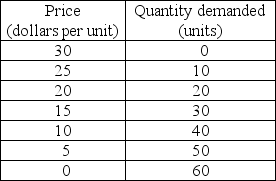 -The table above has the market demand schedule in an industry that has two firms in it. The marginal cost of this product is zero because these two firms have exclusive ownership of the resource and it does not cost any additional amount to produce additional units.
a) If the firms cooperate with each other so that they operate as a monopoly, what price will they charge and what (total) output will they produce?
b) If the firms cannot cooperate but instead behave as perfect competitors, what will be the price and the (total) output they produce?
-The table above has the market demand schedule in an industry that has two firms in it. The marginal cost of this product is zero because these two firms have exclusive ownership of the resource and it does not cost any additional amount to produce additional units.
a) If the firms cooperate with each other so that they operate as a monopoly, what price will they charge and what (total) output will they produce?
b) If the firms cannot cooperate but instead behave as perfect competitors, what will be the price and the (total) output they produce? (Essay)
4.9/5 (92)
(92) If McDonald's, Wendy's, and Burger King agree with each other not to sell hamburgers for less than $3.95 apiece, all three could be found guilty of
(Multiple Choice)
5.0/5 (76)
(76) The maximum total economic profit that can be made by colluding duopolists
(Multiple Choice)
4.8/5 (71)
(71) 
Filters
- Essay(0)
- Multiple Choice(0)
- Short Answer(0)
- True False(0)
- Matching(0)