



 Chat with AI
Exam 5: Efficiency and Equity

Exam 1: What Is Economics479 Questions
Exam 2: The Economic Problem440 Questions
Exam 3: Demand and Supply515 Questions
Exam 4: Elasticity533 Questions
Exam 5: Efficiency and Equity450 Questions
Exam 6: Government Actions in Markets412 Questions
Exam 7: Global Markets in Action200 Questions
Exam 8: Utility and Demand364 Questions
Exam 9: Possibilities, Preferences, and Choices459 Questions
Exam 10: Organizing Production385 Questions
Exam 11: Output and Costs493 Questions
Exam 12: Perfect Competition487 Questions
Exam 13: Monopoly599 Questions
Exam 14: Monopolistic Competition319 Questions
Exam 15: Oligopoly276 Questions
Exam 16: Public Choices, Public Goods, and Healthcare205 Questions
Exam 17: Externalities437 Questions
Exam 18: Markets for Factors of Production382 Questions
Exam 19: Economic Inequality353 Questions
Exam 20: Uncertainty and Information233 Questions
Select questions type


 -The figure above shows the market for coffee. If the government pays the coffee producers a subsidy and production increases to 30 million pounds per day, the market is
 (Multiple Choice)
4.7/5  (80)
(80) Consider the market for hot dogs. As long as the marginal benefit of consuming hot dogs is greater than the price of hot dogs
(Multiple Choice)
4.7/5 (87)
(87) Currently kidneys are allocated based on the needs of each perspective recipient, their blood type, and the urgency of their case. An alternative way to allocate kidneys is to go by the order in which patients were placed on the waiting list. In that case, the allocation of resources is made using
(Multiple Choice)
4.9/5 (70)
(70)  -In the above figure, a price of $1.25 and a quantity of 5 million gallons of milk per day maximizes the
 (Multiple Choice)
4.7/5 (76)
(76) Jane is willing to pay $4 for the first cup of coffee a day, $2.50 for the second cup, and $1 for the third cup, after which she won't buy any coffee. The price of a cup of coffee is $2.40. Jane's consumer surplus from the coffee she buys is ________ per day.
(Multiple Choice)
4.8/5 (75)
(75)  -In the table above, if there are 80 umbrellas produced, the deadweight loss from the 80th umbrella is
 (Multiple Choice)
4.7/5 (71)
(71) When there are external costs of production, such as when electric utilities burn coal, a competitive market will produce an inefficient level of output.
(True/False)
4.7/5 (78)
(78)  -The above figure shows the marginal social benefit and marginal social cost curves of doughnuts in the nation of Kaffenia. What is the marginal social cost of producing the 200th dozen doughnuts each day?
 (Multiple Choice)
5.0/5 (79)
(79)  -In the above table, when 200 brownies are produced
 -In the above figure, if five million CDs per month are produced and consumed, that is
 (Multiple Choice)
4.9/5 (70)
(70)  -In the above figure, what is the marginal social benefit of the four-hundredth pretzel?
 (Multiple Choice)
4.9/5 (91)
(91) At the current level of output, the marginal social cost of tennis balls is greater than the marginal social benefit. Then
(Multiple Choice)
4.8/5 (87)
(87) Bill Gates is the world's second richest person whose net worth is estimated at $54 billion. The idea that Bill Gates marginal utility for his 54 billionth dollar is less than someone else's 1000th dollar is the
(Multiple Choice)
4.9/5 (70)
(70) Consumer surplus is the value of a good minus the cost of producing it, summed over the quantity bought.
(True/False)
4.7/5 (64)
(64) When a deadweight loss occurs in a market, we can be certain that
(Multiple Choice)
5.0/5 (85)
(85) 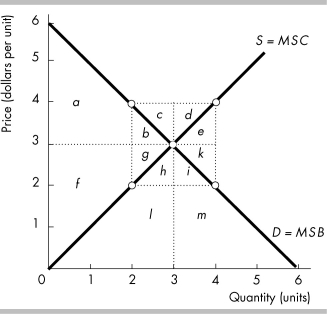 -In the figure above, if the quantity is restricted to 2, then the deadweight loss in this market equals
 (Multiple Choice)
4.8/5 (63)
(63) 
Filters
- Essay(0)
- Multiple Choice(0)
- Short Answer(0)
- True False(0)
- Matching(0)