



 Chat with AI
Exam 13: Inflation, Unemployment, and Bank of Canada Policy

Exam 1: Economics: Foundations and Models148 Questions
Exam 2: Trade-Offs, Comparative Advantage, and the Market System314 Questions
Exam 3: Where Prices Come From: The Interaction of Supply and Demand314 Questions
Exam 4: GDP: Measuring Total Production and Income277 Questions
Exam 5: Unemployment and Inflation300 Questions
Exam 6: Economic Growth, The Financial System, and Business Cycles262 Questions
Exam 7: Long-Run Economic Growth: Sources and Policies280 Questions
Exam 8: Aggregate Expenditure and Output in the Short Run315 Questions
Exam 9: Aggregate Demand and Aggregate Supply Analysis246 Questions
Exam 10: Money, Banks, and the Bank of Canada285 Questions
Exam 11: Monetary Policy281 Questions
Exam 12: Fiscal Policy303 Questions
Exam 13: Inflation, Unemployment, and Bank of Canada Policy265 Questions
Exam 14: Macroeconomics in an Open Economy280 Questions
Exam 15: The International Financial System228 Questions
Select questions type


Use the following information to draw a graph showing the short-run and long-run Phillips curves, and be sure your graph shows the point where the short-run and long-run Phillips curves intersect.
Natural rate of unemployment = 4 percent
Current rate of unemployment = 5 percent
Expected inflation rate = 3 percent
Current inflation rate = 2 percent
(Essay)
4.9/5  (84)
(84) The long-run aggregate supply curve is ________, while the long-run Phillips curve is ________.
(Multiple Choice)
4.8/5 (87)
(87) What actions could the Bank of Canada take to achieve consistent growth in real GDP at 4 percent per year?
(Multiple Choice)
4.9/5 (78)
(78) If the Bank of Canada chooses to fight high unemployment with expansionary monetary policy and firms and consumers expect this policy to increase inflation, which of the following would you expect to see?
(Multiple Choice)
4.9/5 (76)
(76) Ceteris paribus, in the short run following a decrease in the rate of growth in Aggregate Demand, we would expect to see an increase in the rate of unemployment and a decrease in the rate of inflation.
(True/False)
4.9/5 (91)
(91) Figure 13.4 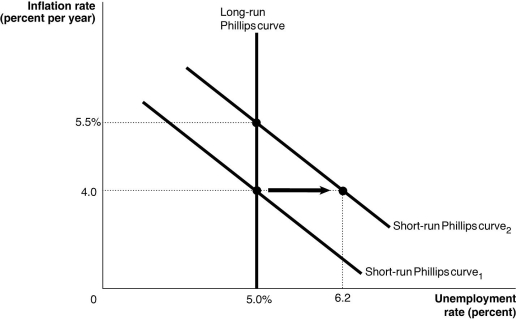 Alt text for Figure 13.4: In figure 13.4, a graph shows the shift in the short-run Phillips curve.
Long description for Figure 13.4: The x-axis is labelled, unemployment rate percent.The y-axis is labelled, inflation rate percent per year.A straight line labelled, short-run Philips Curve 1, begins at the top left corner and slopes down to the end of the x-axis.A straight line labelled, short-run Philips Curve 2, follows the same slope as curve 1, but is plotted to the right.The area between Curve 1 and Curve 2 is indicated by a right pointing arrow.A straight line labelled, long-run Philips Curve 1 is perpendicular to the x-axis, and begins from the x-axis value 5.0%.Long-run Philips Curve 1 intersects the short-run Philips Curve 1 at point (5.0%, 4.0)and intersects the short-run Philips Curve 2 at point (5.0%, 5.5%).Point (6.2, 4.0)is plotted toward the right end of the short-run Philips Curve 2.The points are connected to their respective coordinates on the x-axis and y-axis with dotted lines.
-Refer to Figure 13.4.Consider the shift in the short-run Phillips curve shown in the above graph. This shift may be explained by
Alt text for Figure 13.4: In figure 13.4, a graph shows the shift in the short-run Phillips curve.
Long description for Figure 13.4: The x-axis is labelled, unemployment rate percent.The y-axis is labelled, inflation rate percent per year.A straight line labelled, short-run Philips Curve 1, begins at the top left corner and slopes down to the end of the x-axis.A straight line labelled, short-run Philips Curve 2, follows the same slope as curve 1, but is plotted to the right.The area between Curve 1 and Curve 2 is indicated by a right pointing arrow.A straight line labelled, long-run Philips Curve 1 is perpendicular to the x-axis, and begins from the x-axis value 5.0%.Long-run Philips Curve 1 intersects the short-run Philips Curve 1 at point (5.0%, 4.0)and intersects the short-run Philips Curve 2 at point (5.0%, 5.5%).Point (6.2, 4.0)is plotted toward the right end of the short-run Philips Curve 2.The points are connected to their respective coordinates on the x-axis and y-axis with dotted lines.
-Refer to Figure 13.4.Consider the shift in the short-run Phillips curve shown in the above graph. This shift may be explained by (Multiple Choice)
4.7/5 (78)
(78) If the current unemployment rate is 5%, under which of the following circumstances would you expect the Bank of Canada to use contractionary monetary policy?
(Multiple Choice)
4.8/5 (81)
(81) The expansionary monetary and fiscal policies of the 1960s resulted in
(Multiple Choice)
4.8/5 (73)
(73) According to the short-run Phillips curve, which of the following would result in low rates of unemployment?
(Multiple Choice)
4.8/5 (76)
(76) Workers at a local construction company are paid $32.50 per hour, and they have incorporated a 4 percent annual raise in their contracts to account for expected inflation.Explain how unexpected inflation of 2 percent will affect the real wages earned by these workers and the unemployment rate of these workers.
(Essay)
4.9/5 (77)
(77) The 1989-1993 Bank of Canada adoption of inflationary targets led to substantial reductions in the inflation rate, but it came at the cost of
(Multiple Choice)
4.7/5 (70)
(70) According to economists Robert Lucas and Thomas Sargent, when are the gains to accurately forecasting inflation highest?
(Multiple Choice)
4.9/5 (70)
(70) Robert Shiller posed the following question to workers: "Imagine that next year the inflation rate unexpectedly doubles.How long would it probably take, in these times, before your income is increased enough so that you can afford the same things as you do today?" Shiller found that ________ percent of the workers he interviewed reported that it would take several years to restore the purchasing power of their wages or that this power would never be restored.
(Multiple Choice)
4.9/5 (73)
(73) Models that focus on factors such as technology shocks rather than "monetary" explanations of fluctuations in real GDP are called
(Multiple Choice)
4.9/5 (90)
(90) If firms and workers have rational expectations, including knowledge of the policy being used by the Bank of Canada, the short-run Phillips curve will be
(Multiple Choice)
4.8/5 (85)
(85) Suppose a candidate for Prime Minister makes a statement in a debate whereby he promises that he would encourage the Bank of Canada to permanently lower the unemployment rate to 3%.His opponents claim that this type of policy idea is mired in the 1960s and would only cause inflation.Explain what the opponent means.
(Essay)
4.8/5 (89)
(89) Lucas and Sargent argue that the short-run trade-off between unemployment and inflation is caused by
(Multiple Choice)
4.9/5 (76)
(76) Which of the following is not an appropriate policy for a central bank to follow if the economy is plagued with deflation?
(Multiple Choice)
4.9/5 (76)
(76) 
Filters
- Essay(0)
- Multiple Choice(0)
- Short Answer(0)
- True False(0)
- Matching(0)