



 Chat with AI
Exam 22: The Short-Run Trade-Off Between Inflation and Unemployment

Exam 1: Ten Principles of Economics347 Questions
Exam 2: Thinking Like an Economist535 Questions
Exam 3: Interdependence and the Gains From Trade442 Questions
Exam 4: The Market Forces of Supply and Demand569 Questions
Exam 5: Elasticity and Its Application503 Questions
Exam 6: Supply, Demand, and Government Policies556 Questions
Exam 7: Consumers, Producers, and the Efficiency of Markets460 Questions
Exam 8: Application: The Costs of Taxation422 Questions
Exam 9: Application: International Trade409 Questions
Exam 10: Measuring a Nations Income428 Questions
Exam 11: Measuring the Cost of Living436 Questions
Exam 12: Production and Growth417 Questions
Exam 13: Saving, Investment, and the Financial System473 Questions
Exam 14: The Basic Tools of Finance419 Questions
Exam 15: Unemployment571 Questions
Exam 16: The Monetary System423 Questions
Exam 17: Money Growth and Inflation388 Questions
Exam 18: Open-Economy Macroeconomic Models448 Questions
Exam 19: A Macroeconomic Theory of the Open Economy374 Questions
Exam 20: Aggregate Demand and Aggregate Supply471 Questions
Exam 21: The Influence of Monetary and Fiscal Policy on Aggregate Demand416 Questions
Exam 22: The Short-Run Trade-Off Between Inflation and Unemployment400 Questions
Exam 23: Six Debates Over Macroeconomic Policy235 Questions
Select questions type


Which of the following is correct according to the long-run Phillips curve?
(Multiple Choice)
4.8/5  (76)
(76) Figure 22-2
Use the pair of diagrams below to answer the following questions. 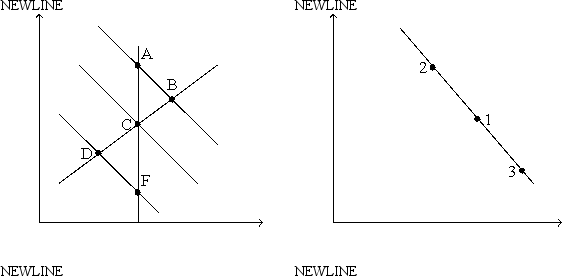 -Refer to Figure 22-2. If the economy starts at C and 1, then in the short run, a decrease in taxes moves the economy to
 (Multiple Choice)
4.9/5 (72)
(72) When they are confronted with an adverse shock to aggregate supply, policymakers face a difficult choice in that
(Multiple Choice)
4.9/5 (79)
(79) Other things the same, if the Fed increases the rate at which it increases the money supply then the short-run Phillips curve shifts right in the long run.
(True/False)
4.8/5 (79)
(79) Which of the following would tend to shorten recessions associated with anti-inflation policies by central banks?
(Multiple Choice)
4.9/5 (75)
(75) An increase in the natural rate of unemployment shifts the long-run Phillips curve to the right.
(True/False)
4.8/5 (74)
(74) Figure 22-8. The left-hand graph shows a short-run aggregate-supply (SRAS) curve and two aggregate-demand (AD) curves. On the right-hand diagram, "Inf Rate" means "Inflation Rate." 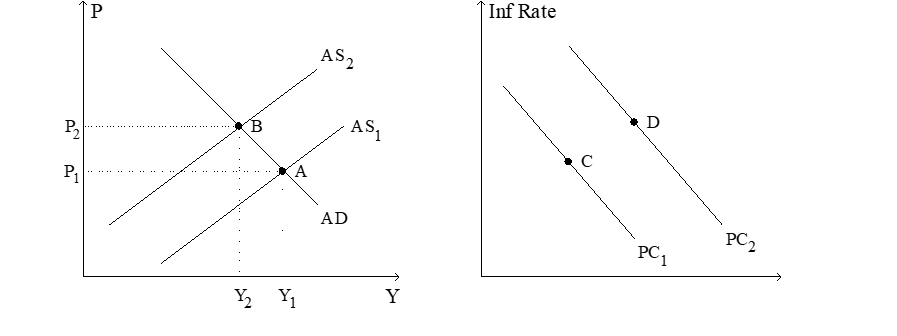 -Refer to Figure 22-8. The shift of the aggregate-supply curve from AS1 to AS2
 (Multiple Choice)
4.7/5 (75)
(75) The classical notion of monetary neutrality is consistent both with a vertical long-run aggregate-supply curve and with a vertical long-run Phillips curve.
(True/False)
4.9/5 (87)
(87) Figure 22-5
Use the graph below to answer the following questions. 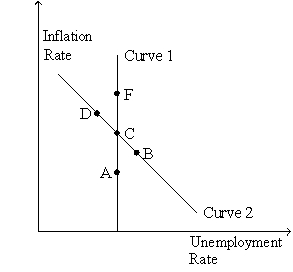 -Refer to Figure 22-5. Curve 2 is the
 (Multiple Choice)
4.7/5 (88)
(88) An adverse supply shock shifts the short-run Phillips curve right. If people raise their inflation expectations, the short-run Phillips curve shifts farther right.
(True/False)
4.7/5 (76)
(76) Which of the following depends primarily on the growth rate of the money supply?
(Multiple Choice)
4.9/5 (81)
(81) A basis for the slope of the short-run Phillips curve is that when unemployment is high there are
(Multiple Choice)
4.9/5 (83)
(83) In the long run, a decrease in the money supply growth rate
(Multiple Choice)
4.8/5 (94)
(94) A politician blames the Federal Reserve for being "soft on unemployment" and claims that a permanently higher money supply growth rate will lead to a permanent reduction in the unemployment rate. The politician's argument is
(Multiple Choice)
4.8/5 (61)
(61) If there is a temporary adverse supply shock, then the short-run Phillips curve shifts to the
(Multiple Choice)
4.8/5 (88)
(88) In the long run, an increase in the money supply growth rate
(Multiple Choice)
4.8/5 (68)
(68) In the long run, if the Fed increases the rate at which it increases the money supply,
(Multiple Choice)
4.8/5 (76)
(76) 
Filters
- Essay(0)
- Multiple Choice(0)
- Short Answer(0)
- True False(0)
- Matching(0)