



 Chat with AI
Exam 21: The Influence of Monetary and Fiscal Policy on Aggregate Demand

Exam 1: Ten Principles of Economics347 Questions
Exam 2: Thinking Like an Economist535 Questions
Exam 3: Interdependence and the Gains From Trade442 Questions
Exam 4: The Market Forces of Supply and Demand569 Questions
Exam 5: Elasticity and Its Application503 Questions
Exam 6: Supply, Demand, and Government Policies556 Questions
Exam 7: Consumers, Producers, and the Efficiency of Markets460 Questions
Exam 8: Application: The Costs of Taxation422 Questions
Exam 9: Application: International Trade409 Questions
Exam 10: Measuring a Nations Income428 Questions
Exam 11: Measuring the Cost of Living436 Questions
Exam 12: Production and Growth417 Questions
Exam 13: Saving, Investment, and the Financial System473 Questions
Exam 14: The Basic Tools of Finance419 Questions
Exam 15: Unemployment571 Questions
Exam 16: The Monetary System423 Questions
Exam 17: Money Growth and Inflation388 Questions
Exam 18: Open-Economy Macroeconomic Models448 Questions
Exam 19: A Macroeconomic Theory of the Open Economy374 Questions
Exam 20: Aggregate Demand and Aggregate Supply471 Questions
Exam 21: The Influence of Monetary and Fiscal Policy on Aggregate Demand416 Questions
Exam 22: The Short-Run Trade-Off Between Inflation and Unemployment400 Questions
Exam 23: Six Debates Over Macroeconomic Policy235 Questions
Select questions type


While a television news reporter might state that "Today the Fed lowered the federal funds rate from 5.5 percent to 5.25 percent," a more precise account of the Fed's action would be as follows:
(Multiple Choice)
4.9/5  (82)
(82) Which of the following properly describes the interest-rate effect?
(Multiple Choice)
4.8/5 (86)
(86) Which of the following statements is correct for the short run?
(Multiple Choice)
4.8/5 (63)
(63) According to liquidity preference theory, equilibrium in the money market is achieved by adjustments in
(Multiple Choice)
4.8/5 (72)
(72) According to the theory of liquidity preference, the money supply
(Multiple Choice)
4.8/5 (82)
(82) The marginal propensity to consume (MPC) is defined as the fraction of
(Multiple Choice)
4.8/5 (88)
(88) The theory of liquidity preference assumes that the nominal supply of money is determined by the
(Multiple Choice)
4.7/5 (68)
(68) In the short run, a decrease in the money supply causes interest rates to
(Multiple Choice)
4.8/5 (85)
(85) Suppose that the government spends more on a missile defense program. What does this do to aggregate demand? How is you answer affected by the presence of the multiplier, crowding-out, taxes, and investment-accelerator effects?
(Essay)
4.7/5 (67)
(67) Scenario 21-1. Take the following information as given for a small, imaginary economy:
- When income is , consingtion spending is
- Whan income is , cansumption spending is
-Refer to Scenario 21-1. The marginal propensity to consume for this economy is
(Multiple Choice)
4.9/5 (78)
(78) People might deposit more money into interest-bearing accounts,
(Multiple Choice)
4.8/5 (75)
(75) According to the theory of liquidity preference, if the interest rate rises
(Multiple Choice)
4.9/5 (74)
(74) Figure 21-3. 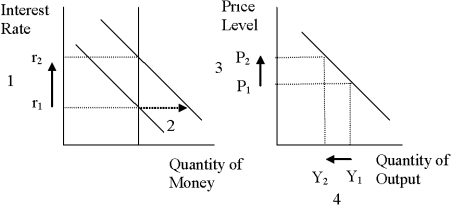 -Refer to Figure 21-3. Which of the following sequences (numbered arrows) shows the logic of the interest-rate effect?
 (Multiple Choice)
4.8/5 (74)
(74) During periods of expansion, automatic stabilizers cause government expenditures
(Multiple Choice)
4.9/5 (69)
(69) 
Filters
- Essay(0)
- Multiple Choice(0)
- Short Answer(0)
- True False(0)
- Matching(0)