



 Chat with AI
Exam 15: Unemployment

Exam 1: Ten Principles of Economics347 Questions
Exam 2: Thinking Like an Economist535 Questions
Exam 3: Interdependence and the Gains From Trade442 Questions
Exam 4: The Market Forces of Supply and Demand569 Questions
Exam 5: Elasticity and Its Application503 Questions
Exam 6: Supply, Demand, and Government Policies556 Questions
Exam 7: Consumers, Producers, and the Efficiency of Markets460 Questions
Exam 8: Application: The Costs of Taxation422 Questions
Exam 9: Application: International Trade409 Questions
Exam 10: Measuring a Nations Income428 Questions
Exam 11: Measuring the Cost of Living436 Questions
Exam 12: Production and Growth417 Questions
Exam 13: Saving, Investment, and the Financial System473 Questions
Exam 14: The Basic Tools of Finance419 Questions
Exam 15: Unemployment571 Questions
Exam 16: The Monetary System423 Questions
Exam 17: Money Growth and Inflation388 Questions
Exam 18: Open-Economy Macroeconomic Models448 Questions
Exam 19: A Macroeconomic Theory of the Open Economy374 Questions
Exam 20: Aggregate Demand and Aggregate Supply471 Questions
Exam 21: The Influence of Monetary and Fiscal Policy on Aggregate Demand416 Questions
Exam 22: The Short-Run Trade-Off Between Inflation and Unemployment400 Questions
Exam 23: Six Debates Over Macroeconomic Policy235 Questions
Select questions type


Like any cartel, a union is a group of sellers acting together in the hope of exerting their joint market power.
(True/False)
4.8/5  (79)
(79) Unemployment insurance is designed to offer workers full protection against job loss.
(True/False)
4.8/5 (86)
(86) Frictional unemployment is often the result of changes in the demand for labor among different firms.
(True/False)
4.9/5 (78)
(78) When a union is present in a labor market, wages are not determined by the equilibrium of supply and demand.
(True/False)
4.9/5 (78)
(78) Economists at the Congressional Budget Office estimated that for 2009, the U.S. natural rate of unemployment was 5.0 percent.
(True/False)
4.9/5 (77)
(77) Jouke is on a temporary layoff from his factory job but has not looked for work in the last four weeks. The Bureau of Labor Statistics counts Jouke as
(Multiple Choice)
4.8/5 (79)
(79) Figure 15-1 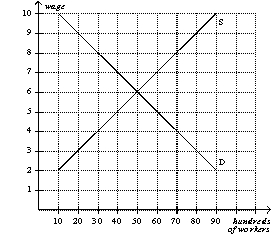 -Refer to Figure 15-1. At the equilibrium wage, how many workers are employed?
 (Multiple Choice)
4.9/5 (67)
(67) The efficiency-wage theory of worker quality suggests that if firms respond to a surplus of labor by reducing the wage, then highly qualified workers will be
(Multiple Choice)
4.9/5 (84)
(84) Josh is a full-time college student who is not working or looking for a job. The Bureau of Labor Statistics counts Josh as
(Multiple Choice)
4.7/5 (79)
(79) Which of the following is not an explanation for the existence of structural unemployment?
(Multiple Choice)
4.8/5 (76)
(76) Figure 15-1
-Refer to Figure 15-1. If the government imposes a minimum wage of $8, then unemployment will increase by
-Refer to Figure 15-1. If the government imposes a minimum wage of $8, then unemployment will increase by (Multiple Choice)
4.9/5 (78)
(78) If the wage is kept above the equilibrium wage for any reason, the result is
(Multiple Choice)
4.8/5 (80)
(80) It is only among the least skilled and least experienced members of the labor force that minimum-wage laws cause unemployment.
(True/False)
4.9/5 (64)
(64) Today, the four industries with the largest employment in the United States are autos, aircraft, communications, and electrical components.
(True/False)
4.9/5 (77)
(77) What is the theory of efficiency wages? Provide four reasons that employers might pay efficiency wages.
(Essay)
4.8/5 (68)
(68) 
Filters
- Essay(0)
- Multiple Choice(0)
- Short Answer(0)
- True False(0)
- Matching(0)