



 Chat with AI
Exam 13: Saving, Investment, and the Financial System

Exam 1: Ten Principles of Economics347 Questions
Exam 2: Thinking Like an Economist535 Questions
Exam 3: Interdependence and the Gains From Trade442 Questions
Exam 4: The Market Forces of Supply and Demand569 Questions
Exam 5: Elasticity and Its Application503 Questions
Exam 6: Supply, Demand, and Government Policies556 Questions
Exam 7: Consumers, Producers, and the Efficiency of Markets460 Questions
Exam 8: Application: The Costs of Taxation422 Questions
Exam 9: Application: International Trade409 Questions
Exam 10: Measuring a Nations Income428 Questions
Exam 11: Measuring the Cost of Living436 Questions
Exam 12: Production and Growth417 Questions
Exam 13: Saving, Investment, and the Financial System473 Questions
Exam 14: The Basic Tools of Finance419 Questions
Exam 15: Unemployment571 Questions
Exam 16: The Monetary System423 Questions
Exam 17: Money Growth and Inflation388 Questions
Exam 18: Open-Economy Macroeconomic Models448 Questions
Exam 19: A Macroeconomic Theory of the Open Economy374 Questions
Exam 20: Aggregate Demand and Aggregate Supply471 Questions
Exam 21: The Influence of Monetary and Fiscal Policy on Aggregate Demand416 Questions
Exam 22: The Short-Run Trade-Off Between Inflation and Unemployment400 Questions
Exam 23: Six Debates Over Macroeconomic Policy235 Questions
Select questions type


Figure 13-4. On the horizontal axis of the graph, L represents the quantity of loanable funds in billions of dollars. 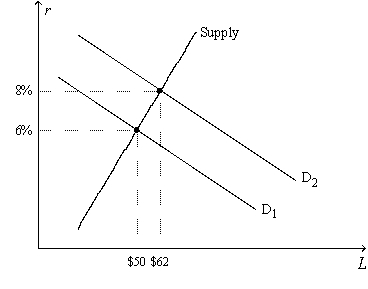 -Refer to Figure 13-4. Regard the position of the Supply curve as fixed, as on the graph. If the real interest rate is 8 percent, the inflation rate is 3 percent, and the market for loanable funds is in equilibrium, then the position of the demand-for-loanable-funds curve must be
 (Multiple Choice)
4.9/5  (75)
(75) All financial intermediaries are financial institutions, but not all financial institutions are financial intermediaries.
(True/False)
4.7/5 (83)
(83) XDF Corporation had a P/E ratio of 25, earnings per share of $4, and retained earnings per share of $3. What was its dividend yield?
(Multiple Choice)
4.9/5 (67)
(67) What would happen in the market for loanable funds if the government were to increase the tax on interest income?
(Multiple Choice)
4.9/5 (68)
(68) Compared to short-term bonds, other things the same, long-term bonds generally have
(Multiple Choice)
4.9/5 (73)
(73) Other things the same, which bond would you expect to pay the highest interest rate?
(Multiple Choice)
5.0/5 (76)
(76) For a closed economy, GDP is $11 trillion, consumption is $7 trillion, taxes are $3 trillion and the government runs a surplus of $1 trillion. What are private saving and national saving?
(Multiple Choice)
4.9/5 (82)
(82) A particular stock pays an annual dividend of $2 per share and the annual dividend yield is 4 percent. The price of a share of this stock is
(Multiple Choice)
4.9/5 (63)
(63) Which of the following lists correctly identifies the four expenditure categories of GDP?
(Multiple Choice)
4.7/5 (75)
(75) Which of the following equations represents GDP for an open economy?
(Multiple Choice)
4.8/5 (81)
(81) A change in the tax laws that increases the supply of loanable funds will have a smaller effect on investment when
(Multiple Choice)
4.8/5 (72)
(72) Suppose that Congress were to institute an investment tax credit. What would happen in the market for loanable funds?
(Multiple Choice)
5.0/5 (73)
(73) 
Filters
- Essay(0)
- Multiple Choice(0)
- Short Answer(0)
- True False(0)
- Matching(0)