



 Chat with AI
Exam 12: Production and Growth

Exam 1: Ten Principles of Economics347 Questions
Exam 2: Thinking Like an Economist535 Questions
Exam 3: Interdependence and the Gains From Trade442 Questions
Exam 4: The Market Forces of Supply and Demand569 Questions
Exam 5: Elasticity and Its Application503 Questions
Exam 6: Supply, Demand, and Government Policies556 Questions
Exam 7: Consumers, Producers, and the Efficiency of Markets460 Questions
Exam 8: Application: The Costs of Taxation422 Questions
Exam 9: Application: International Trade409 Questions
Exam 10: Measuring a Nations Income428 Questions
Exam 11: Measuring the Cost of Living436 Questions
Exam 12: Production and Growth417 Questions
Exam 13: Saving, Investment, and the Financial System473 Questions
Exam 14: The Basic Tools of Finance419 Questions
Exam 15: Unemployment571 Questions
Exam 16: The Monetary System423 Questions
Exam 17: Money Growth and Inflation388 Questions
Exam 18: Open-Economy Macroeconomic Models448 Questions
Exam 19: A Macroeconomic Theory of the Open Economy374 Questions
Exam 20: Aggregate Demand and Aggregate Supply471 Questions
Exam 21: The Influence of Monetary and Fiscal Policy on Aggregate Demand416 Questions
Exam 22: The Short-Run Trade-Off Between Inflation and Unemployment400 Questions
Exam 23: Six Debates Over Macroeconomic Policy235 Questions
Select questions type


Suppose that there are diminishing returns to capital. Suppose also that two countries are the same except one has less capital and so less real GDP per person. Suppose that both increase their saving rate from 3 percent to 4 percent. In the long run
(Multiple Choice)
4.8/5  (83)
(83) The key determinant of the standard of living in a country is
(Multiple Choice)
4.9/5 (80)
(80) Which of the following countries had the highest level of real GDP per person in 2008?
(Multiple Choice)
4.7/5 (74)
(74) Last year a country had 800 workers who worked an average of 8 hours and produced 12,800 units. This year the same country had 1000 workers who worked an average of 8 hours and produced 14,000 units. This country's productivity was
(Multiple Choice)
4.8/5 (73)
(73) Over the period 1870-2008, the United States experienced an average annual growth rate of real GDP per person of about 4 percent per year.
(True/False)
4.9/5 (68)
(68) Educated people may generate ideas that increase production. These ideas
(Multiple Choice)
4.8/5 (77)
(77) Suppose U.S.-based Intel Corporation builds and operates a new computer chip factory in Ghana. Future production from such an investment would
(Multiple Choice)
4.7/5 (80)
(80) Suppose that an American opens and operates a recording studio in Poland. This is an example of
(Multiple Choice)
4.7/5 (79)
(79) In which of the following countries has economic growth been sufficiently strong in recent history to propel that country from being among the poorest in the world to being among the richest in the world?
(Multiple Choice)
4.7/5 (71)
(71) Waldo works eight hours and produces 7 units of goods per hour. Emerson works six hours and produces 10 units of goods per hour.
(Multiple Choice)
4.8/5 (79)
(79) In 2009, the imaginary nation of Mainland had a population of 7,000 and real GDP of 210,000. In 2010 the population was 7,300 and real GDP of 223,380. Over the year in question, real GDP per person in Mainland grew by
(Multiple Choice)
4.9/5 (79)
(79) When Americans invest in Russia, the income of Russians (that is, Russian GNP) rises by more than production in Russia (that is, Russian GDP).
(True/False)
4.9/5 (73)
(73) The same size decrease in the amount of capital stock per worker will cause output per worker to fall by more in a country with a relatively high level of capital per worker than in a country with a relatively low level of capital per worker.
(True/False)
4.9/5 (77)
(77) Senator Noitall says that in order to help poor countries develop, the United States should: 1. Prevent U.S. corporations from investing in poor countries because they take profits that the poor countries should have; 2. Not import goods from poor countries that use child labor; 3. Work to promote political stability in poor countries; and 4. Reduce poor countries' reliance on market forces in their economies. How many of these ideas are likely to help poor countries grow?
(Multiple Choice)
4.8/5 (89)
(89) Table 12-1.Athens and Troy both produce only ribs and baked potatoes. 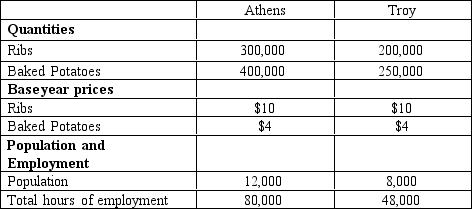 -Refer to Table 12-1. Which of the following is correct?
 (Multiple Choice)
4.8/5 (86)
(86) Workland has a population of 10,000, of whom 7,000 work 8 hours a day to produce a total of 224,000 final goods. Laborland has a population of 5,000, of whom 4,000 work 12 hours a day to produce a total of 120,000 final goods.
(Multiple Choice)
4.9/5 (87)
(87) Last year real GDP per person in the imaginary nation of Olympus was 4,500. The year before it was 4,250. By about what percentage did Olympian real GDP per person grow during the period?
(Multiple Choice)
4.8/5 (75)
(75) Which of the following is an example of a renewable natural resource?
(Multiple Choice)
4.7/5 (79)
(79) The population growth rate tends to be higher in developed countries than in developing countries.
(True/False)
4.9/5 (73)
(73) 
Filters
- Essay(0)
- Multiple Choice(0)
- Short Answer(0)
- True False(0)
- Matching(0)