



 Chat with AI
Exam 3: Interdependence and the Gains From Trade

Exam 1: Ten Principles of Economics347 Questions
Exam 2: Thinking Like an Economist535 Questions
Exam 3: Interdependence and the Gains From Trade442 Questions
Exam 4: The Market Forces of Supply and Demand569 Questions
Exam 5: Elasticity and Its Application503 Questions
Exam 6: Supply, Demand, and Government Policies556 Questions
Exam 7: Consumers, Producers, and the Efficiency of Markets460 Questions
Exam 8: Application: The Costs of Taxation422 Questions
Exam 9: Application: International Trade409 Questions
Exam 10: Measuring a Nations Income428 Questions
Exam 11: Measuring the Cost of Living436 Questions
Exam 12: Production and Growth417 Questions
Exam 13: Saving, Investment, and the Financial System473 Questions
Exam 14: The Basic Tools of Finance419 Questions
Exam 15: Unemployment571 Questions
Exam 16: The Monetary System423 Questions
Exam 17: Money Growth and Inflation388 Questions
Exam 18: Open-Economy Macroeconomic Models448 Questions
Exam 19: A Macroeconomic Theory of the Open Economy374 Questions
Exam 20: Aggregate Demand and Aggregate Supply471 Questions
Exam 21: The Influence of Monetary and Fiscal Policy on Aggregate Demand416 Questions
Exam 22: The Short-Run Trade-Off Between Inflation and Unemployment400 Questions
Exam 23: Six Debates Over Macroeconomic Policy235 Questions
Select questions type


Table 3-1
Assume that Andia and Zardia can switch between producing wheat and producing beef at a constant rate.  -Refer to Table 3-1. What is Zardia's opportunity cost of producing one pound of beef?
 (Multiple Choice)
4.8/5  (73)
(73) In an economy consisting of two people producing two goods, it is possible for one person to have the absolute advantage and the comparative advantage in both goods.
(True/False)
4.8/5 (81)
(81) Table 3-4
Assume that the farmer and the rancher can switch between producing meat and producing potatoes at a constant rate.  -Refer to Table 3-4. The opportunity cost of 1 pound of potatoes for the rancher is
 (Multiple Choice)
5.0/5 (72)
(72) Table 3-1
Assume that Andia and Zardia can switch between producing wheat and producing beef at a constant rate.
-Refer to Table 3-1. What is Andia's opportunity cost of producing one bushel of wheat?
-Refer to Table 3-1. What is Andia's opportunity cost of producing one bushel of wheat? (Multiple Choice)
4.8/5 (87)
(87) If a country has the comparative advantage in producing a product, then that country must also have the absolute advantage in producing that product.
(True/False)
4.8/5 (80)
(80) Figure 3-5
 -Refer to Figure 3-5. If Hosne and Merve both spend all of their time making wallets, then total production is
 (Multiple Choice)
4.8/5 (78)
(78) Table 3-7
Assume that Japan and Korea can switch between producing cars and producing airplanes at a constant rate.  -Refer to Table 3-7. We could use the information in the table to draw a production possibilities frontier for Japan and a second production possibilities frontier for Korea. If we were to do this, measuring cars along the horizontal axis, then
 (Multiple Choice)
4.8/5 (78)
(78) Figure 3-10
Alice and Betty's Production Possibilities in one 8-hour day. 

 -Refer to Figure 3-10. Which of the following statements is correct regarding comparative advantage?
 (Multiple Choice)
4.8/5 (74)
(74) Figure 3-8

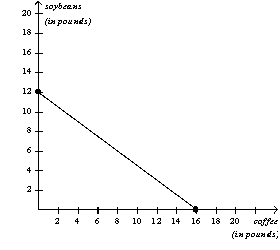
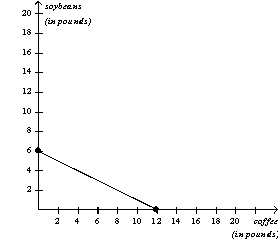 -Refer to Figure 3-8. Chile has a comparative advantage in the production of
 (Multiple Choice)
4.9/5 (75)
(75) Figure 3-4

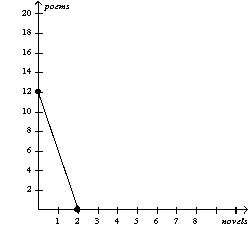
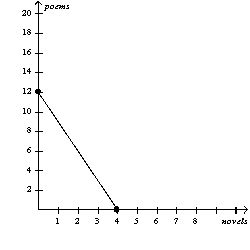 -Refer to Figure 3-4. Which of the following is not correct?
 (Multiple Choice)
4.8/5 (86)
(86) Table 3-8
Assume that Huang and Min can switch between producing parasols and producing porcelain plates at a constant rate.  -Refer to Table 3-8. Which of the following points would be on Min's production possibilities frontier, based on a 36-hour production period?
 (Multiple Choice)
4.9/5 (86)
(86) Table 3-3
Assume that Zimbabwe and Portugal can switch between producing toothbrushes and producing hairbrushes at a constant rate.  -Refer to Table 3-3. Which of the following combinations of toothbrushes and hairbrushes could Zimbabwe not produce in 120 minutes?
 (Multiple Choice)
4.9/5 (72)
(72) Figure 3-6
 -Refer to Figure 3-6. If the production possibilities frontier shown for Maxine is for 3 hours of work, then how long does it take Maxine to make one pie?
 (Multiple Choice)
4.8/5 (79)
(79) Figure 3-9

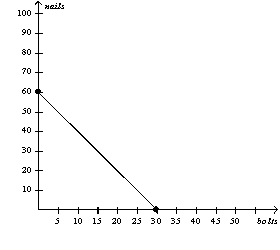
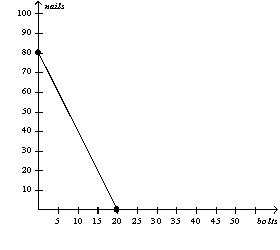 -Refer to Figure 3-9. If Uzbekistan and Azerbaijan each spends all its time producing the good in which it has a comparative advantage and trade takes place at a price of 12 bolts for 36 nails, then
 (Multiple Choice)
4.8/5 (82)
(82) Table 3-7
Assume that Japan and Korea can switch between producing cars and producing airplanes at a constant rate.
-Refer to Table 3-7. Assume that Japan and Korea each has 2400 hours available. If each country divides its time equally between the production of cars and airplanes, then total production is
-Refer to Table 3-7. Assume that Japan and Korea each has 2400 hours available. If each country divides its time equally between the production of cars and airplanes, then total production is (Multiple Choice)
4.8/5 (75)
(75) Table 3-2
Assume that Aruba and Iceland can switch between producing coolers and producing radios at a constant rate.  -Refer to Table 3-2. Suppose Aruba decides to increase its production of radios by 10. What is the opportunity cost of this decision?
 (Multiple Choice)
4.8/5 (74)
(74) Table 3-17
US and French Production Opportunities
Wire (in millions of pallons) Cheere (in millinns of lhs.) US 16 32 Frante 8 4
-Refer to Table 3-17 The US has a comparative advantage in the production of
(Multiple Choice)
4.8/5 (58)
(58) Table 3-5
Assume that England and Spain can switch between producing cheese and producing bread at a constant rate.  -Refer to Table 3-5. Which of the following combinations of cheese and bread could England not produce in 40 hours?
 (Multiple Choice)
4.9/5 (79)
(79) Table 3-4
Assume that the farmer and the rancher can switch between producing meat and producing potatoes at a constant rate.
-Refer to Table 3-4. The rancher has an absolute advantage in the production of
-Refer to Table 3-4. The rancher has an absolute advantage in the production of (Multiple Choice)
4.9/5 (70)
(70) Figure 3-7


 -Refer to Figure 3-7. The opportunity cost of 1 cup for Bintu is
 (Multiple Choice)
4.9/5 (78)
(78) 
Filters
- Essay(0)
- Multiple Choice(0)
- Short Answer(0)
- True False(0)
- Matching(0)