



 Chat with AI
Exam 15: Factor Markets

Exam 1: Introduction60 Questions
Exam 2: Supply and Demand151 Questions
Exam 3: Applying the Supply-And-Demand Model124 Questions
Exam 4: Consumer Choice125 Questions
Exam 5: Applying Consumer Theory118 Questions
Exam 6: Firms and Production128 Questions
Exam 7: Costs124 Questions
Exam 8: Competitive Firms and Markets127 Questions
Exam 9: Applying the Competitive Model156 Questions
Exam 10: General Equilibrium and Economic Welfare122 Questions
Exam 11: Monopoly147 Questions
Exam 12: Pricing and Advertising135 Questions
Exam 13: Oligopoly and Monopolistic Competition128 Questions
Exam 14: Game Theory109 Questions
Exam 15: Factor Markets103 Questions
Exam 16: Interest Rates, Investments, and Capital Markets120 Questions
Exam 17: Uncertainty122 Questions
Exam 18: Externalities, Open-Access, and Public Goods123 Questions
Exam 19: Asymmetric Information119 Questions
Exam 20: Contracts and Moral Hazards107 Questions
Select questions type


For a competitive firm the marginal revenue product of labor is usually downward sloping.
(True/False)
4.8/5  (82)
(82) If an upstream monopoly and a downstream monopoly vertically integrate into a profit-maximizing monopoly,then the total amount of deadweight loss in the industry
(Multiple Choice)
4.9/5 (85)
(85) In a perfectly competitive resource market the Marginal Revenue Product Curve is
(Multiple Choice)
5.0/5 (82)
(82) If the supply of labor to a monopsonist is everywhere unit elastic,and the marginal expenditure equals $1,then the wage will equal
(Multiple Choice)
4.8/5 (78)
(78) The long-run labor demand curve is relatively flatter than the short-run labor demand curve because,in the short run,
(Multiple Choice)
4.8/5 (92)
(92) Which of the following would be most able to act like a monopsonist?
(Multiple Choice)
4.9/5 (86)
(86) The difference between the marginal expenditure and the wage is greater when the supply curve of labor is
(Multiple Choice)
4.8/5 (84)
(84) Which of the following labor markets is more likely to be competitive?
(Multiple Choice)
4.8/5 (77)
(77) In a perfectly competitive resource market the labor supply curve facing the single firm is
(Multiple Choice)
4.8/5 (75)
(75) Suppose the labor market is competitive,the supply curve of labor is upward sloping,and the amount of capital is fixed.If the output market changes from a competitive market to a monopoly,what is the effect on its demand for labor? Explain.
(Essay)
4.7/5 (84)
(84) The gap between the value a monopsony places on the last worker hired and the wage paid will increase when
(Multiple Choice)
4.9/5 (77)
(77) Suppose the marginal product of labor equals 1/L.If the wage is $1 per unit of labor,what is the short-run effect on the firm's labor demand if the price of output were to double?
(Multiple Choice)
4.9/5 (99)
(99) If the supply of labor to a monopsonist is everywhere unit elastic,then the wage will equal
(Multiple Choice)
4.9/5 (74)
(74) 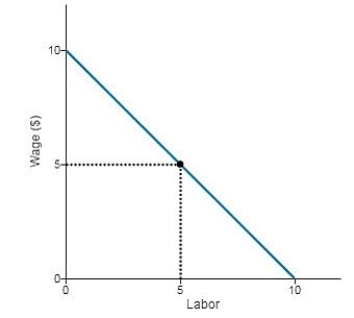 -The above figure shows a competitive firm's demand for labor assuming that the firm's output sells for $1 per unit.If the wage is $5 per hour,a ten cent specific tax on the good sold by the firm will cause the firm to
 (Multiple Choice)
4.8/5 (72)
(72) A monopolist faces a market demand curve with a constant elasticity of -2.The monopoly's production function is Q = 4L and its output price is given by p.What is the monopoly's marginal revenue product of labor function?
(Multiple Choice)
4.8/5 (79)
(79) For a monopsonist,the labor supply curve is upward sloping because
(Multiple Choice)
4.9/5 (68)
(68) 
Filters
- Essay(0)
- Multiple Choice(0)
- Short Answer(0)
- True False(0)
- Matching(0)