



 Chat with AI
Exam 12: Pricing and Advertising

Exam 1: Introduction60 Questions
Exam 2: Supply and Demand151 Questions
Exam 3: Applying the Supply-And-Demand Model124 Questions
Exam 4: Consumer Choice125 Questions
Exam 5: Applying Consumer Theory118 Questions
Exam 6: Firms and Production128 Questions
Exam 7: Costs124 Questions
Exam 8: Competitive Firms and Markets127 Questions
Exam 9: Applying the Competitive Model156 Questions
Exam 10: General Equilibrium and Economic Welfare122 Questions
Exam 11: Monopoly147 Questions
Exam 12: Pricing and Advertising135 Questions
Exam 13: Oligopoly and Monopolistic Competition128 Questions
Exam 14: Game Theory109 Questions
Exam 15: Factor Markets103 Questions
Exam 16: Interest Rates, Investments, and Capital Markets120 Questions
Exam 17: Uncertainty122 Questions
Exam 18: Externalities, Open-Access, and Public Goods123 Questions
Exam 19: Asymmetric Information119 Questions
Exam 20: Contracts and Moral Hazards107 Questions
Select questions type


Suppose group price discrimination is possible; however,a firm sets the same price in each market.As a result,
(Multiple Choice)
4.9/5  (84)
(84) What is one reason consumers might demand a discount for quantity purchases?
(Multiple Choice)
4.7/5 (92)
(92) Suppose all individuals are identical,and their monthly demand for Internet access from a certain leading provider can be represented as p = 5 - (1/2)q where p is price in $ per hour and q is hours per month.The firm faces a constant marginal cost of $1.If the firm will charge a monthly access fee plus a per hour rate,the monthly access fee will equal
(Multiple Choice)
4.8/5 (79)
(79) At the current price of a good,Al's consumer surplus equals 15 and Ben's consumer surplus equals 15.By using two-part pricing,a monopolist could increase his profit by
(Multiple Choice)
5.0/5 (72)
(72) Suppose all individuals are identical,and their monthly demand for Internet access from a certain leading provider can be represented as p = 5 - (1/2)q where p is price in $ per hour and q is hours per month.The firm faces a constant marginal cost of $1.Potential consumer surplus equals
(Multiple Choice)
4.9/5 (78)
(78) Assume a company can offer customers cable television and Internet service at essentially zero marginal and average cost.The following table shows each customer's marginal willingness to pay for television,Internet services,and for a bundle containing both.Which strategy yields the maximum profit,and what maximum profit is obtained? 
(Multiple Choice)
4.8/5 (77)
(77) If you purchase one pound of apples the price is $1.50 per pound.If you buy a five pound bag of apples,the cost is $5.00.This is most likely an example of
(Multiple Choice)
4.9/5 (82)
(82) Pizza joints often offer substantially lower prices for pizza picked up at the shop compared to delivered pizza prices.This may be an attempt at
(Multiple Choice)
4.8/5 (77)
(77) A perfect price discriminator receives a price equal to marginal revenue for each unit.
(True/False)
4.8/5 (79)
(79) Suppose two countries,A and B,are at war with each other.Country A is very wealthy; country B is very poor.The XYZ Co.produces tanks.Is XYZ able to set a different price for the tank sold to country A than the price for the tank sold to country B? Explain.
(Essay)
4.8/5 (66)
(66) If Ben values good X more than good Y,and Catherine values good Y more than good X,a firm can increase its profits by
(Multiple Choice)
4.9/5 (78)
(78) Suppose a monopoly sells to two identifiably different types of customers,A and B,who are unable to practice arbitrage.The inverse demand curve for group A is PA = 10 - QA,and the inverse demand curve for group B is PB = 18 - QB.The monopolist is able to produce the good for either type of customer at a constant marginal cost of 2,and the monopolist has no fixed costs.If the monopolist is able to practice group price discrimination,the values of the elasticities of the two groups at the profit-maximizing prices are
(Multiple Choice)
4.9/5 (74)
(74) If two markets have the same price elasticity of demand at every price,a monopoly will not practice multimarket price discrimination.
(True/False)
4.9/5 (68)
(68) A monopolist has a marginal cost of $10 and no fixed cost.It faces the following inverse demand curve: p = 80 - q.The monopolist can engage in an advertising campaign that leads to a new inverse demand curve represented by p = 100 - q.What is the maximum amount that the monopolist is willing to spend in this campaign?
(Multiple Choice)
4.8/5 (80)
(80) A perfect-price-discriminating monopoly's marginal revenue curve
(Multiple Choice)
4.8/5 (77)
(77) 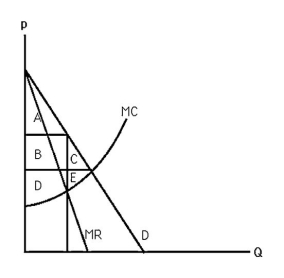 -The above figure shows the market for a particular good.If the market is controlled by a perfect-price-discriminating monopoly,the deadweight loss equals
 (Multiple Choice)
4.9/5 (98)
(98) A firm that holds a monopoly in both goods stands to gain from a tie-in sale.
(Multiple Choice)
4.8/5 (70)
(70) 
Filters
- Essay(0)
- Multiple Choice(0)
- Short Answer(0)
- True False(0)
- Matching(0)