



 Chat with AI
Exam 14: Premolars

Exam 1: Oral Cavity30 Questions
Exam 2: The Tooth: Functions and Terms35 Questions
Exam 3: Fundamental and Preventive Curvatures23 Questions
Exam 4: Dentition25 Questions
Exam 5: Development, form, and Eruption27 Questions
Exam 6: Occlusion30 Questions
Exam 7: Dental Anomalies23 Questions
Exam 8: Supporting Structures31 Questions
Exam 9: Clinical Considerations26 Questions
Exam 10: Tooth Identification30 Questions
Exam 11: Root Morphology31 Questions
Exam 12: Incisors26 Questions
Exam 13: Canines28 Questions
Exam 14: Premolars29 Questions
Exam 15: Molars35 Questions
Exam 16: Deciduous Dentition30 Questions
Exam 17: Basic Tissues32 Questions
Exam 18: Development of Orofacial Complex31 Questions
Exam 19: Dental Lamina and Enamel Organ29 Questions
Exam 20: Enamel, Dentin, and Pulp33 Questions
Exam 21: Root Formation and Attachment Apparatus33 Questions
Exam 22: Eruption and Shedding of Teeth29 Questions
Exam 23: Oral Mucous Membrane29 Questions
Exam 24: The Tongue30 Questions
Exam 25: Histology of the Salivary Glands29 Questions
Exam 26: Osteology of the Skull35 Questions
Exam 27: Nose, Nasal Cavity, and Paranasal Sinuses28 Questions
Exam 28: Muscles of Mastication, Hyoid Muscles, and Sternocleidomastoid and Trapezius Muscles30 Questions
Exam 29: Tempo-romandibular Joint28 Questions
Exam 30: Muscles of Facial Expression28 Questions
Exam 31: Soft Palate and Pharynx31 Questions
Exam 32: Arterial Supply and Venous Drainage29 Questions
Exam 33: Salivary Glands27 Questions
Exam 34: Nervous System33 Questions
Exam 35: Lymphatics and Spread of Dental Infection29 Questions
Exam 36: Anatomical Considerations of Local Anesthesia30 Questions
Select questions type


The mandibular second premolar shows evidence of calcification at 2.5 years.Completion of enamel formation does not occur,until 11 to 12 years.

Free
(Multiple Choice)
4.7/5  (76)
(76) Correct Answer: Verified
B
Premolars erupt between 9 and 12 years of age.Premolars are the succedaneous teeth that replace primary canines.
Free
(Multiple Choice)
4.8/5 (82)
(82) Correct Answer:Verified
VerifiedD
Which selection best describes the roots of the maxillary first premolar?
Free
(Multiple Choice)
4.7/5 (77)
(77) Correct Answer:Verified
VerifiedB
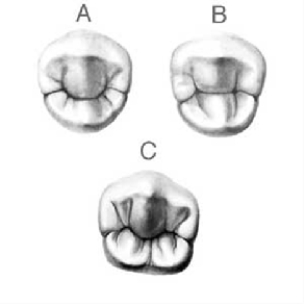
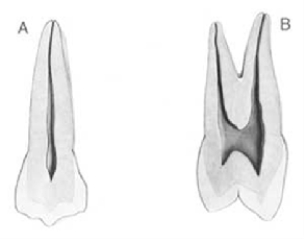
In figure "A" below,identify the tooth,the number of cusps,and groove pattern.
(Multiple Choice)
4.9/5 (77)
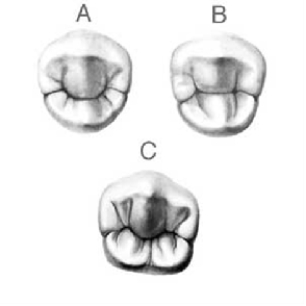
(77) In figure "B" below,identify the tooth,the number of cusps,and groove pattern.
(Multiple Choice)
4.9/5 (75)
(75) As a rule,the mandibular first premolars are always smaller than the mandibular second premolars.The most striking identifying feature of the mandibular first premolar is the mesiolingual developmental groove.
(Multiple Choice)
4.9/5 (79)
(79) The lingual surface of premolars is formed from how many lobes?
(Multiple Choice)
5.0/5 (76)
(76) Maxillary second premolars have a smoother,less detailed occlusal surface than first premolars.
(True/False)
4.9/5 (71)
(71) Any ridge that extends from the cusp tip to the central groove of the occlusal surface is called a marginal ridge.When two marginal ridges join,after traversing the tooth buccolingually,they form a transverse ridge.
(Multiple Choice)
4.9/5 (72)
(72) Which of the following are true of both maxillary first premolars and maxillary second premolars (Select all that apply. )?
(Multiple Choice)
4.8/5 (83)
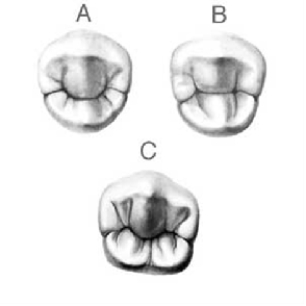
(83) In figure "C" below,identify the tooth,the number of cusps,and groove pattern.
(Multiple Choice)
4.7/5 (68)
(68) Which of the following are true of the maxillary second premolars (Select all that apply. )?
(Multiple Choice)
4.9/5 (92)
(92) Which premolar has buccal and lingual cusps that are almost the same height?
(Multiple Choice)
4.9/5 (97)
(97) Mandibular first premolars typically have two roots,a mesial and a distal.An anomaly is formation of a third auxiliary root.
(Multiple Choice)
4.8/5 (75)
(75) The overall height of the premolars is longer than that of the canines because the root of the premolars is considerably longer than those of the canines.
(Multiple Choice)
4.7/5 (67)
(67) 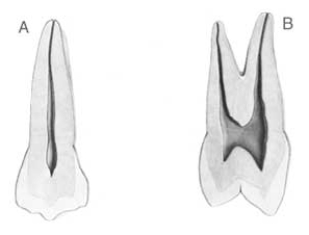
Each of the following is evident on a maxillary first premolar EXCEPT one.Which one is the EXCEPTION?
(Multiple Choice)
4.7/5 (78)
(78) Which of the following are located on the occlusal surfaces of premolars (Select all that apply. )?
(Multiple Choice)
4.9/5 (81)
(81) 

Filters
- Essay(0)
- Multiple Choice(0)
- Short Answer(0)
- True False(0)
- Matching(0)