



 Chat with AI
Exam 10: Credit Risk: Individual Loans

Exam 1: Why Are Financial Institutions Special90 Questions
Exam 2: Deposit-Taking Institutions43 Questions
Exam 3: Finance Companies71 Questions
Exam 4: Securities, Brokerage, and Investment Banking91 Questions
Exam 5: Mutual Funds, Hedge Funds, and Pension Funds61 Questions
Exam 6: Insurance Companies80 Questions
Exam 7: Risks of Financial Institutions110 Questions
Exam 8: Interest Rate Risk I110 Questions
Exam 9: Interest Rate Risk II116 Questions
Exam 10: Credit Risk: Individual Loans112 Questions
Exam 11: Credit Risk: Loan Portfolio and Concentration Risk51 Questions
Exam 12: Liquidity Risk85 Questions
Exam 13: Foreign Exchange Risk87 Questions
Exam 14: Sovereign Risk89 Questions
Exam 15: Market Risk95 Questions
Exam 16: Off-Balance-Sheet Risk101 Questions
Exam 17: Technology and Other Operational Risks107 Questions
Exam 18: Liability and Liquidity Management38 Questions
Exam 19: Deposit Insurance and Other Liability Guarantees54 Questions
Exam 20: Capital Adequacy102 Questions
Exam 21: Product and Geographic Expansion114 Questions
Exam 22: Futures and Forwards234 Questions
Exam 23: Options, Caps, Floors, and Collars113 Questions
Exam 24: Swaps95 Questions
Exam 25: Loan Sales83 Questions
Exam 26: Securitization Index98 Questions
Select questions type


Adjusting interest rates, fees, and other terms upward for increasing amounts of default risk is a way to attempt to realize the expected return on the loan.
(True/False)
5.0/5  (75)
(75) There is a positive relationship between the interest rate charged on a retail loan and the expected return on the loan.
(True/False)
4.9/5 (85)
(85) Junk bonds are bonds that are rated less than investment grade by bond-rating agencies.
(True/False)
4.8/5 (75)
(75) What refers to the risk that the borrower is unable or unwilling to fulfill the terms promised under the loan contract?
(Multiple Choice)
4.9/5 (82)
(82) Long-term loans are more likely to be made under a loan commitment agreement than short-term loans.
(True/False)
4.7/5 (81)
(81) Which of the following is the major weakness of the linear probability model?
(Multiple Choice)
4.8/5 (86)
(86) A major advantage of discriminant models is the stability of the coefficient weights over time.
(True/False)
4.8/5 (74)
(74) Sustained credit quality problems can drain an FI's capital and net worth.
(True/False)
4.7/5 (72)
(72) A borrower's reputation is an example of a market-specific factor in the credit decision.
(True/False)
4.8/5 (83)
(83) In terms of rating agencies such as S&P, investment grade companies are those whose bond ratings are grade B or above.
(True/False)
4.8/5 (71)
(71) The following represents two yield curves. 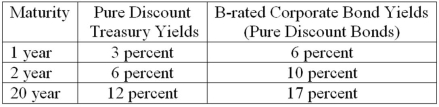 What is the implied probability of repayment on one-year B - rated debt?
 (Multiple Choice)
4.8/5 (94)
(94) Credit scoring models include all of the following broad types of models EXCEPT
(Multiple Choice)
4.8/5 (82)
(82) Which of the following is a problem in using discriminant analysis to evaluate credit risk?
(Multiple Choice)
4.7/5 (80)
(80) Covenants are restrictions in loan and bond agreements that encourage or forbid certain actions by the borrower.
(True/False)
4.8/5 (74)
(74) A major problem in estimating RAROC is the measurement of loan risk.
(True/False)
4.9/5 (83)
(83) The amount of security or collateral on a loan and the interest rate or risk premium on a loan normally are negatively related.
(True/False)
4.9/5 (91)
(91) A secured loan has a claim to specific assets of the borrower in the case of default.
(True/False)
5.0/5 (87)
(87) The following represents two yield curves. 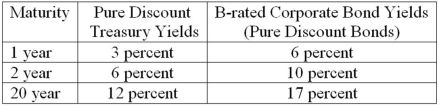 What is the probability that two-year B-rated corporate debt will be fully repaid?
 (Multiple Choice)
4.9/5 (78)
(78) 
Filters
- Essay(0)
- Multiple Choice(0)
- Short Answer(0)
- True False(0)
- Matching(0)