



 Chat with AI
Exam 11: Cardiovascular System

Exam 1: Cellular Responses to Injury5 Questions
Exam 2: Acute Inflammation, Healing and Repair13 Questions
Exam 3: Chronic Inflammation9 Questions
Exam 4: Infections of Histological Importance18 Questions
Exam 5: Amyloidosis3 Questions
Exam 6: Disorders of Growth3 Questions
Exam 7: Dysplasia and Neoplasia2 Questions
Exam 8: Atherosclerosis8 Questions
Exam 9: Thrombosis and Embolism7 Questions
Exam 10: Infarction9 Questions
Exam 11: Cardiovascular System12 Questions
Exam 12: Respiratory System11 Questions
Exam 13: Gastrointestinal System8 Questions
Exam 14: Liver and Pancreaticobiliary System8 Questions
Exam 15: Urinary System9 Questions
Exam 16: Lymphoid and Haematopoietic Systems6 Questions
Exam 17: Female Reproductive System7 Questions
Exam 18: Breast7 Questions
Exam 19: Male Reproductive System2 Questions
Exam 20: Endocrine System4 Questions
Exam 21: Skin8 Questions
Exam 22: Bone and Soft Tissues6 Questions
Exam 23: Nervous System8 Questions
Select questions type


A 30 year old male homosexual,who was HIV-positive,presented to his primary care physician complaining of a rash on his arm.He had not been taking his anti-retroviral drugs,due to the side effects.Numerous,slightly raised,purple lesions were noted on the patient's forearm by the examining physician.A biopsy of one of the nodules was performed.A representative section of the biopsy is shown in the accompanying photomicrograph.Which one of the following is the most likely diagnosis? 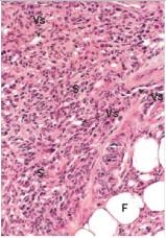

Free
(Multiple Choice)
4.9/5  (90)
(90) Correct Answer: Verified
E
A 67 year old man,with a known history of inoperable pancreatic adenocarcinoma,suddenly developed symptoms of a massive stroke,losing the ability to walk.He subsequently died from cerebral oedema,and the family requested an autopsy.In the accompanying low power photomicrograph of a mitral valve leaflet (L),the thrombus (T)attached to the leaflet was probably caused by which one of the following pathophysiologic conditions? 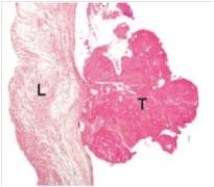
Free
(Multiple Choice)
4.9/5 (70)
(70) Correct Answer:Verified
VerifiedE
A 54 year old man presented to his primary care physician complaining of headache.A tortuous artery,which was indurated and tender to touch,was noted on his forehead.A representative section of a biopsy of this artery is shown in the accompanying photomicrograph,in low and high power.Which one of the following is the best diagnosis? 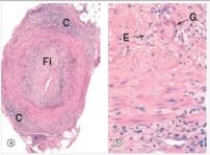
Free
(Multiple Choice)
4.8/5 (63)
(63) Correct Answer:Verified
VerifiedB
A 15 year old girl developed fever,aching joints,and a heart murmur.Her past medical history was negative,except for a "Strep throat" approximately 6 weeks prior,for which she did not seek treatment.An endomyocardial biopsy was performed,via the external jugular vein,a representative section of which is shown in the accompanying photomicrograph.Which one of the following best describes the pathology seen in the biopsy? 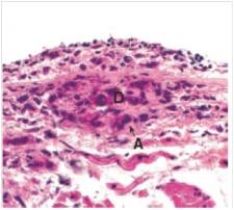
(Multiple Choice)
4.9/5 (77)
(77) The low power photomicrograph of the aorta demonstrates a pathologic condition that is usually related to which one of the following disorders? 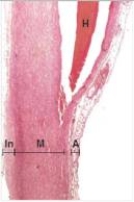
(Multiple Choice)
4.9/5 (79)
(79) This high power photomicrograph of a renal arteriole in a patient with severe hypertension depicts a serious condition that is known by which one of the following words or phrases? 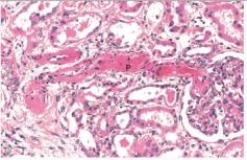
(Multiple Choice)
5.0/5 (64)
(64) A 24 year old woman,who was otherwise in excellent health,presented at the Emergency Department complaining of abdominal pain.Her past medical history was notable only for oral contraceptives.A peritoneal tap disclosed gross blood so emergency open laparotomy (abdominal exploration)was performed.A bleeding mass in the liver (L)was found,resected,and good haemostasis was obtained.The patient recovered without further incident.A representative section of the resected mass is shown in the accompanying photomicrograph.Which one of the following is the best diagnosis? 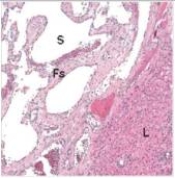
(Multiple Choice)
5.0/5 (82)
(82) In this medium power photomicrograph of a medium artery in a patient with systemic hypertension,the area of the image labelled "In" depicts which one of the following pathologic processes? 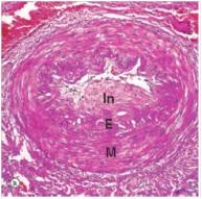
(Multiple Choice)
4.8/5 (78)
(78) A 38 year old female was seen for "fever of unknown origin" (FUO).In addition to fever,she was experiencing abdominal pain.Finally,it was decided that an appendicectomy was required,as her pain seemed to favour the right lower quadrant.The appendix was essentially normal microscopically,but a small artery in the fat surrounding the appendix demonstrated the findings seen in the accompanying photomicrograph.Which one of the following is the best diagnosis? 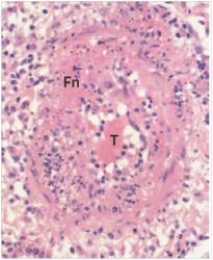
(Multiple Choice)
4.9/5 (78)
(78) A 16 year old female was given penicillin for an apparent "Strep throat".She soon developed a reddish-appearing skin rash,which was firm when palpated.A biopsy was performed.A representative section of the biopsy is shown in the accompanying photomicrograph.Which one of the following is the best diagnosis? 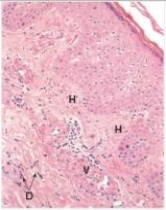
(Multiple Choice)
4.7/5 (70)
(70) In this high power photomicrograph of a renal arteriole from a diabetic patient,the area of the image labelled "H" depicts which one of the following pathologic processes? 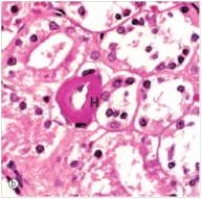
(Multiple Choice)
4.8/5 (84)
(84) This high power photomicrograph of a medium sized artery in a patient with severe hypertension depicts a serious condition that is known by which one of the following words or phrases? 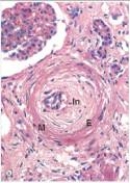
(Multiple Choice)
4.8/5 (88)
(88) 
Filters
- Essay(0)
- Multiple Choice(0)
- Short Answer(0)
- True False(0)
- Matching(0)