



 Chat with AI
Exam 17: Biological Diversity, Bacteria, and Archaea

Exam 1: The Nature of Science and the Characteristics of Life80 Questions
Exam 2: The Chemistry of Life93 Questions
Exam 3: Cell Structure and Internal Compartments89 Questions
Exam 4: Cell Membranes, Transport, and Communication89 Questions
Exam 5: Energy, Metabolism, and Enzymes85 Questions
Exam 6: Photo Synthesis and Cellular Respiration89 Questions
Exam 7: Cell Division84 Questions
Exam 8: Cancer and Human Health86 Questions
Exam 9: Patterns of Inheritance86 Questions
Exam 10: Chromosomes and Human Genetics77 Questions
Exam 11: DNA and Genes83 Questions
Exam 12: From Gene to Protein88 Questions
Exam 13: DNA Technology96 Questions
Exam 14: How Evolution Works72 Questions
Exam 15: The Origin of Species76 Questions
Exam 16: The Evolution of Biodiversity102 Questions
Exam 17: Biological Diversity, Bacteria, and Archaea80 Questions
Exam 18: Protista, Plantae, and Fungi83 Questions
Exam 19: Animalia80 Questions
Exam 20: The Biosphere88 Questions
Exam 21: Growth of Populations70 Questions
Exam 22: Animal Behavior82 Questions
Exam 23: Ecological Communities105 Questions
Exam 24: Ecosystems74 Questions
Exam 25: Global Change73 Questions
Select questions type


There are currently three recognized domains; which of the following is NOT included within this system?
(Multiple Choice)
4.8/5  (85)
(85) What do these products have in common-soy sauce,yogurt,Swiss cheese,and buttermilk?
(Multiple Choice)
4.8/5 (73)
(73) The concept that includes all living things as well as the nonliving things they interact with is ________.
(Short Answer)
4.9/5 (80)
(80) A disease-causing cellular organism is found in the lungs of a patient with a respiratory infection.This cellular organism in most likely a(n)
(Multiple Choice)
4.9/5 (76)
(76) What best explains why bacteria can reproduce so much more rapidly than an organism such as a mushroom?
(Multiple Choice)
4.8/5 (78)
(78) Students in a biology class count all the different types of plants in a 3 ´ 3-foot quadrant on their college campus.They are studying
(Multiple Choice)
4.9/5 (73)
(73) The most commonly used classification system includes 12 kingdoms.
(True/False)
4.7/5 (77)
(77) What aspect of the viral life cycle depicted in the following illustration explains the pathology associated with a viral infection? 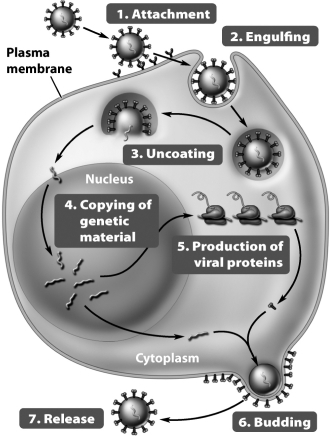
(Multiple Choice)
4.7/5 (75)
(75) A young girl swimming in a lake on a warm summer day is infected with the amoeba Naegleria fowleri.She is infected with a(n)
(Multiple Choice)
4.7/5 (78)
(78) The following photograph shows Sulfolobus,an archaean that lives in environments with very high temperatures. 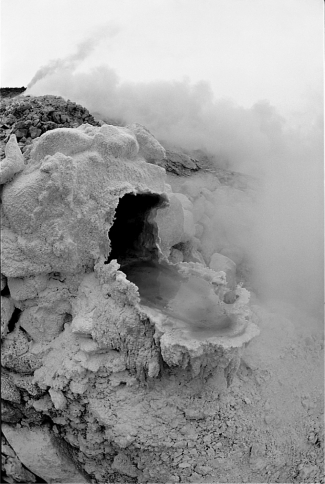 What hypothesis can explain the extreme habitats of the archaeans?
 (Multiple Choice)
4.8/5 (67)
(67) The influenza virus evolves rapidly because DNA changes are frequently incorporated into the virus as it is being made.
(True/False)
4.7/5 (75)
(75) Using the simplest methods to study the composition of intestinal microbial flora,it is necessary to collect a ________ sample from the subject.
(Short Answer)
4.9/5 (70)
(70) The kingdom Bacteria consists of the same species as the domain Bacteria.
(True/False)
4.9/5 (77)
(77) Carbon and energy are among the most basic life resources and organisms that have been classified with respect to how they are obtained.What term describes an organism that obtains these substances from inorganic molecules in rock and air?
(Multiple Choice)
5.0/5 (80)
(80) Prokaryotes differ in several ways from eukaryotes; one of the most distinctive is
(Multiple Choice)
4.8/5 (86)
(86) During nitrogen fixation,bacteria convert toxic ammonia into atmospheric nitrogen.
(True/False)
4.7/5 (81)
(81) A viral particle is very simple,consisting of a core of DNA or RNA surrounded by a ________.
(Short Answer)
4.8/5 (77)
(77) 
Filters
- Essay(0)
- Multiple Choice(0)
- Short Answer(0)
- True False(0)
- Matching(0)