



 Chat with AI
Exam 16: The Evolution of Biodiversity

Exam 1: The Nature of Science and the Characteristics of Life80 Questions
Exam 2: The Chemistry of Life93 Questions
Exam 3: Cell Structure and Internal Compartments89 Questions
Exam 4: Cell Membranes, Transport, and Communication89 Questions
Exam 5: Energy, Metabolism, and Enzymes85 Questions
Exam 6: Photo Synthesis and Cellular Respiration89 Questions
Exam 7: Cell Division84 Questions
Exam 8: Cancer and Human Health86 Questions
Exam 9: Patterns of Inheritance86 Questions
Exam 10: Chromosomes and Human Genetics77 Questions
Exam 11: DNA and Genes83 Questions
Exam 12: From Gene to Protein88 Questions
Exam 13: DNA Technology96 Questions
Exam 14: How Evolution Works72 Questions
Exam 15: The Origin of Species76 Questions
Exam 16: The Evolution of Biodiversity102 Questions
Exam 17: Biological Diversity, Bacteria, and Archaea80 Questions
Exam 18: Protista, Plantae, and Fungi83 Questions
Exam 19: Animalia80 Questions
Exam 20: The Biosphere88 Questions
Exam 21: Growth of Populations70 Questions
Exam 22: Animal Behavior82 Questions
Exam 23: Ecological Communities105 Questions
Exam 24: Ecosystems74 Questions
Exam 25: Global Change73 Questions
Select questions type


Which of the following is NOT an effect of mass extinctions on the diversity of life?
(Multiple Choice)
4.8/5  (96)
(96) At which labeled point in the following graph are the first eukaryotes thought to have evolved? 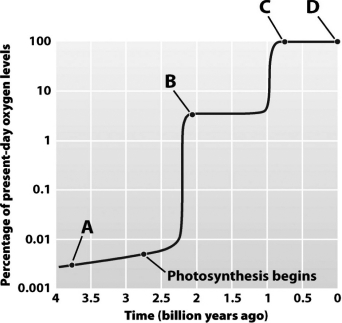
(Multiple Choice)
5.0/5 (75)
(75) If a gene from the coelacanth that drives the development of limbs in the coelacanth embryo was inserted into rats,what would the result likely be?
(Multiple Choice)
4.8/5 (84)
(84) Among the first organisms to colonize land were descendants of ____________________.
(Short Answer)
4.9/5 (72)
(72) Fossils found closer to the surface are usually older than those buried deeper in the Earth's crust.
(True/False)
4.8/5 (85)
(85) Continental drift has played a role in all of the following except ________.
(Multiple Choice)
4.8/5 (56)
(56) Measuring the amount of the radioisotope ¹⁴C in a fossil that is assumed to be over 70,000 years is a good way to determine the age of the fossil.
(True/False)
4.9/5 (89)
(89) Two organisms that are more closely related will generally possess more homologous traits than two organisms that are more distantly related.
(True/False)
4.7/5 (68)
(68) The lowest level of classification in the Linnaean hierarchy is the species.
(True/False)
5.0/5 (81)
(81) Why might many new species form in the aftermath of a mass extinction?
(Multiple Choice)
4.7/5 (67)
(67) A trait that represents a reversion to an ancestral state is known as a(n)____________.
(Multiple Choice)
4.8/5 (82)
(82) The genes that once encoded the development of the human tail may still be present in the human genome.
(True/False)
4.8/5 (85)
(85) The most recent mass extinction,which occurred during the Cretaceous period,may have been caused by ______________.
(Multiple Choice)
4.9/5 (71)
(71) Which of the following reflects the order of the Linnaean hierarchy from the highest-level (or most general)to the lowest-level (or most specific)taxon?
(Multiple Choice)
4.8/5 (67)
(67) A particular homeotic gene,if it is present in an organism's genome,will be active in every cell in that organism's body.
(True/False)
4.9/5 (70)
(70) The earliest forms of life evolved and lived in ____________________.
(Short Answer)
4.8/5 (89)
(89) The appearance of a tail on a human baby would be an example of an atavistic trait.
(True/False)
4.8/5 (76)
(76) Which of the following is an example of a human atavistic trait?
(Multiple Choice)
4.9/5 (79)
(79) During the time of Pangaea,an ancestor of modern crocodiles inhabited the region marked by the star in this map (left in the following figure). 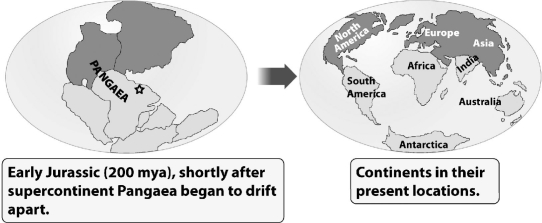 Where would you expect to find fossils of this animal today (the map on the right)?
 (Multiple Choice)
4.8/5 (92)
(92) 
Filters
- Essay(0)
- Multiple Choice(0)
- Short Answer(0)
- True False(0)
- Matching(0)