



 Chat with AI
Exam 6: Color Perception

Exam 1: What Is Perception60 Questions
Exam 2: Research Methodology60 Questions
Exam 3: Visual System: The Eye60 Questions
Exam 4: Visual System: The Brain60 Questions
Exam 5: Object Perception65 Questions
Exam 6: Color Perception60 Questions
Exam 7: Depth and Size Perception60 Questions
Exam 8: Movement and Action60 Questions
Exam 9: Visual Attention60 Questions
Exam 10: The Auditory System60 Questions
Exam 11: The Auditory Brain and Sound Localization60 Questions
Exam 12: Speech Perception60 Questions
Exam 13: Music Perception59 Questions
Exam 14: Touch and Pain60 Questions
Exam 15: Olfaction and Taste59 Questions
Select questions type


Because infants cannot describe what they see, researchers test infants' perception of color using a process called ______.

Free
(Multiple Choice)
4.9/5  (90)
(90) Correct Answer: Verified
C
Which of the following changes in color perception is most likely to happen as a person ages?
Free
(Multiple Choice)
4.7/5 (71)
(71) Correct Answer:Verified
VerifiedD
Additive color mixing is used in which of the following technologies?
Free
(Multiple Choice)
4.8/5 (79)
(79) Correct Answer:Verified
VerifiedC
In this color circle, what dimension of color is represented by the perimeter of the circle? 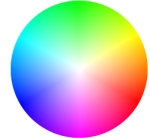
(Multiple Choice)
4.8/5 (70)
(70) An object appears red despite the fact that it is illuminated by a green light or a yellow light.This phenomenon is known as ______.
(Multiple Choice)
4.7/5 (85)
(85) In the figure below, the two inner circles are identical physically.That the surroundings make them appear to have different colors is an example of ______. 
(Multiple Choice)
4.9/5 (83)
(83) The trichromatic theory of color vision states that the color of any light is determined by the output of the three cone systems in our retinae.
(True/False)
4.8/5 (82)
(82) In an experiment in color matching, an observer is shown two patches of light.One is called the test patch, and the other is called the comparison patch.The test patch is a single wavelength of an unchanging illumination or brightness.The comparison patch is composed of three primary colors, such as the red, green, and blue used in a television.The observer has control over the intensities of the three lights in the comparison patch.The observer should be able to ______.
(Multiple Choice)
4.9/5 (78)
(78) Experiments have shown that although infants have all three types of cones, they have not yet developed the mental concept of color.
(True/False)
4.8/5 (79)
(79) Loss of color vision caused by damage to the occipital lobe is known as ______.
(Multiple Choice)
4.7/5 (79)
(79) A phenomenon whereby an intensely lit black object appears to be gray or white in a homogeneously dark space is known as ______.
(Multiple Choice)
4.9/5 (72)
(72) That the color of any light is determined by the output of the three cone systems in our retinae is known as the ______ theory of color vision.
(Multiple Choice)
4.8/5 (89)
(89) The Gelb effect is a phenomenon whereby an intensely lit black object appears white in a homogeneously dark space, thereby demonstrating the principle of lightness constancy.
(True/False)
4.8/5 (91)
(91) The band of wavelengths from 400 to 700 nm that people with normal vision can detect is known as the ______.
(Multiple Choice)
4.9/5 (64)
(64) People with protanopia and deuteranopia are both considered red-green color-deficient.
(True/False)
5.0/5 (89)
(89) This image is known as a ______ and it serves to determine if a person is ______. 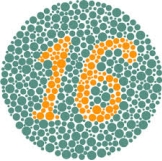
(Multiple Choice)
4.9/5 (86)
(86) Two conditions lead to a red-green deficiency.One is ______, or a lack of L-cones, while the other is ______, or a lack of M-cones.
(Multiple Choice)
4.9/5 (83)
(83) White light, consisting of many wavelengths, is known as ______, whereas light consisting of one wavelength is known as ______.
(Multiple Choice)
4.8/5 (89)
(89) 
Filters
- Essay(0)
- Multiple Choice(0)
- Short Answer(0)
- True False(0)
- Matching(0)