



 Chat with AI
Exam 7: Investments


In the current year,Norris,an individual,has $50,000 of ordinary income,a Net Short Term Capital Loss (NSTCL)of $10,000 and a Net Long Term Capital Gain (NLTCG)of $2,800.From his capital gains and losses,Norris reports:

 (88)
 Verified
E
In X8,Erin had the following capital gains (losses)from the sale of her investments: $2,000 LTCG,$25,000 STCG,($9,000)LTCL,and ($15,000)STCL.What is the amount and nature of Erin's capital gains and losses?
(78) VerifiedA
Henry,a single taxpayer with a marginal tax rate of 35 percent,sold the following assets during the year:
 *$25,000 of the gain is a 25 percent gain.The remaining gain is 0/15/20 percent gain.
What tax rate(s)will apply to Henry's capital gains or losses?
*$25,000 of the gain is a 25 percent gain.The remaining gain is 0/15/20 percent gain.
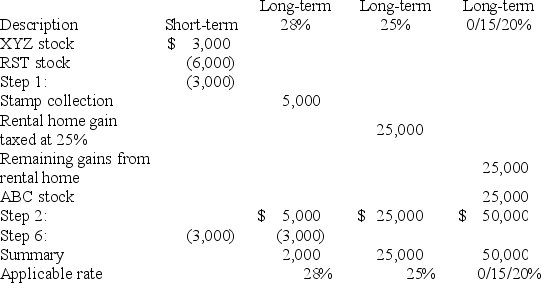
What tax rate(s)will apply to Henry's capital gains or losses? (71) VerifiedA $2,000 long-term capital gain taxed at 28%,$25,000 long-term capital gains taxed at 25% and $50,000 long-term capital gain taxed at 15%.
See computations below:
Step 1: ($3,000)net short-term capital loss [$3,000 + ($6,000)].
Step 2: The $25,000 gain on the ABC stock,and $25,000 of gain from the rental home are placed in the 0/15/20 percent group resulting in $50,000 of 0/15/20 percent gains.$25,000 of the gain from the rental property is placed in the 25 percent group,and the $5,000 gain on the stamp collection is placed in the 28 percent group.
Step 3: (B)Proceed to step 6.
Step 4: Not required.
Step 5: Not required.
Step 6: Move the ($3,000)loss from Step 1 into the 28 percent group to offset the $5,000 gain from the stamp collection.This step leaves $2,000 to be taxed at a maximum of 28 percent,$25,000 taxed at a maximum of 25 percent,and $50,000 taxed at 15 percent because Henry's marginal tax rate is 35 percent.
Step 7: Not required.
The netting process for capital gains (losses)with 0/15/20 percent,25 percent,and 28 percent capital assets helps maximize the tax benefit of:
(75) Roy,a resident of Michigan,owns 25 percent of a fourplex in the nearby college town of Ann Arbor with three other friends.The fourplex is rented to students who attend the University of Michigan.Roy's responsibility is to approve new tenants each year and take care of any maintenance issues.During the year,the rental property generated a $25,000 loss,which was split equally among Roy and his three friends.Assuming Roy's only source of income was $145,000 of salary,how much of the rental loss can Roy deduct this year and what amount must be carried forward?
(73) Taxpayers may make an election to include long-term capital gains and qualified dividends in net investment income and deduct more investment interest expense currently if they are willing to subject this income to ordinary tax rates.
(75) What is the tax treatment for qualified small business stock acquired in 2017 and held for more than five years and what is the tax treatment if held for less than five years?
(75) Generally,which of the following does not correctly categorize the type of income?
(78) When calculating net investment income,gross investment income includes:
(77) The Crane family recognized the following types of investment income during 20X6: (1)$1,500 qualified dividends,(2)$3,000 long-term capital gains,and (3)$850 taxable interest.Additionally,the Crane family has $500 in investment expenses and their other miscellaneous itemized deductions exceed 2% of their AGI for the year.The Crane family paid $3,333 in investment interest expense during 20X6.Calculate the different possibilities to determine the maximum deduction for investment interest expense for the Crane family in 20X6.From these possibilities,which provides the maximum deduction?
(84) Sue invested $5,000 in the ABC Limited Partnership and received a 10 percent interest in the partnership.The partnership had $20,000 of qualified nonrecourse debt and $20,000 of debt she is not responsible to repay because she is a limited partner.Sue is allocated a 10 percent share of both types of debt resulting in a tax basis of $9,000 and an at risk amount of $7,000.During the year,ABC LP generated a ($90,000)loss.How much of Sue's loss is disallowed due to her tax basis or at-risk amount?
(89) Doug and Sue Click file a joint tax return and decide to itemize their deductions.The Click's income for the year consists of $90,000 in salary,$2,000 interest income,$800 long-term capital loss.The Click's expenses for the year consist of $1,500 investment interest expense.Assuming that the Click's marginal tax rate is 35%,what is the amount of their investment interest expense deduction for the year?
(63) A taxpayer's at-risk amount in an activity is increased by:
(90) Given that losses from passive activities can only offset income from passive activities unless the passive activity is sold,what types of activities are not considered to be passive? Name at least three ways a taxpayer may be treated as an active participant in an activity.
(83) When a taxable bond is issued at a premium,the taxpayer may elect to calculate and apply the yearly amortization amount to reduce a portion of the actual interest payments that taxpayers include in gross income.
(81) Ms.Fresh bought 1,000 shares of Ibis Corporation stock for $5,000 on January 15,2015.On December 31,2017 she sold all 1,000 shares of her Ibis stock for $4,500.Based on a hot tip from her friend,she bought 1,000 shares of Ibis stock on January 23,2018 for $3,000.What is Ms.Fresh's recognized loss on her 2017 sale and what is her basis in her 1,000 shares purchased in 2018?
(72) Interest earned on U.S.savings bonds is interest received at sale or maturity but must be taxed annually.
(73) Investment expenses and investment interest expense are for AGI deductions.
(79) A passive activity is any activity that involves a trade or business or rental activity in which the taxpayer does not materially participate.
(75) 
Filters
- Essay(0)
- Multiple Choice(0)
- Short Answer(0)
- True False(0)
- Matching(0)