



 Chat with AI
Exam 6: Extreme Markets II: Monopoly

Exam 1: Reasoning With Economics: Models and Information75 Questions
Exam 2: Transactions and Institutions: the Building Blocks80 Questions
Exam 3: Markets76 Questions
Exam 4: Cost and Production67 Questions
Exam 5: Extreme Markets I: Perfect Competition68 Questions
Exam 6: Extreme Markets II: Monopoly69 Questions
Exam 7: Between the Extremes: Interaction and Strategy66 Questions
Exam 8: Competition and Strategy70 Questions
Exam 9: Beyond Markets; Property and Contracts67 Questions
Exam 10: The Economics of Contracts67 Questions
Exam 11: Risk and Information in Contracts67 Questions
Exam 12: Organizations in Concept and Practice67 Questions
Exam 13: Organizational Design64 Questions
Exam 14: Vertical Relationships66 Questions
Exam 15: Employment Relationships69 Questions
Exam 16: Time, Risk and Options73 Questions
Exam 17: Conflict, Negotiation and Group Choice68 Questions
Select questions type


The practice of charging different prices on the basis of varying customer preferences is known as:
(Multiple Choice)
4.9/5  (92)
(92) The following figure shows the demand and marginal revenue for a monopolist, who has many buyers with different valuations of the good.Each buyer demands only one unit of the good, and only two are willing to pay $6.5 for it.The valuation decreases for each additional buyer as shown in the figure.The marginal cost of production is $3 per unit.
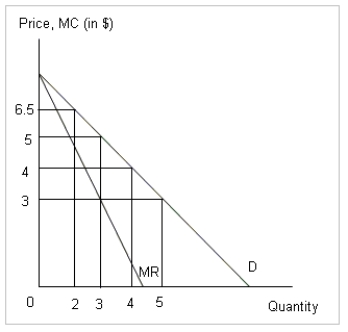 -Refer to Figure .How much profit will the monopolist earn if he practices price discrimination?
 (Multiple Choice)
4.9/5 (79)
(79) The following figure shows the demand, marginal revenue, and marginal cost curves for a profit maximizing monopolist.
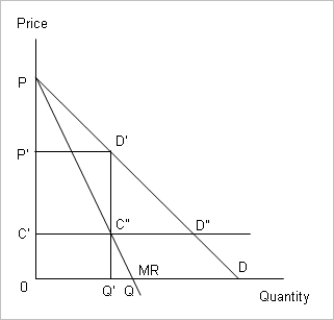 -Refer to Figure .Which of the following conclusions can be drawn from this figure?
 (Multiple Choice)
4.7/5 (83)
(83) A monopolist serves two markets with constant elasticity demand curves.However, the elasticities vary between the two markets.Graphically show how price discrimination benefits the monopolist in this case.
(Essay)
4.8/5 (78)
(78) What are the main differences between a monopolist and a perfectly competitive firm?
(Essay)
4.7/5 (64)
(64) A single-price monopolist produces closer to the competitive level than a discriminating monopolist.
(True/False)
4.8/5 (73)
(73) The peak of the total revenue curve is achieved at the point where:
(Multiple Choice)
4.7/5 (83)
(83) When a monopolist faces a fixed marginal cost of production, profit is maximized if:
(Multiple Choice)
5.0/5 (79)
(79) A monopolist always decides on how much to produce by equating marginal revenue to zero.
(True/False)
4.7/5 (73)
(73) The following table shows the price and revenue for a monopolist at different levels of production.The monopolist incurs no marginal cost of production.
Quantity Price Revenue 2 16 32 3 15 45 4 14.5 58 5 11.6 58 6 9.5 57 7 8 56
-Refer to Table .The profit maximizing output level in this case is determined by which of the following criteria?
(Multiple Choice)
4.8/5 (87)
(87)
A group of firms in competitive market produced 20 units of a good when the market price was $2.They incurred no marginal cost.Eventually they realized the benefits they could get by teaming up and acting as a monopolist.The following figure shows the demand curve and marginal revenue curve for this profit maximizing monopolist.
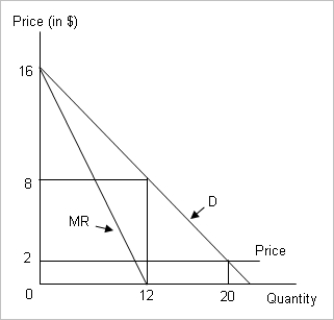 -Refer to Figure .Calculate the total revenue from production for the monopolist.
 (Multiple Choice)
4.9/5 (73)
(73) The following figure depicts the demand curves for vacation cruises of four individuals A, B, C, and D.
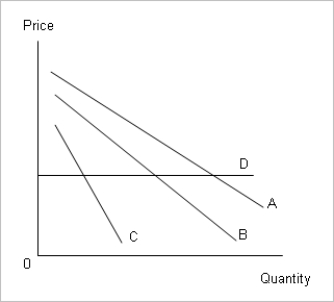 -Refer to Figure .A monopoly provider of cruise services recognizes the opportunity to price discriminate and will charge the highest price to individual _____.
 (Multiple Choice)
4.8/5 (63)
(63) The following figure shows the demand curve and marginal revenue curve for a monopolist who incurs a marginal cost of $2 per unit.
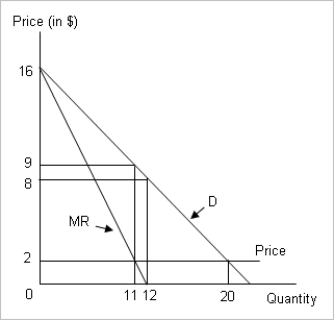 -Refer to Figure .What is the monopolist's revenue when he incurs a marginal cost of $2 per unit?
 (Multiple Choice)
4.9/5 (87)
(87) The Wells Fargo Bank Tower in downtown Los Angeles displays a sign at its parking entrance that clearly shows that the per-hour parking charges are higher for people who visit the building for a short while.How is this consistent with the general principle of price discrimination?
(Essay)
4.8/5 (82)
(82)
A group of firms in competitive market produced 20 units of a good when the market price was $2.They incurred no marginal cost.Eventually they realized the benefits they could get by teaming up and acting as a monopolist.The following figure shows the demand curve and marginal revenue curve for this profit maximizing monopolist.
-Refer to Figure .Calculate the deadweight loss in this market caused by monopoly.
-Refer to Figure .Calculate the deadweight loss in this market caused by monopoly. (Multiple Choice)
4.8/5 (88)
(88) Which of the following statements is NOT true regarding DeBeers' rise to monopoly power in the diamond market?
(Multiple Choice)
4.8/5 (77)
(77) 
Filters
- Essay(0)
- Multiple Choice(0)
- Short Answer(0)
- True False(0)
- Matching(0)