



 Chat with AI
Exam 16: The Evolution of Sex

Exam 1: An Overview of Evolutionary Biology40 Questions
Exam 2: Early Evolutionary Ideas and Darwins Insight43 Questions
Exam 3: Natural Selection45 Questions
Exam 4: Phylogeny and Evolutionary History43 Questions
Exam 5: Inferring Phylogeny47 Questions
Exam 6: Transmission Genetics and the Sources of Genetic Variation43 Questions
Exam 7: The Genetics of Populations42 Questions
Exam 8: Evolution in Finite Populations38 Questions
Exam 9: Evolution at Multiple Loci39 Questions
Exam 10: Genome Evolution38 Questions
Exam 11: The Origin and Evolution of Early Life42 Questions
Exam 12: Major Transitions42 Questions
Exam 13: Evolution and Development39 Questions
Exam 14: Species and Speciation37 Questions
Exam 15: Extinction and Evolutionary Trends25 Questions
Exam 16: The Evolution of Sex32 Questions
Exam 17: Sexual Selection23 Questions
Exam 18: The Evolution of Sociality31 Questions
Exam 19: Coevolution26 Questions
Exam 20: Evolution and Medicine27 Questions
Select questions type


Which of the following statements describes an element of the Fisher-Muller hypothesis for adaptive advantage of sexual reproduction?
(Multiple Choice)
4.8/5  (72)
(72) Which of the following systems lends itself best to the study of the environmental factors that lead to the maintenance of sexual reproduction?
(Multiple Choice)
4.8/5 (81)
(81) Are there any costs when asexual organisms reproduce automictically as opposed to apomictically?
(Multiple Choice)
4.8/5 (75)
(75) Water fleas,Daphnia magna,can switch between asexual and sexual reproduction cycles.Which of the following observations support the hypothesis that sex is favored in unpredictable environments?
(Multiple Choice)
5.0/5 (71)
(71) Why is sexual reproduction believed to be the ancestral state in eukaryotes?
(Multiple Choice)
4.7/5 (74)
(74) The Amazon molly,Poecillia formosa,is a freshwater fish that is gynogenetic.In order to reproduce,individuals of this all-female species must mate with a male from a closely related species to initiate the development of their offspring.The male's genetic material does not,however,enter the Amazon molly's egg.What costs of sexual reproduction does the Amazon molly potentially experience?
(Multiple Choice)
4.9/5 (98)
(98) Does Muller's ratchet apply to both apomictic and automictic asexual populations?
(Essay)
4.9/5 (89)
(89) Under what conditions are asexual and sexual reproduction favored by the three evolutionary models,involving environmental unpredictability,number of niches,and parasite load?
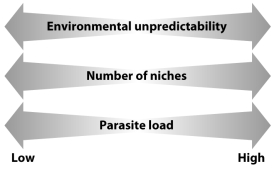 A)Low environmental unpredictability
B)High environmental unpredictability:
C)Low number of niches
D)High number of niches
E)Low parasite load
F)High parasite load
A)Low environmental unpredictability
B)High environmental unpredictability:
C)Low number of niches
D)High number of niches
E)Low parasite load
F)High parasite load (Essay)
4.8/5 (83)
(83) The two figures below represent an asexual and a sexual population,respectively.The letters indicate beneficial mutations.The shaded areas represent the frequency of particular combinations of mutations in the population over time.Why does it take longer for the beneficial allele combination of ABC to go to fixation in the asexual population than in the sexual population? 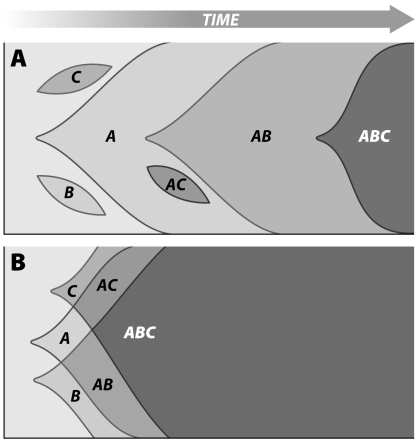
(Multiple Choice)
4.8/5 (69)
(69) In a population that is polymorphic for sexual/asexual reproduction,a sexually transmitted disease has just eliminated most of the sexually reproducing individuals.When you expose samples of asexuals and sexuals from this population to harsh environmental conditions in the lab,you discover that the sexual individuals are worse at adapting to the new environment than the asexual individuals.(Note that your lab population is free from the sexually transmitted disease.)Which of the following statements is a likely explanation for your results?
(Multiple Choice)
5.0/5 (79)
(79) In an experiment,Jokela and colleagues reared 14 replicate populations of a snail species that is polymorphic for sexual/asexual reproduction under controlled,identical conditions in the lab.Each population started with 35% asexual and 65% sexual individuals.The figure below shows the percent of asexual individuals after a year-long experimental run.Which of the following statements is a possible explanation for these results? 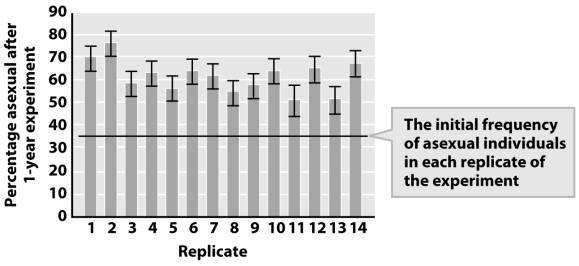
(Multiple Choice)
4.9/5 (80)
(80) 
Filters
- Essay(0)
- Multiple Choice(0)
- Short Answer(0)
- True False(0)
- Matching(0)