



 Chat with AI
Exam 10: Genome Evolution

Exam 1: An Overview of Evolutionary Biology40 Questions
Exam 2: Early Evolutionary Ideas and Darwins Insight43 Questions
Exam 3: Natural Selection45 Questions
Exam 4: Phylogeny and Evolutionary History43 Questions
Exam 5: Inferring Phylogeny47 Questions
Exam 6: Transmission Genetics and the Sources of Genetic Variation43 Questions
Exam 7: The Genetics of Populations42 Questions
Exam 8: Evolution in Finite Populations38 Questions
Exam 9: Evolution at Multiple Loci39 Questions
Exam 10: Genome Evolution38 Questions
Exam 11: The Origin and Evolution of Early Life42 Questions
Exam 12: Major Transitions42 Questions
Exam 13: Evolution and Development39 Questions
Exam 14: Species and Speciation37 Questions
Exam 15: Extinction and Evolutionary Trends25 Questions
Exam 16: The Evolution of Sex32 Questions
Exam 17: Sexual Selection23 Questions
Exam 18: The Evolution of Sociality31 Questions
Exam 19: Coevolution26 Questions
Exam 20: Evolution and Medicine27 Questions
Select questions type


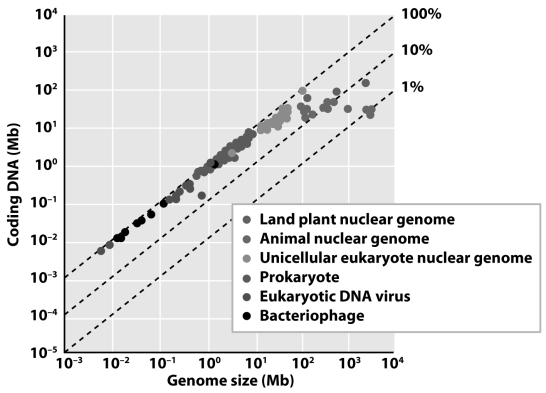 From the figure above,one can deduce that larger genomes

A researcher collects a soil sample and sequences the entire genomes of two prokaryotes found in the sample.In these genomes,he finds identical prophage DNA located in different areas of the two genomes.Based on the similarity of the sequences of the prophages and their placement in the prokaryotes' genomes,what could he conclude about the relatedness of the two prokaryotes?
(Essay)
4.8/5  (85)
(85) 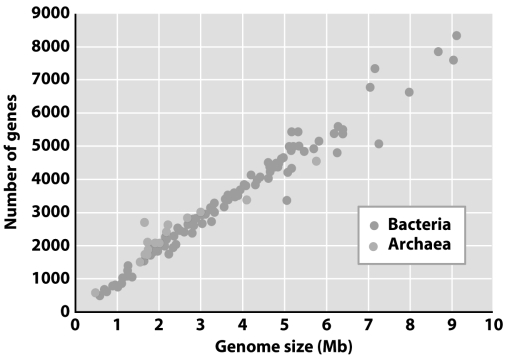 What does the figure above convey about the G-value paradox in prokaryotes?
 (Multiple Choice)
4.8/5 (76)
(76) What are transcription factors and how do they address the G-value paradox?
(Essay)
4.8/5 (87)
(87) Explain how horizontal gene transfer is different than sexual reproduction.
(Essay)
4.8/5 (87)
(87) The nematode,C.elegans,and humans have nearly identical numbers of protein coding genes,yet humans have much more complex organismal features.This is an example of
(Multiple Choice)
4.9/5 (84)
(84) 
Filters
- Essay(0)
- Multiple Choice(0)
- Short Answer(0)
- True False(0)
- Matching(0)