



 Chat with AI
Exam 3: Natural Selection

Exam 1: An Overview of Evolutionary Biology40 Questions
Exam 2: Early Evolutionary Ideas and Darwins Insight43 Questions
Exam 3: Natural Selection45 Questions
Exam 4: Phylogeny and Evolutionary History43 Questions
Exam 5: Inferring Phylogeny47 Questions
Exam 6: Transmission Genetics and the Sources of Genetic Variation43 Questions
Exam 7: The Genetics of Populations42 Questions
Exam 8: Evolution in Finite Populations38 Questions
Exam 9: Evolution at Multiple Loci39 Questions
Exam 10: Genome Evolution38 Questions
Exam 11: The Origin and Evolution of Early Life42 Questions
Exam 12: Major Transitions42 Questions
Exam 13: Evolution and Development39 Questions
Exam 14: Species and Speciation37 Questions
Exam 15: Extinction and Evolutionary Trends25 Questions
Exam 16: The Evolution of Sex32 Questions
Exam 17: Sexual Selection23 Questions
Exam 18: The Evolution of Sociality31 Questions
Exam 19: Coevolution26 Questions
Exam 20: Evolution and Medicine27 Questions
Select questions type


Explain how natural selection has played an essential role in driving the modifications that have lead to the incredible biodiversity of life on Earth.
(Essay)
4.8/5  (82)
(82) Why do exaptations provide challenges to evolutionary biologists' attempts to generate testable hypotheses about how natural selection produces adaptations?
(Essay)
4.8/5 (93)
(93) 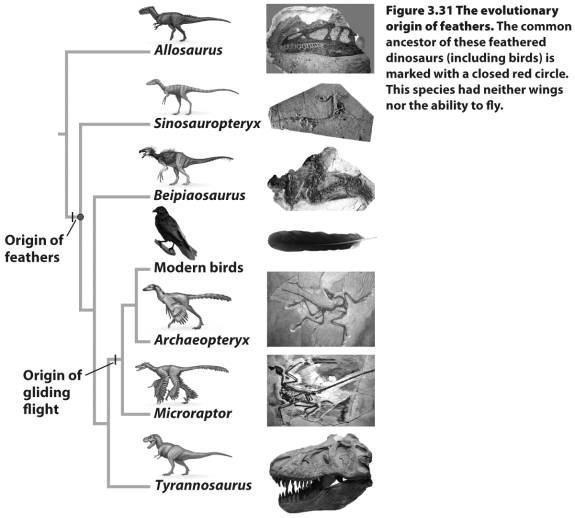 Based on the figure above,use phylogenetic reasoning to explain whether feathers evolved for flight,and why.What other possible advantages could feathers provide? Is there a way to determine which was the original selective function? Explain your answer.
 (Essay)
4.9/5 (80)
(80) 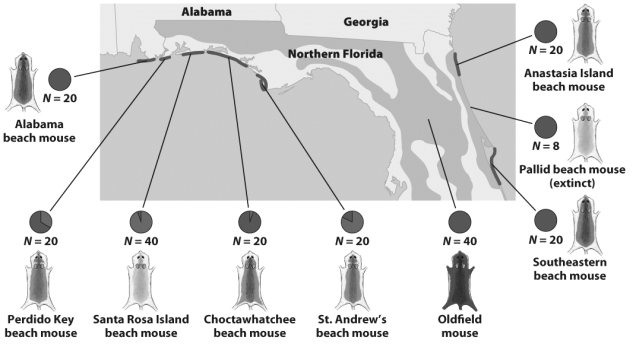 In principle,the variations in oldfield mouse coat color illustrated in the figure above could result from
 (Multiple Choice)
4.7/5 (80)
(80) 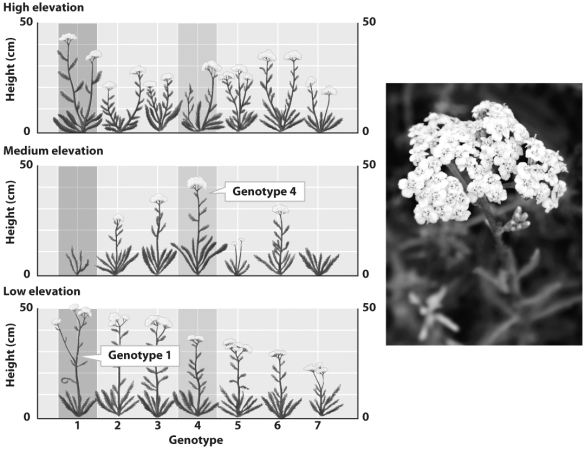 According to the figure above,plants with genotype 1
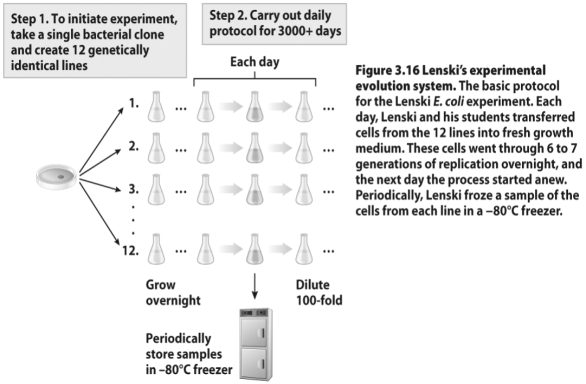 The text presents the experiments of Richard Lenski and his colleagues,who set up long-range experiments on E.coli.In the experiment illustrated in the figure above,12 parallel E.coli lineages were created and maintained,cells from each line were periodically frozen,and the team followed the lineages for more than 50,000 generations.Why were these experiments groundbreaking? How have these experiments revolutionized the sorts of questions evolutionary biologists can ask?
 (Not Answered)
This question doesn't have any answer yet
A trait that serves one purpose today but evolved under different selective conditions is
(Multiple Choice)
4.9/5 (69)
(69) 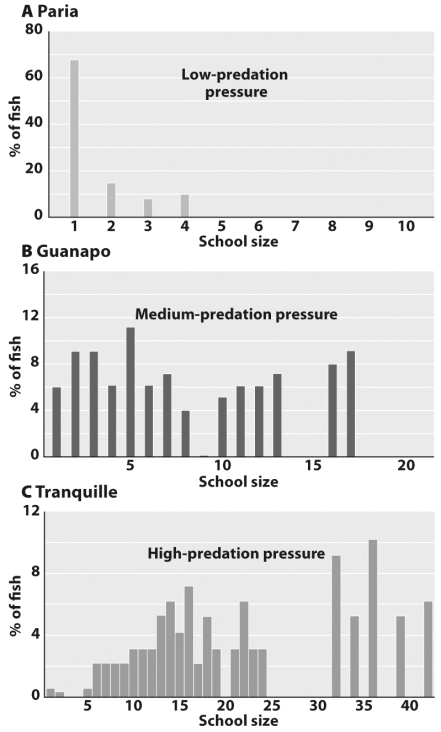 According to the figure above,which of the following statements is true?
 (Multiple Choice)
4.8/5 (97)
(97) The term for a simultaneous action of natural selection on each side of the host-pathogen interaction is known as a(n)
(Multiple Choice)
4.7/5 (78)
(78) 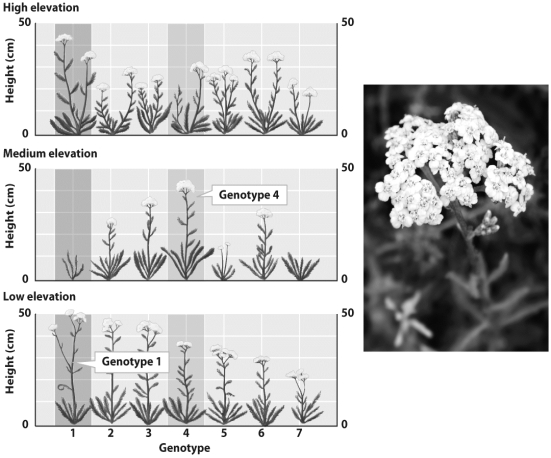 Explain the figure above,including how the study graphed here illustrates the concept of "norm of reaction."
 (Not Answered)
This question doesn't have any answer yet
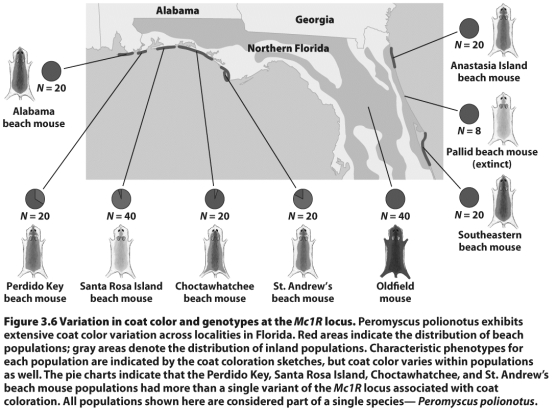 Geological evidence reveals that the barrier islands where the populations of oldfield mice shown in the figure above occur formed only 6000 years ago.Presumably,divergence in coat color occurred after the islands' formation (Hoekstra et al.2006).Explain how these dramatic variations in coat color between populations could have evolved over such a short period relative to the scale of evolutionary time.
 (Not Answered)
This question doesn't have any answer yet
Evolutionary change in one species that affects the selective conditions for a second species is known as
(Multiple Choice)
4.8/5 (67)
(67) Considering the phylogenetic evidence that feathers evolved prior to flight,what might have been the original function of feathers?
(Multiple Choice)
4.8/5 (69)
(69) 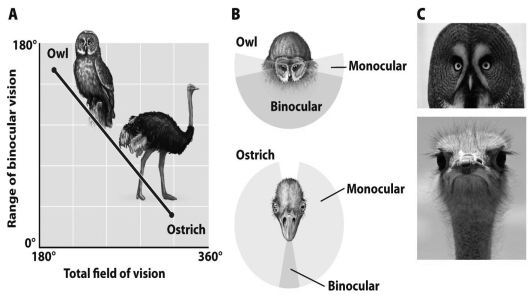 Compare the placement of eyes in an ostrich to that in an owl.What are the trade-offs in physical constraint that each faces?
 (Not Answered)
This question doesn't have any answer yet
Imagine you are an evolutionary biologist studying reproductive trade-offs in populations of guppies that have been separated by the formation of barrier waterfalls.The upstream population faces lower predation than the downstream population,and the predators on the downstream side are larger and can eat any guppy offspring,no matter the size.Make a prediction about the reproductive strategies you might find and explain the trade-offs faced by the reproducing female guppies on each side of the barrier.
(Essay)
4.8/5 (82)
(82) Describe some ways in which,at the molecular level,the process of evolution tinkers with existing structures to produce novel functions.
(Essay)
4.8/5 (75)
(75) 
Filters
- Essay(0)
- Multiple Choice(0)
- Short Answer(0)
- True False(0)
- Matching(0)