



 Chat with AI
Exam 6: Vision

Exam 1: What Is Behavioral Neuroscience?146 Questions
Exam 2: Functional Neuroanatomy and the Evolution of the Nervous System202 Questions
Exam 3: Neurophysiology: The Structure and Functions of the Cells of the Nervous System163 Questions
Exam 4: Psychopharmacology180 Questions
Exam 5: Genetics and the Development of the Human Brain147 Questions
Exam 6: Vision171 Questions
Exam 7: Nonvisual Sensation and Perception165 Questions
Exam 8: Movement164 Questions
Exam 9: Homeostasis, Motivation, and Reward163 Questions
Exam 10: Sexual Behavior159 Questions
Exam 11: Sleep and Waking169 Questions
Exam 12: Learning and Memory168 Questions
Exam 13: Cognition168 Questions
Exam 14: Emotion, Aggression, and Stress160 Questions
Exam 15: Neuropsychology151 Questions
Exam 16: Psychopathology166 Questions
Select questions type


Retinal disparity decreases with the distance of the object from the viewer.
(True/False)
4.8/5  (84)
(84) Nyla is shedding tears because she is sad. Willow is shedding tears because she is cutting an onion. Nyla's tears contain ______ than Willow's tears.
(Multiple Choice)
4.8/5 (69)
(69) Horizontal cells receive input from _________ and provide output to _________.
(Multiple Choice)
4.9/5 (93)
(93) Courtney suffered a corneal abrasion on one eye after she fell asleep with her hard contact lenses in place. When she asked her physician what to expect from her injury, the physician told her that
(Multiple Choice)
4.8/5 (75)
(75) Red, or long-wavelength, cones contain which of the following photopigments?
(Multiple Choice)
4.8/5 (91)
(91) Sarah is in charge of lighting for a school play, and she must find the right "gel," or color filter, to produce a light with a wavelength of about 680 nm. When used on stage, the light will look
(Multiple Choice)
4.9/5 (77)
(77) Rods are unable to distinguish color, yet show a peak sensitivity to light in the blue-green range of the visible spectrum.
(True/False)
4.7/5 (83)
(83) The process of adjusting focus when looking at objects close up or at a distance is known as
(Multiple Choice)
5.0/5 (85)
(85) Carmella is an artist and calls her most recent work "short wavelength" because she used mostly red colors.
(True/False)
4.8/5 (62)
(62) Professor Crass tells her students that each human eye contains around _____ million rods.
(Multiple Choice)
4.8/5 (75)
(75) Professor Gasaway tells her class that humans have a blind spot in each eye because of the
(Multiple Choice)
4.8/5 (84)
(84) Jessica's vision is 20/20, but her friend Joshua needs to wear glasses to correct for his 20/200 vision. Without his glasses, Joshua sees as much detail in objects that are 20 feet away from him as Jessica sees in objects that are _________ feet away from her.
(Multiple Choice)
4.9/5 (91)
(91) (see Figure 6.10)
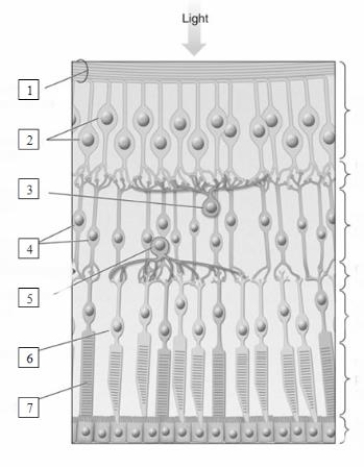 - In this image, #6 and #7 together are known as _____. They send information to _________ (#4), which, in turn, sends information to ___________ (#2).
(Short Answer)
4.9/5 (73)
(73) The amplitude of a light wave is encoded as _____________, while the wavelength of a light wave is encoded as ___________________.
(Multiple Choice)
4.8/5 (81)
(81) The color of an object that a human sees is a function of the wavelengths that are _________ the object.
(Multiple Choice)
4.7/5 (86)
(86) Elanor is unable to recognize faces, even if they should be familiar to her (e.g., her daughter). She is likely to be diagnosed with
(Multiple Choice)
4.9/5 (98)
(98) How many major layers are found in the lateral geniculate nucleus (LGN)?
(Multiple Choice)
4.9/5 (87)
(87) Heidy is studying for a quiz and writes in her notes that amacrine cells help process
(Multiple Choice)
4.8/5 (81)
(81) Which of the following sets of cells forms a direct pathway for visual information and lies perpendicular to the back of the eye?
(Multiple Choice)
4.8/5 (89)
(89) 
Filters
- Essay(0)
- Multiple Choice(0)
- Short Answer(0)
- True False(0)
- Matching(0)