



 Chat with AI
Exam 10: Quasi-Experimental Design

Exam 1: Introduction70 Questions
Exam 2: Ethics Foundations of Ethics in Research70 Questions
Exam 3: Qualitative Approaches to Research70 Questions
Exam 4: Sampling Foundations of Sampling70 Questions
Exam 5: Introduction to Measurement70 Questions
Exam 6: Scales, Tests, and Indexes70 Questions
Exam 7: Survey Research70 Questions
Exam 8: Introduction to Design70 Questions
Exam 9: Experimental Design70 Questions
Exam 10: Quasi-Experimental Design70 Questions
Exam 11: Introduction to Data Analysis70 Questions
Exam 12: Inferential Analysis57 Questions
Exam 13: Communicating Research70 Questions
Select questions type


From a methodological point of view,inferences drawn from a well-implemented regression-discontinuity design are ____ conclusions from randomized experiments.
(Multiple Choice)
4.7/5  (81)
(81) Research designs that have several of the key features of randomized experimental designs,such as pre-post measurement and treatment-control group comparisons,but lack random assignment to a treatment group are called _______________ designs.
(Short Answer)
4.9/5 (69)
(69) Any factor other than the program that leads to posttest differences between groups is termed a(n) _______________.
(Short Answer)
5.0/5 (76)
(76) Narrative 10-2 -Daycare Center - Part II
Ken studies literacy and is particularly concerned about children who lag in reading readiness.He has developed a reading readiness program that can easily be implemented by day care providers in group settings,and has selected two day cares in demographically similar neighborhoods.Ken begins by giving a reading readiness to all of the three- and four-year-olds in both of the day cares.He then implements his intervention at one daycare but not the other,and after the intervention is complete,he administers the reading readiness test again to both groups of children.
Figure TB 10-12
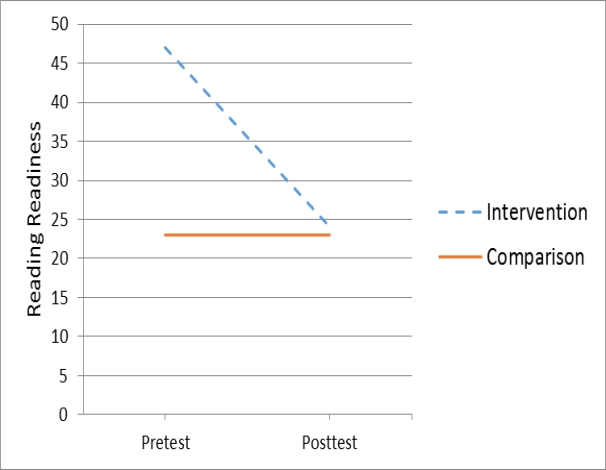 -Ken's results are shown in the accompanying figure.What conclusion is most strongly supported by these results?
 (Multiple Choice)
4.8/5 (81)
(81) Figure TB 10-10
N 0 0 X 0 N 0 0 0
-What design is shown in the accompanying figure?
(Multiple Choice)
4.9/5 (72)
(72) Figure TB 10-7
0 X 0 0 0
-What type of design is shown in the accompanying figure?
(Multiple Choice)
4.9/5 (68)
(68) The fundamental threat to internal validity in the nonequivalent groups design is selection.
(True/False)
4.8/5 (67)
(67) Narrative 10-1 -Daycare Center - Part I
Ken studies literacy and is particularly concerned about children who lag in reading readiness.He has developed a reading readiness program that can easily be implemented by day care providers in group settings,and has selected two day cares in demographically similar neighborhoods.He starts by giving a reading readiness to all of the three- and four-year-olds in both day care centers.
Figure TB 10-11
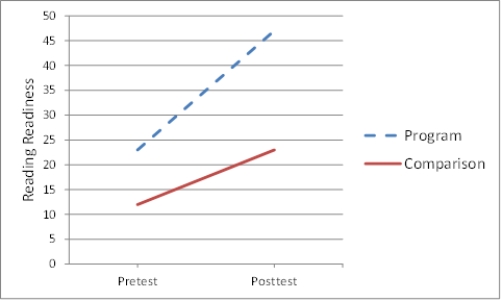 -Ken decides to implement his intervention at one daycare but not the other,and after the intervention is complete,he administers the reading readiness test again to both groups of children.His results are shown in the accompanying figure.The performance of both of the groups improves over time,suggesting the operation of ____.
 (Multiple Choice)
4.9/5 (94)
(94) The branch of mathematics dealing with the collection,analysis,interpretation,and presentation of quantitative data is _______________.
(Short Answer)
4.7/5 (80)
(80) The regression-discontinuity design is very susceptible to selection bias.
(True/False)
4.8/5 (71)
(71) Figure TB 10-4
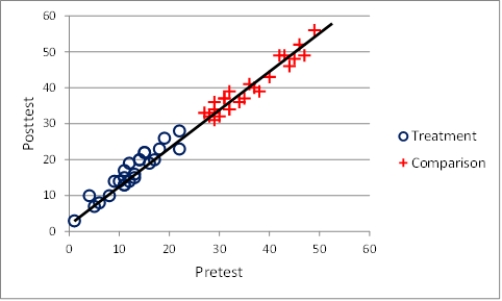 -The graph in the accompanying figure was most likely generated by a study using the ____ design.
 (Multiple Choice)
4.7/5 (76)
(76) Figure TB 10-1
N 0 X 0 N 0 0
-What type of design is a pre-post two-group quasi-experimental design structured like a pretest-posttest randomized experiment,but lacks random assignment to groups?
(Multiple Choice)
4.8/5 (88)
(88) The _______________ design allows the researcher to give the intervention to those who need it the most,based on the use of cut-off scores.
(Short Answer)
4.9/5 (81)
(81) Figure TB 10-14
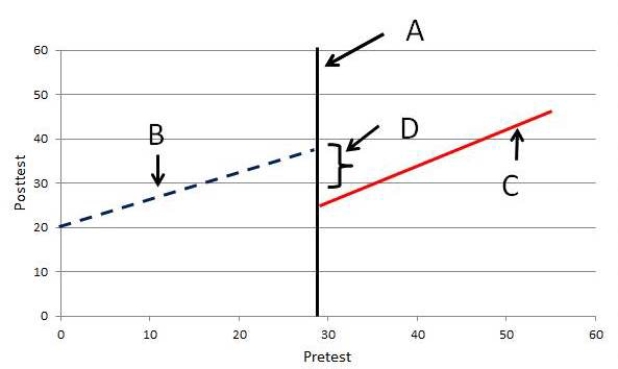 -Consider the figure above,illustrating the regression discontinuity design.What can you conclude?
 (Multiple Choice)
4.8/5 (78)
(78) Narrative 10-1 -Daycare Center - Part I
Ken studies literacy and is particularly concerned about children who lag in reading readiness.He has developed a reading readiness program that can easily be implemented by day care providers in group settings,and has selected two day cares in demographically similar neighborhoods.He starts by giving a reading readiness to all of the three- and four-year-olds in both day care centers.
-Ken decides to implement his intervention at one daycare but not the other,and after the intervention is complete,he will administer the reading readiness test again to both groups of children.This design is a(n)____ design.
(Multiple Choice)
4.8/5 (72)
(72) What type of design is a post-only design in which,after the fact,a pretest measure is constructed from preexisting data?
(Multiple Choice)
4.9/5 (86)
(86) Why is the regression point displacement design so useful in assessing the impact of community interventions?
(Essay)
4.9/5 (76)
(76) In the _______________ design,the people used for the pretest are not the same as the people used for the posttest.
(Short Answer)
4.8/5 (69)
(69) Figure TB 10-4
-The graph in the accompanying figure indicates _____.
-The graph in the accompanying figure indicates _____. (Multiple Choice)
4.7/5 (87)
(87) 
Filters
- Essay(0)
- Multiple Choice(0)
- Short Answer(0)
- True False(0)
- Matching(0)