



 Chat with AI
Exam 5: Biodiversity, Species Interactions, and Population Control

Exam 1: Environmental Problems, Their Causes, and Sustainability92 Questions
Exam 2: Science, Matter, and Energy113 Questions
Exam 3: Ecosystems: What Are They and How Do They Work172 Questions
Exam 4: Biodiversity and Evolution93 Questions
Exam 5: Biodiversity, Species Interactions, and Population Control92 Questions
Exam 6: The Human Population and Urbanization112 Questions
Exam 7: Climate and Biodiversity145 Questions
Exam 8: Sustaining Biodiversity: the Species Approach104 Questions
Exam 9: Sustaining Biodiversity: the Ecosystem Approach85 Questions
Exam 10: Food, Soil, and Pest Management121 Questions
Exam 11: Water Resources and Water Pollution128 Questions
Exam 12: Geology and Nonrenewable Minerals96 Questions
Exam 13: Energy117 Questions
Exam 14: Environmental Hazards and Human Health97 Questions
Exam 15: Air Pollution, Climate Change, and Ozone Depletion137 Questions
Exam 16: Solid and Hazardous Waste100 Questions
Exam 17: Environmental Economics, Politics, and Worldviews87 Questions
Select questions type


Which of the following is NOT one of the chapter's three big ideas?
(Multiple Choice)
4.9/5  (68)
(68) A relationship in which a member of one species obtains its nourishment by living on, in, or near a member of another species over an extended time is best labeled
(Multiple Choice)
4.8/5 (79)
(79) A relationship in which one species benefits while the other is neither helped nor harmed to any significant degree is best labeled
(Multiple Choice)
4.9/5 (72)
(72) Limiting factors are physical or chemical factors that can determine the numbers of organisms in a population.
(True/False)
4.8/5 (74)
(74) The process of secondary succession would typically follow a forest fire.
(True/False)
4.7/5 (81)
(81) Hawks typically forage for their rodent prey species during the daytime. While owls may eat similar prey species, and live in the same area, they forage during the night. This is best described as an example of
(Multiple Choice)
4.9/5 (74)
(74) The interaction of two species with each can actually affect the evolution of those species.
(True/False)
4.8/5 (97)
(97) Which of the following is accurate with regards to the balance of nature hypothesis?
(Multiple Choice)
4.7/5 (77)
(77) A relationship in which both species benefit is best labeled
(Multiple Choice)
4.8/5 (66)
(66) 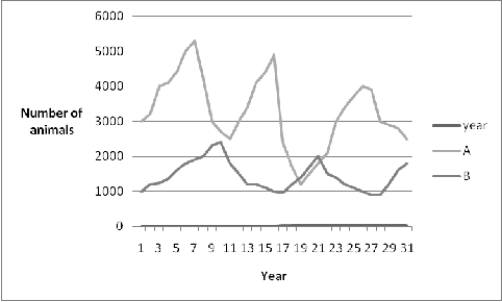 The graph above shows the census count for two animal species, A and B, over a 31 year period. Animal A and animal B have a predator-prey relationship.
-What description would apply to the predator species in the graph above if the prey species were its only source of food? What assumptions could we make about that predator species if this were the case?
The graph above shows the census count for two animal species, A and B, over a 31 year period. Animal A and animal B have a predator-prey relationship.
-What description would apply to the predator species in the graph above if the prey species were its only source of food? What assumptions could we make about that predator species if this were the case? (Short Answer)
4.9/5 (80)
(80) Which of the following best categorizes the most common form of interspecific species interactions?
(Multiple Choice)
4.8/5 (88)
(88) In a certain population of rabbits one year, 25 new rabbits are born and 5 move into the population from surrounding areas. However, 10 rabbits die, and 5 leave the population. What is the population change?
(Multiple Choice)
4.8/5 (85)
(85) ____________________ starts slowly but then accelerates as the population increases.
(Short Answer)
4.7/5 (83)
(83) The key reason we should care about recovery of the southern sea otter population is
(Multiple Choice)
4.7/5 (86)
(86) The terms inertia and stability, with respect to ecosystems, are mutually exclusive.
(True/False)
4.9/5 (70)
(70) 
Filters
- Essay(0)
- Multiple Choice(0)
- Short Answer(0)
- True False(0)
- Matching(0)