



 Chat with AI
Exam 1: Environmental Problems, Their Causes, and Sustainability

Exam 1: Environmental Problems, Their Causes, and Sustainability92 Questions
Exam 2: Science, Matter, and Energy113 Questions
Exam 3: Ecosystems: What Are They and How Do They Work172 Questions
Exam 4: Biodiversity and Evolution93 Questions
Exam 5: Biodiversity, Species Interactions, and Population Control92 Questions
Exam 6: The Human Population and Urbanization112 Questions
Exam 7: Climate and Biodiversity145 Questions
Exam 8: Sustaining Biodiversity: the Species Approach104 Questions
Exam 9: Sustaining Biodiversity: the Ecosystem Approach85 Questions
Exam 10: Food, Soil, and Pest Management121 Questions
Exam 11: Water Resources and Water Pollution128 Questions
Exam 12: Geology and Nonrenewable Minerals96 Questions
Exam 13: Energy117 Questions
Exam 14: Environmental Hazards and Human Health97 Questions
Exam 15: Air Pollution, Climate Change, and Ozone Depletion137 Questions
Exam 16: Solid and Hazardous Waste100 Questions
Exam 17: Environmental Economics, Politics, and Worldviews87 Questions
Select questions type


Which of the following is a form of natural capital gained directly or indirectly as a result of solar energy?
(Multiple Choice)
4.8/5  (86)
(86) Perpetual resources exist in a fixed quantity or stock in the Earth's crust.
(True/False)
4.8/5 (75)
(75) Recycling nonrenewable metallic resources takes much less energy, water, and other resources and produces less pollution and environmental degradation than exploiting virgin metallic resources.
(True/False)
4.9/5 (70)
(70) A worldview that holds that we can and should manage the Earth for our own benefit but that we also have an ethical responsibility to be caring stewards is called the
(Multiple Choice)
4.8/5 (87)
(87) The three principles of sustainability are chemical cycling, reliance on solar energy, and ____________________.
(Short Answer)
4.8/5 (86)
(86) 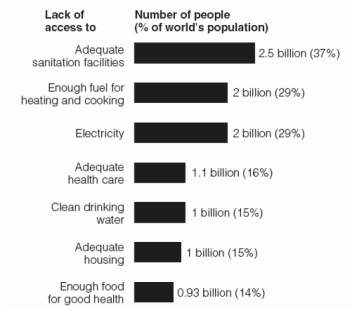 -If poverty stricken people in developing countries engage in activities that degrade valuable natural resources, which two statistics do you think are driving those actions?
 (Short Answer)
4.9/5 (64)
(64) The resource consumption of the average person in the United States is about _____ times that of the average citizen of India, and about _____ times that of the average person in the world's poorest countries.
(Multiple Choice)
4.8/5 (74)
(74) Which of the following terms encompasses all of the others?
(Multiple Choice)
4.9/5 (76)
(76) Which of the following best describes the concept of environmental degradation?
(Multiple Choice)
4.7/5 (85)
(85) Pollution cleanup is considered a short-term solution if population and consumption levels grow without corresponding improvement in pollution control technology.
(True/False)
4.7/5 (79)
(79) Which of the following is an environmental benefit of affluence and wealth?
(Multiple Choice)
4.9/5 (79)
(79) A fictional vision of a more environmentally healthy planet in the future uses which of the following fuels and renewable energy resources?
(Multiple Choice)
4.7/5 (85)
(85) Evidence that we are living unsustainably includes which of the following?
(Multiple Choice)
4.8/5 (73)
(73) It has been estimated that humanity's global ecological footprint exceeds the Earth's biological capacity by about ____________________.
(Short Answer)
4.9/5 (88)
(88) 
Filters
- Essay(0)
- Multiple Choice(0)
- Short Answer(0)
- True False(0)
- Matching(0)