



 Chat with AI
Exam 12: Air Pollution, Climate Change, and Ozone Depletion

Exam 1: Environmental Problems, Their Causes, and Sustainability101 Questions
Exam 2: Science, Matter, Energy, and Systems162 Questions
Exam 3: Biodiversity and Evolution104 Questions
Exam 4: Community Ecology, Population Ecology, and the Human Population117 Questions
Exam 5: Sustaining Biodiversity: The Species Approach114 Questions
Exam 6: Sustaining Biodiversity: The Ecosystem Approach142 Questions
Exam 7: Food,Soil,and Pest Management151 Questions
Exam 8: Water Resources and Water Pollution147 Questions
Exam 9: Nonrenewable Energy Resources100 Questions
Exam 10: Energy Efficiency and Renewable Energy114 Questions
Exam 11: Environmental Hazards and Human Health116 Questions
Exam 12: Air Pollution, Climate Change, and Ozone Depletion148 Questions
Exam 13: Urbanization and Solid and Hazardous Waste189 Questions
Exam 14: Economics, Politics, Worldviews, and Sustainability141 Questions
Select questions type


Which of the following factors would not increase air pollution?
(Multiple Choice)
4.8/5  (81)
(81) Which of the following is not a major indoor air pollutant?
(Multiple Choice)
4.8/5 (82)
(82) Respiratory illnesses in developing countries are most likely to be caused by
(Multiple Choice)
4.8/5 (75)
(75) Which of the following is not a preventative approach to lead poisoning?
(Multiple Choice)
5.0/5 (66)
(66) The frequency and severity of smog in an area depends least upon the
(Multiple Choice)
4.7/5 (66)
(66) The world's oceans absorb carbon dioxide as part of the ____________________ cycle.
(Short Answer)
4.8/5 (74)
(74) In a warmer world,which is not an incidence caused by droughts?
(Multiple Choice)
4.7/5 (83)
(83) According to a 2005 EPA report,the six regulated air pollutants in the U.S.decreased between 1970 and 2004 due to the Clean Air Act.
(True/False)
4.8/5 (79)
(79) 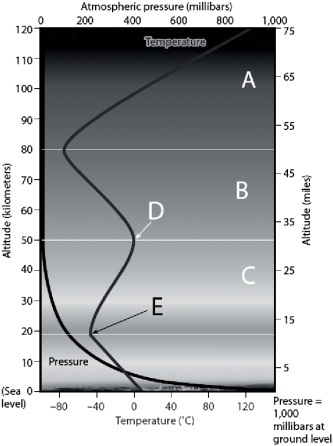 -On the atmospheric layers figure,choose the letter that represents the boundary in the atmosphere between the troposphere and the stratosphere.
 (Short Answer)
4.8/5 (76)
(76) Coal burning,diesel engines,and open fires produce ____________________,which may be the second largest contributor to global warming.
(Short Answer)
4.7/5 (74)
(74) Global warming threats to human health include increased disease,death from heat waves,environmental refugees,and displacement.
(True/False)
4.9/5 (79)
(79) The health risks of indoor air pollution is exacerbated in developed urban areas because these people spend the majority of their time indoors or inside vehicles.
(True/False)
4.9/5 (78)
(78) List five (5)major classes of air pollutants and three sources of these pollutants for each class.
(Essay)
4.9/5 (81)
(81) All of the following are ecological tipping points identified by scientists except
(Multiple Choice)
4.9/5 (83)
(83) Prevention approaches to global warming that revolve around energy policy include all of the following except
(Multiple Choice)
4.9/5 (82)
(82) The part of the world that has been warming fastest in the last 50 years is ____.
(Multiple Choice)
4.9/5 (81)
(81) Air pollutants in small quantities can be removed from the atmosphere by chemical cycles,precipitation and gravity.
(True/False)
4.8/5 (86)
(86) Prevention approaches to global warming include all of the following except
(Multiple Choice)
4.8/5 (74)
(74) Mountaintop forests are especially vulnerable to acid deposition.
(True/False)
4.9/5 (81)
(81) 
Filters
- Essay(0)
- Multiple Choice(0)
- Short Answer(0)
- True False(0)
- Matching(0)