



 Chat with AI
Exam 11: Environmental Hazards and Human Health

Exam 1: Environmental Problems, Their Causes, and Sustainability101 Questions
Exam 2: Science, Matter, Energy, and Systems162 Questions
Exam 3: Biodiversity and Evolution104 Questions
Exam 4: Community Ecology, Population Ecology, and the Human Population117 Questions
Exam 5: Sustaining Biodiversity: The Species Approach114 Questions
Exam 6: Sustaining Biodiversity: The Ecosystem Approach142 Questions
Exam 7: Food,Soil,and Pest Management151 Questions
Exam 8: Water Resources and Water Pollution147 Questions
Exam 9: Nonrenewable Energy Resources100 Questions
Exam 10: Energy Efficiency and Renewable Energy114 Questions
Exam 11: Environmental Hazards and Human Health116 Questions
Exam 12: Air Pollution, Climate Change, and Ozone Depletion148 Questions
Exam 13: Urbanization and Solid and Hazardous Waste189 Questions
Exam 14: Economics, Politics, Worldviews, and Sustainability141 Questions
Select questions type


The most dangerous activity ( in terms of number of deaths per participants)that most people in the U.S.do is
(Multiple Choice)
4.8/5  (76)
(76) The incidence of tuberculosis is increasing because of all but which one?
(Multiple Choice)
4.9/5 (82)
(82) Types of hazards discussed in this chapter include all of the following except
(Multiple Choice)
4.8/5 (88)
(88) All of the following are considered to be biological hazards except
(Multiple Choice)
4.8/5 (74)
(74) The widespread use of vaccines could improve human health and decrease death rates more than any other effort.
(True/False)
4.9/5 (70)
(70) Why is it difficult to estimate chemical toxicity in real life using laboratory experiments?
(Essay)
4.8/5 (72)
(72) Name three human systems vulnerable to chemical effects.Then,for each of the three systems,provide two examples of human ailments and the causative chemicals.
(Essay)
4.9/5 (77)
(77) After poverty and gender,the greatest risks people face are mainly from lifestyle choices.
(True/False)
4.8/5 (86)
(86) A large-scale outbreak of a disease is called a(n)____________________ and a global-scale outbreak is called a(n)____________________.
(Short Answer)
4.8/5 (80)
(80) 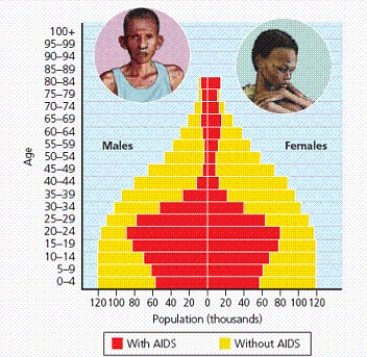 -According to the diagram,how does the life expectancy for males with AIDS change? How does the life expectancy with AIDS compare between males and females?
 (Essay)
4.8/5 (84)
(84) The leading cause of preventable death each year in the U.S.is
(Multiple Choice)
4.9/5 (82)
(82) Six infectious diseases are influenza,hepatitis B,SARS,HIV,malaria and West Nile.
(True/False)
4.8/5 (74)
(74) Infectious disease can be transmitted by all but which one?
(Multiple Choice)
4.8/5 (76)
(76) Explain the precautionary principle.Give one advantage and one disadvantage to using the precautionary principle to evaluate toxins.
(Essay)
4.8/5 (93)
(93) A person experiencing dizziness after using a strong household cleaner is showing
(Multiple Choice)
4.9/5 (83)
(83) 
Filters
- Essay(0)
- Multiple Choice(0)
- Short Answer(0)
- True False(0)
- Matching(0)